
全麻与椎管内麻醉对男性腰椎手术患者术后转归的影响:一项比较丙泊酚-瑞芬太尼全凭静脉麻醉与七氟醚麻醉的随机试验。
Type of anesthesia and quality of recovery in male patients undergoing lumbar surgery: a randomized trial comparing propofol-remifentanil total i.v. anesthesia with sevoflurane anesthesia.
机构信息
Department of Anesthesiology, The First Affiliated Hospital of USTC, Division of Life Sciences and Medicine, University of Science and Technology of China, Hefei, 230036, China.
出版信息
BMC Anesthesiol. 2021 Dec 1;21(1):300. doi: 10.1186/s12871-021-01519-y.
BACKGROUND
Previous studies have shown that women achieve a better quality of postoperative recovery from total intravenous anesthesia (TIVA) than from inhalation anesthesia, but the effect of anesthesia type on recovery in male patients is unclear. This study therefore compared patient recovery between males undergoing lumbar surgery who received TIVA and those who received sevoflurane anesthesia.
METHODS
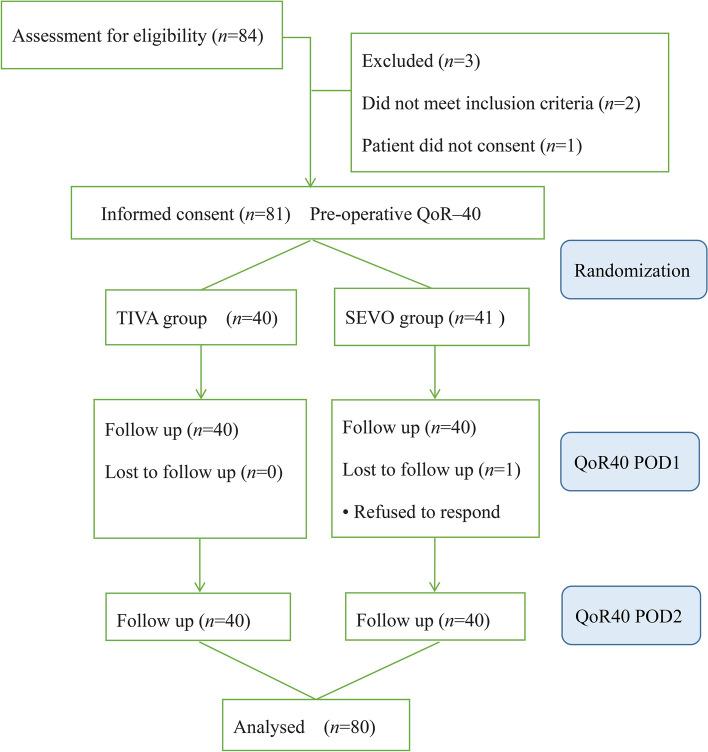
Eighty male patients undergoing elective one- or two-level primary transforaminal lumbar interbody fusion (TLIF) were randomly divided into two groups: the TIVA group (maintenance was achieved with propofol and remifentanil) or sevoflurane group (SEVO group: maintenance was achieved with sevoflurane and remifentanil). The quality of recovery-40 questionnaire (QoR-40) was administered before surgery and on postoperative days 1 and 2 (POD1 and POD2). Pain scores, postoperative nausea and vomiting, postoperative hospital stay, anesthesia consumption, and adverse effects were recorded.
RESULTS
The QoR-40 scores were similar on the three points (Preoperative, POD1 and POD2). Pain scores were significantly lower in the SEVO group than in the TIVA group on POD1 (30.6 vs 31.4; P = 0.01) and POD2 (32 vs 33; P = 0.002). There was no significant difference in the postoperative hospital stay or complications in the postanesthesia care unit between the TIVA group and the SEVO group.
CONCLUSIONS
This study demonstrates that the quality of recovery is not significantly different between male TLIF surgery patients who receive TIVA and those who receive sevoflurane anesthesia. Patients in the TIVA group had better postoperative analgesic effect on POD2.
TRIAL REGISTRATION
This was registered at http://www.chictr.org.cn (registration number ChiCTR-IOR-16007987, registration date: 24/02/2016).
背景
先前的研究表明,与吸入麻醉相比,女性在全凭静脉麻醉(TIVA)后的术后恢复质量更好,但麻醉类型对男性患者的恢复影响尚不清楚。因此,本研究比较了接受 TIVA 与七氟醚麻醉的男性腰椎手术患者的恢复情况。
方法
80 例择期行单侧或双侧经椎间孔腰椎体间融合术(TLIF)的男性患者被随机分为两组:TIVA 组(以丙泊酚和瑞芬太尼维持麻醉)和七氟醚组(SEVO 组:以七氟醚和瑞芬太尼维持麻醉)。分别于术前及术后第 1 天(POD1)和第 2 天(POD2)采用恢复质量 40 项问卷(QoR-40)进行评估。记录疼痛评分、术后恶心呕吐、术后住院时间、麻醉药物用量及不良反应。
结果
三组患者的 QoR-40 评分在术前、POD1 和 POD2 三个时间点均无明显差异。与 TIVA 组相比,SEVO 组患者在 POD1(30.6 比 31.4;P = 0.01)和 POD2(32 比 33;P = 0.002)时疼痛评分更低。两组患者术后在麻醉后恢复室的住院时间及并发症无显著差异。
结论
本研究表明,接受 TIVA 或七氟醚麻醉的男性 TLIF 手术患者的恢复质量无显著差异。TIVA 组患者在术后第 2 天的镇痛效果更好。
试验注册
本研究于 2016 年 2 月 24 日在 ChiCTR-IOR-16007987 注册。

 Zotero 插件