
人类季节性冠状病毒抗体的相对比例可预测 SARS-CoV-2 刺突与 ACE2 结合的交叉中和效率。
Relative Ratios of Human Seasonal Coronavirus Antibodies Predict the Efficiency of Cross-Neutralization of SARS-CoV-2 Spike Binding to ACE2.
机构信息
Department of Biochemistry, Microbiology & Immunology, Faculty of Medicine, University of Ottawa, Canada.
The Ottawa Hospital Research Institute.
出版信息
EBioMedicine. 2021 Dec;74:103700. doi: 10.1016/j.ebiom.2021.103700. Epub 2021 Nov 30.
BACKGROUND
Antibodies raised against human seasonal coronaviruses (sCoVs), which are responsible for the common cold, are known to cross-react with SARS-CoV-2 antigens. This prompts questions about their protective role against SARS-CoV-2 infections and COVID-19 severity. However, the relationship between sCoVs exposure and SARS-CoV-2 correlates of protection are not clearly identified.
METHODS
We performed a cross-sectional analysis of cross-reactivity and cross-neutralization to SARS-CoV-2 antigens (S-RBD, S-trimer, N) using pre-pandemic sera from four different groups: pediatrics and adolescents, individuals 21 to 70 years of age, older than 70 years of age, and individuals living with HCV or HIV. Data was then further analysed using machine learning to identify predictive patterns of neutralization based on sCoVs serology.
FINDINGS
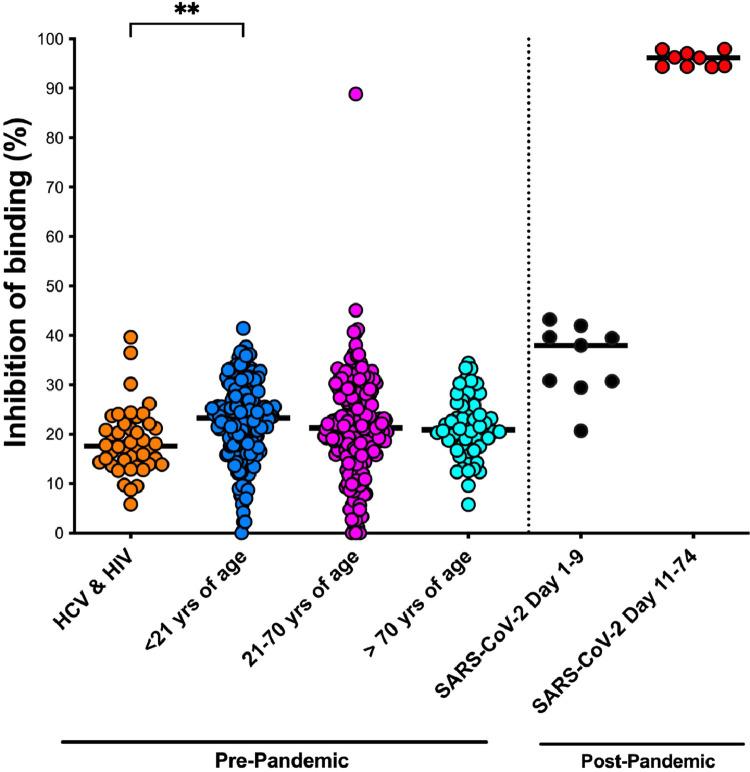
Antibody cross-reactivity to SARS-CoV-2 antigens varied between 1.6% and 15.3% depending on the cohort and the isotype-antigen pair analyzed. We also show a range of neutralizing activity (0-45%) with median inhibition ranging from 17.6 % to 23.3 % in serum that interferes with SARS-CoV-2 spike attachment to ACE2 independently of age group. While the abundance of sCoV antibodies did not directly correlate with neutralization, we show that neutralizing activity is rather dependent on relative ratios of IgGs in sera directed to all four sCoV spike proteins. More specifically, we identified antibodies to NL63 and OC43 as being the most important predictors of neutralization.
INTERPRETATION
Our data support the concept that exposure to sCoVs triggers antibody responses that influence the efficiency of SARS-CoV-2 spike binding to ACE2, which may potentially impact COVID-19 disease severity through other latent variables.
FUNDING
This study was supported by a grant by the CIHR (VR2 -172722) and by a grant supplement by the CITF, and by a NRC Collaborative R&D Initiative Grant (PR031-1).
背景
针对引起普通感冒的人类季节性冠状病毒(sCoV)产生的抗体已知会与 SARS-CoV-2 抗原发生交叉反应。这引发了关于其对 SARS-CoV-2 感染和 COVID-19 严重程度的保护作用的问题。然而,sCoV 暴露与 SARS-CoV-2 保护相关物之间的关系尚不清楚。
方法
我们使用来自四个不同群体的大流行前血清进行了交叉反应和交叉中和 SARS-CoV-2 抗原(S-RBD、S-三聚体、N)的横断面分析:儿科和青少年、21 至 70 岁的个体、70 岁以上的个体以及患有 HCV 或 HIV 的个体。然后使用机器学习进一步分析数据,根据 sCoV 血清学确定中和的预测模式。
结果
根据队列和分析的同种型-抗原对,SARS-CoV-2 抗原的抗体交叉反应性在 1.6%至 15.3%之间变化。我们还显示了一系列中和活性(0-45%),其中在干扰 SARS-CoV-2 刺突附着到 ACE2 的血清中,中位数抑制范围为 17.6%至 23.3%,而与年龄组无关。虽然 sCoV 抗体的丰度与中和没有直接相关性,但我们表明,中和活性主要取决于针对所有四个 sCoV 刺突蛋白的血清中 IgG 的相对比例。更具体地说,我们确定了针对 NL63 和 OC43 的抗体是中和的最重要预测因子。
解释
我们的数据支持这样一种概念,即 sCoV 暴露会引发影响 SARS-CoV-2 刺突与 ACE2 结合效率的抗体反应,这可能通过其他潜在变量影响 COVID-19 疾病的严重程度。
资金
本研究由加拿大卫生研究院(VR2-172722)资助,并由 CITF 资助补充,以及 NRC 合作研发计划资助(PR031-1)。


 Zotero 插件