
实体瘤中的循环肿瘤DNA与微小残留病(MRD):当前视野与未来展望
Circulating Tumor DNA and Minimal Residual Disease (MRD) in Solid Tumors: Current Horizons and Future Perspectives.
作者信息
Peng Yan, Mei Wuxuan, Ma Kaidong, Zeng Changchun
机构信息
Department of Obstetrics, Longhua District Central Hospital, Shenzhen, China.
Clinical Medical College, Hubei University of Science and Technology, Xianning, China.
出版信息
Front Oncol. 2021 Nov 18;11:763790. doi: 10.3389/fonc.2021.763790. eCollection 2021.
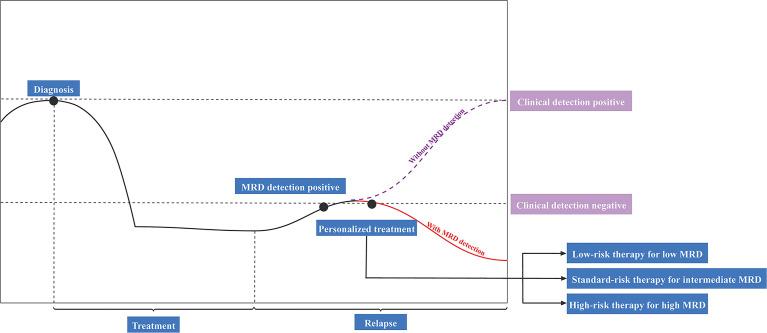
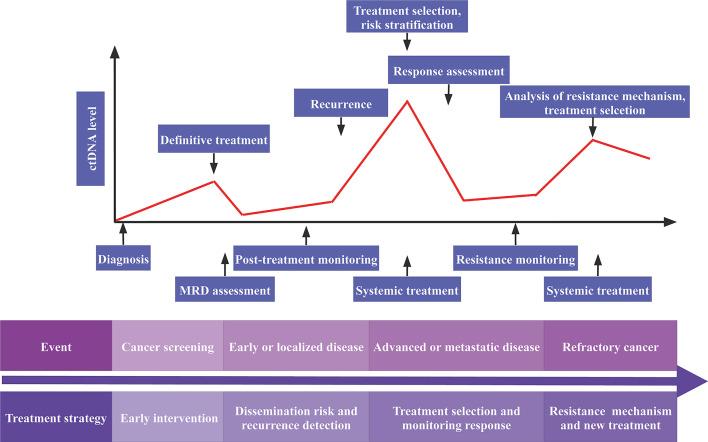
Circulating tumor DNA (ctDNA) is cell-free DNA (cfDNA) fragment in the bloodstream that originates from malignant tumors or circulating tumor cells. Recently, ctDNA has emerged as a promising non-invasive biomarker in clinical oncology. Analysis of ctDNA opens up new avenues for individualized cancer diagnosis and therapy in various types of tumors. Evidence suggests that minimum residual disease (MRD) is closely associated with disease recurrence, thus identifying specific genetic and molecular alterations as novel MRD detection targets using ctDNA has been a research focus. MRD is considered a promising prognostic marker to identify individuals at increased risk of recurrence and who may benefit from treatment. This review summarizes the current knowledge of ctDNA and MRD in solid tumors, focusing on the potential clinical applications and challenges. We describe the current state of ctDNA detection methods and the milestones of ctDNA development and discuss how ctDNA analysis may be an alternative for tissue biopsy. Additionally, we evaluate the clinical utility of ctDNA analysis in solid tumors, such as recurrence risk assessment, monitoring response, and resistance mechanism analysis. MRD detection aids in assessing treatment response, patient prognosis, and risk of recurrence. Moreover, this review highlights current advancements in utilizing ctDNA to monitor the MRD of solid tumors such as lung cancer, breast cancer, and colon cancer. Overall, the clinical application of ctDNA-based MRD detection can assist clinical decision-making and improve patient outcomes in malignant tumors.
循环肿瘤DNA(ctDNA)是血液中源自恶性肿瘤或循环肿瘤细胞的游离DNA(cfDNA)片段。近年来,ctDNA已成为临床肿瘤学中一种有前景的非侵入性生物标志物。对ctDNA的分析为各类肿瘤的个体化癌症诊断和治疗开辟了新途径。有证据表明,最小残留疾病(MRD)与疾病复发密切相关,因此利用ctDNA识别特定的基因和分子改变作为新型MRD检测靶点一直是研究热点。MRD被认为是一种有前景的预后标志物,可用于识别复发风险增加且可能从治疗中获益的个体。本综述总结了实体瘤中ctDNA和MRD的现有知识,重点关注其潜在的临床应用和挑战。我们描述了ctDNA检测方法的现状以及ctDNA发展的里程碑,并讨论了ctDNA分析如何可能成为组织活检的替代方法。此外,我们评估了ctDNA分析在实体瘤中的临床应用,如复发风险评估、监测反应和耐药机制分析。MRD检测有助于评估治疗反应、患者预后和复发风险。此外,本综述强调了利用ctDNA监测肺癌、乳腺癌和结肠癌等实体瘤MRD的当前进展。总体而言,基于ctDNA的MRD检测的临床应用可协助临床决策并改善恶性肿瘤患者的预后。

 Zotero 插件