
2006-2018 年期间巴基斯坦利用孕产妇保健服务趋势的贝叶斯分析。
Bayesian Analysis of Trends in Utilization of Maternal Healthcare Services in Pakistan during 2006-2018.
机构信息
Department of Statistics, The University of Azad Jammu and Kashmir, Muzaffarabad, Pakistan.
COMSATS University Islamabad, Islamabad, Pakistan.
出版信息
Comput Math Methods Med. 2021 Nov 27;2021:4691477. doi: 10.1155/2021/4691477. eCollection 2021.
OBJECTIVES
This study is aimed at investigating the time trends and disparities in access to maternal healthcare in Pakistan using Bayesian models. . A longitudinal study from 2006 to 2018.
METHODS
The detailed analysis is based on the data from Pakistan Demographic and Health Survey (PDHS) conducted during 2006-2018. We have proposed Bayesian logistic regression models (BLRM) to investigate the trends of maternal healthcare in the country. Based on different goodness-of-fit criteria, the performance of proposed models has also been compared with repeatedly used classical logistic regression models (CLRM).
RESULTS
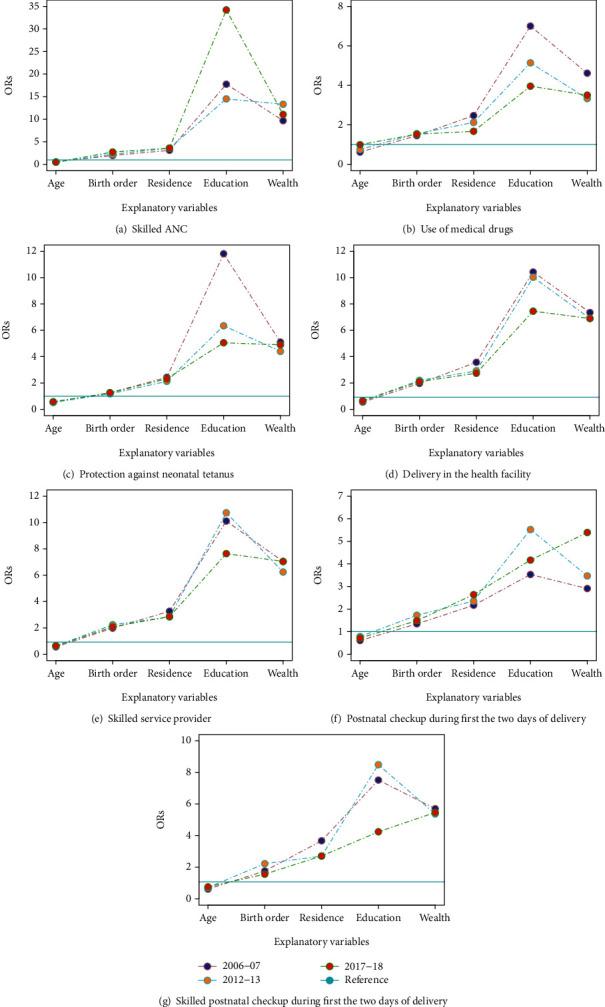
The results from the analysis suggested that BLRM perform better than CLRM. The access to antenatal healthcare increased from 61% to 86% during years 2006-18. The utilization of medication also improved from 44% in 2006 to 60% in 2018. Despite the improvements from 2006 to 2018, every three out of ten women were not protected against neonatal tetanus, neither delivered in the health facility place nor availed with the skilled health provider at the time of delivery during 2018. Similarly, two-fifth mothers did not received any skilled postnatal checkup within two days after delivery. Additionally, the likelihood of MHS provided to mothers is in favor of mothers with lower ages, lower birth orders, urban residences, higher education, higher wealth quintiles, and residents of Sindh and Punjab.
CONCLUSIONS
The gaps in utilization of MHS in different socioeconomic groups of the society have not decreased significantly during 2006-2018. Any future maternal health initiative in the country should focus to reduce the observed disparities among different socioeconomic sectors of the society.
目的
本研究旨在使用贝叶斯模型调查巴基斯坦获得产妇保健的时间趋势和差异。这是一项 2006 年至 2018 年的纵向研究。
方法
详细分析基于 2006-2018 年期间进行的巴基斯坦人口与健康调查(PDHS)的数据。我们提出了贝叶斯逻辑回归模型(BLRM)来调查该国产妇保健的趋势。根据不同的拟合优度标准,还比较了提出的模型与反复使用的经典逻辑回归模型(CLRM)的性能。
结果
分析结果表明,BLRM 比 CLRM 表现更好。2006-18 年间,产前保健的利用率从 61%增加到 86%。药物的使用也从 2006 年的 44%提高到 2018 年的 60%。尽管从 2006 年到 2018 年有所改善,但仍有十分之三的妇女没有预防新生儿破伤风,也没有在 2018 年在卫生机构分娩或获得熟练卫生提供者的帮助。同样,五分之二的母亲在分娩后两天内没有接受任何熟练的产后检查。此外,向母亲提供 MHS 的可能性有利于年龄较小、出生顺序较低、居住在城市、受教育程度较高、财富五分位数较高以及居住在信德省和旁遮普省的母亲。
结论
在 2006-2018 年期间,不同社会经济群体中 MHS 的利用率差距没有显著缩小。该国未来的任何产妇健康倡议都应侧重于减少社会不同社会经济部门之间观察到的差异。
 Zotero 插件