
亚临床动脉粥样硬化的血浆代谢组学分析:糖尿病心脏研究。
Plasma metabolomic profiling in subclinical atherosclerosis: the Diabetes Heart Study.
机构信息
Section on Hospital Medicine, Department of Internal Medicine, Wake Forest School of Medicine, Winston-Salem, NC, USA.
Section on Nephrology, Department of Internal Medicine, Wake Forest School of Medicine, Winston-Salem, NC, USA.
出版信息
Cardiovasc Diabetol. 2021 Dec 7;20(1):231. doi: 10.1186/s12933-021-01419-y.
BACKGROUND
Incidence rates of cardiovascular disease (CVD) are increasing, partly driven by the diabetes epidemic. Novel prediction tools and modifiable treatment targets are needed to enhance risk assessment and management. Plasma metabolite associations with subclinical atherosclerosis were investigated in the Diabetes Heart Study (DHS), a cohort enriched for type 2 diabetes (T2D).
METHODS
The analysis included 700 DHS participants, 438 African Americans (AAs), and 262 European Americans (EAs), in whom coronary artery calcium (CAC) was assessed using ECG-gated computed tomography. Plasma metabolomics using liquid chromatography-mass spectrometry identified 853 known metabolites. An ancestry-specific marginal model incorporating generalized estimating equations examined associations between metabolites and CAC (log-transformed (CAC + 1) as outcome measure). Models were adjusted for age, sex, BMI, diabetes duration, date of plasma collection, time between plasma collection and CT exam, low-density lipoprotein cholesterol (LDL-C), and statin use.
RESULTS
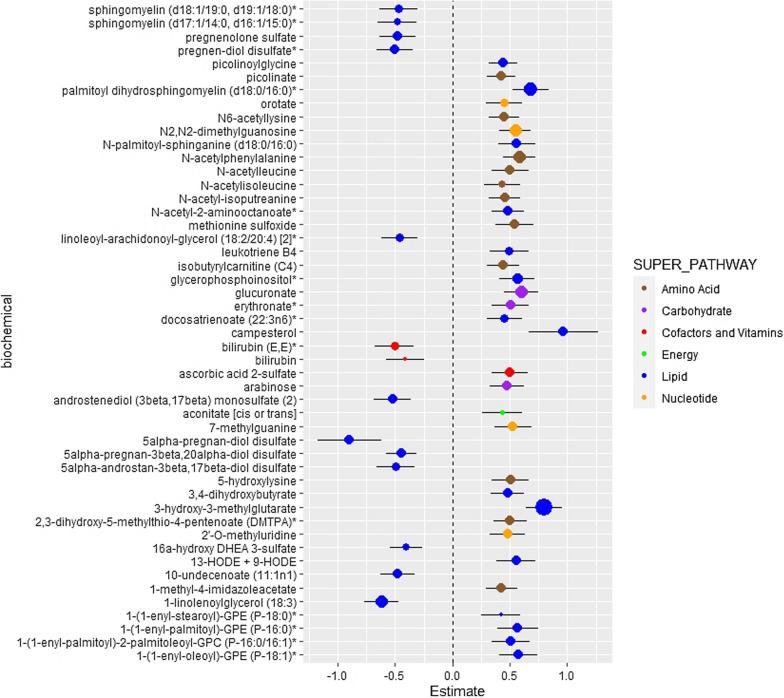
At an FDR-corrected p-value < 0.05, 33 metabolites were associated with CAC in AAs and 36 in EAs. The androgenic steroids, fatty acid, phosphatidylcholine, and bile acid metabolism subpathways were associated with CAC in AAs, whereas fatty acid, lysoplasmalogen, and branched-chain amino acid (BCAA) subpathways were associated with CAC in EAs.
CONCLUSIONS
Strikingly different metabolic signatures were associated with subclinical coronary atherosclerosis in AA and EA DHS participants.
背景
心血管疾病(CVD)的发病率正在上升,部分原因是糖尿病的流行。需要新的预测工具和可改变的治疗靶点来增强风险评估和管理。本研究在糖尿病心脏研究(DHS)中,对亚临床动脉粥样硬化与血浆代谢物的相关性进行了研究,该研究队列中包含了 2 型糖尿病(T2D)患者。
方法
该分析包括 700 名 DHS 参与者,其中 438 名非裔美国人(AA)和 262 名欧洲裔美国人(EA),他们的冠状动脉钙(CAC)使用心电图门控计算机断层扫描进行评估。使用液相色谱-质谱联用技术对血浆代谢组学进行分析,确定了 853 种已知代谢物。采用包含广义估计方程的特定祖先边缘模型,研究了代谢物与 CAC 之间的关联(以对数变换的(CAC+1)作为因变量)。模型调整了年龄、性别、BMI、糖尿病病程、血浆采集日期、血浆采集与 CT 检查之间的时间、低密度脂蛋白胆固醇(LDL-C)和他汀类药物的使用。
结果
在 FDR 校正的 p 值<0.05 时,33 种代谢物与 AA 中的 CAC 相关,36 种代谢物与 EA 中的 CAC 相关。在 AA 中,雄激素、脂肪酸、磷脂酰胆碱和胆汁酸代谢亚途径与 CAC 相关,而在 EA 中,脂肪酸、溶血磷脂酰胆碱和支链氨基酸(BCAA)亚途径与 CAC 相关。
结论
AA 和 EA DHS 参与者的亚临床冠状动脉粥样硬化与截然不同的代谢特征相关。

 Zotero 插件