
单剂量鼻内接种减毒活副流感病毒载体的SARS-CoV-2疫苗对仓鼠具有保护作用。
A single intranasal dose of a live-attenuated parainfluenza virus-vectored SARS-CoV-2 vaccine is protective in hamsters.
作者信息
Liu Xueqiao, Luongo Cindy, Matsuoka Yumiko, Park Hong-Su, Santos Celia, Yang Lijuan, Moore Ian N, Afroz Sharmin, Johnson Reed F, Lafont Bernard A P, Martens Craig, Best Sonja M, Munster Vincent J, Hollý Jaroslav, Yewdell Jonathan W, Le Nouën Cyril, Munir Shirin, Buchholz Ursula J
机构信息
RNA Viruses Section, Laboratory of Infectious Diseases, National Institute of Allergy and Infectious Diseases, National Institutes of Health, Bethesda, MD 20892.
Infectious Disease and Pathogenesis Section, Comparative Medicine Branch, National Institute of Allergy and Infectious Diseases, National Institutes of Health, Bethesda, MD 20892.
出版信息
Proc Natl Acad Sci U S A. 2021 Dec 14;118(50). doi: 10.1073/pnas.2109744118.
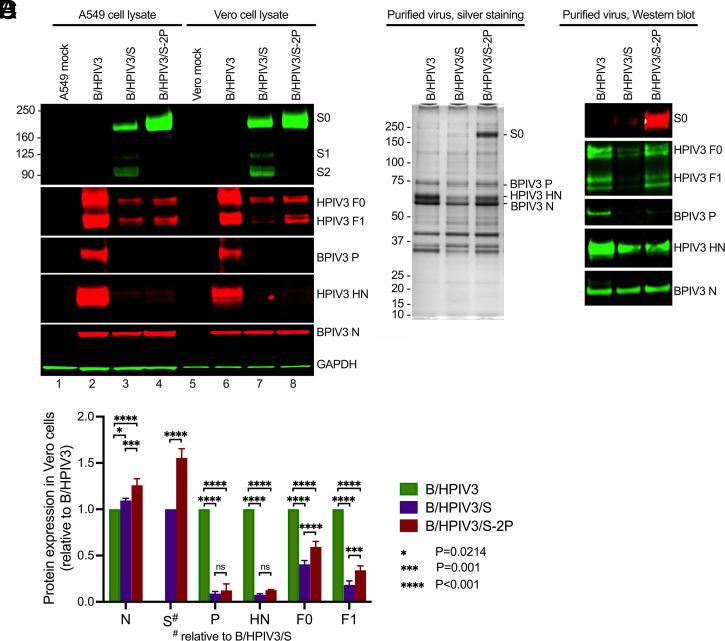
Single-dose vaccines with the ability to restrict SARS-CoV-2 replication in the respiratory tract are needed for all age groups, aiding efforts toward control of COVID-19. We developed a live intranasal vector vaccine for infants and children against COVID-19 based on replication-competent chimeric bovine/human parainfluenza virus type 3 (B/HPIV3) that express the native (S) or prefusion-stabilized (S-2P) SARS-CoV-2 S spike protein, the major protective and neutralization antigen of SARS-CoV-2. B/HPIV3/S and B/HPIV3/S-2P replicated as efficiently as B/HPIV3 in vitro and stably expressed SARS-CoV-2 S. Prefusion stabilization increased S expression by B/HPIV3 in vitro. In hamsters, a single intranasal dose of B/HPIV3/S-2P induced significantly higher titers compared to B/HPIV3/S of serum SARS-CoV-2-neutralizing antibodies (12-fold higher), serum IgA and IgG to SARS-CoV-2 S protein (5-fold and 13-fold), and IgG to the receptor binding domain (10-fold). Antibodies exhibited broad neutralizing activity against SARS-CoV-2 of lineages A, B.1.1.7, and B.1.351. Four weeks after immunization, hamsters were challenged intranasally with 10 50% tissue-culture infectious-dose (TCID) of SARS-CoV-2. In B/HPIV3 empty vector-immunized hamsters, SARS-CoV-2 replicated to mean titers of 10 TCID/g in lungs and 10 TCID/g in nasal tissues and induced moderate weight loss. In B/HPIV3/S-immunized hamsters, SARS-CoV-2 challenge virus was reduced 20-fold in nasal tissues and undetectable in lungs. In B/HPIV3/S-2P-immunized hamsters, infectious challenge virus was undetectable in nasal tissues and lungs; B/HPIV3/S and B/HPIV3/S-2P completely protected against weight loss after SARS-CoV-2 challenge. B/HPIV3/S-2P is a promising vaccine candidate to protect infants and young children against HPIV3 and SARS-CoV-2.
所有年龄组都需要能够限制SARS-CoV-2在呼吸道中复制的单剂量疫苗,以助力控制新冠疫情。我们基于具有复制能力的嵌合牛/人3型副流感病毒(B/HPIV3),开发了一种针对婴幼儿的新冠病毒鼻内活载体疫苗,该病毒表达天然的(S)或预融合稳定化的(S-2P)SARS-CoV-2 S刺突蛋白,这是SARS-CoV-2的主要保护性和中和性抗原。B/HPIV3/S和B/HPIV3/S-2P在体外的复制效率与B/HPIV3相同,并稳定表达SARS-CoV-2 S。预融合稳定化在体外增加了B/HPIV3对S的表达。在仓鼠中,与B/HPIV3/S相比,单次鼻内接种B/HPIV3/S-2P诱导的血清SARS-CoV-2中和抗体滴度显著更高(高12倍),针对SARS-CoV-2 S蛋白的血清IgA和IgG(分别高5倍和13倍),以及针对受体结合域的IgG(高10倍)。这些抗体对A、B.1.1.7和B.1.351谱系的SARS-CoV-2表现出广泛的中和活性。免疫四周后,给仓鼠鼻内接种10个50%组织培养感染剂量(TCID)的SARS-CoV-2。在接种B/HPIV3空载体的仓鼠中,SARS-CoV-2在肺部的平均滴度为10 TCID/g,在鼻组织中的平均滴度为10 TCID/g,并导致体重适度减轻。在接种B/HPIV3/S的仓鼠中,SARS-CoV-2攻击病毒在鼻组织中的含量降低了20倍,在肺部无法检测到。在接种B/HPIV3/S-2P的仓鼠中,在鼻组织和肺部均未检测到有感染性的攻击病毒;B/HPIV3/S和B/HPIV3/S-2P在SARS-CoV-2攻击后完全防止了体重减轻。B/HPIV3/S-2P是一种有前景的疫苗候选物,可保护婴幼儿免受HPIV3和SARS-CoV-2感染。



 Zotero 插件