
微创二尖瓣修复中的全面疼痛控制策略。
Comprehensive Pain Control Strategy in Minimally Invasive Mitral Valve Repair.
机构信息
Department of Cardiovascular Surgery, Kansai Medical University, Hirakata, Osaka, Japan.
出版信息
Ann Thorac Cardiovasc Surg. 2022 Jun 20;28(3):180-185. doi: 10.5761/atcs.oa.21-00131. Epub 2021 Dec 7.
PURPOSE
The effect of our comprehensive strategy to reduce pain after minimally invasive mitral valve repair through a right mini-thoracotomy was assessed retrospectively.
METHODS
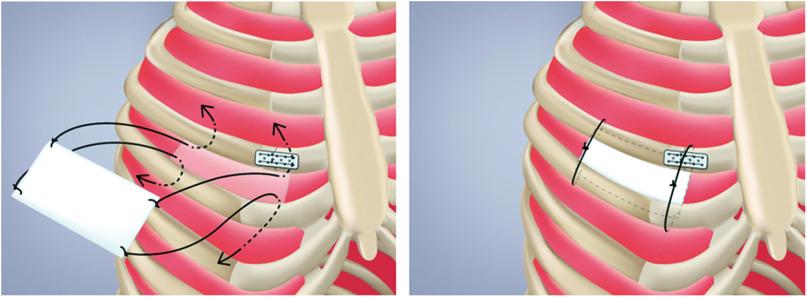
Our comprehensive strategy constituted the following: planned rib cutting to avoid rib injury, sufficient intercostal muscle division to mobilize the cut rib, limiting the number of intercostal ports, avoiding nerve entrapment, continuous extra-pleural intercostal nerve block, and regular use of oral non-steroidal anti-inflammatory drugs. We compared patients treated with this comprehensive strategy (Group S, n = 13) and patients before this strategy was implemented (Group C, n = 13). We used a numerical rating scale (NRS) as a pain scale during the first 3 days postoperatively.
RESULTS
The average NRS was significantly lower in Group S (0.82 ± 0.49) than in Group C (2.40 ± 1.46) (P <0.01). The maximum NRS was also significantly lower in Group S (3.23 ± 1.17) than in Group C (5.69 ± 2.43) (P <0.01). The number of patients using additional single-dose analgesic were significantly less in Group S (23.1%) than in Group C (84.6%) (P <0.01).
CONCLUSION
Our comprehensive pain control strategy effectively reduced postoperative pain in minimally invasive mitral valve repair.
目的
回顾性评估我们通过右胸小切口微创二尖瓣修复术的综合策略对减轻术后疼痛的效果。
方法
我们的综合策略包括:计划切肋以避免肋骨损伤、充分分离肋间肌以移动切断的肋骨、限制肋间端口数量、避免神经卡压、持续行肋间神经外膜阻滞以及规律使用口服非甾体类抗炎药。我们比较了采用该综合策略的患者(S 组,n=13)和该策略实施前的患者(C 组,n=13)。我们使用数字评分量表(NRS)作为术后前 3 天的疼痛评分。
结果
S 组的平均 NRS(0.82±0.49)明显低于 C 组(2.40±1.46)(P<0.01)。S 组的最大 NRS(3.23±1.17)也明显低于 C 组(5.69±2.43)(P<0.01)。S 组使用额外单次剂量镇痛剂的患者数量明显少于 C 组(23.1% vs. 84.6%)(P<0.01)。
结论
我们的综合疼痛控制策略可有效减轻微创二尖瓣修复术后的疼痛。

 Zotero 插件