
动态 queuosine 变化在 tRNA 中偶联营养水平与布鲁氏锥虫的密码子选择。
Dynamic queuosine changes in tRNA couple nutrient levels to codon choice in Trypanosoma brucei.
机构信息
Department of Microbiology and The Center for RNA Biology, The Ohio State University, Columbus, OH, USA.
School of Biological Sciences, Institute for Global Food Security, Queen's University Belfast, Belfast, UK.
出版信息
Nucleic Acids Res. 2021 Dec 16;49(22):12986-12999. doi: 10.1093/nar/gkab1204.
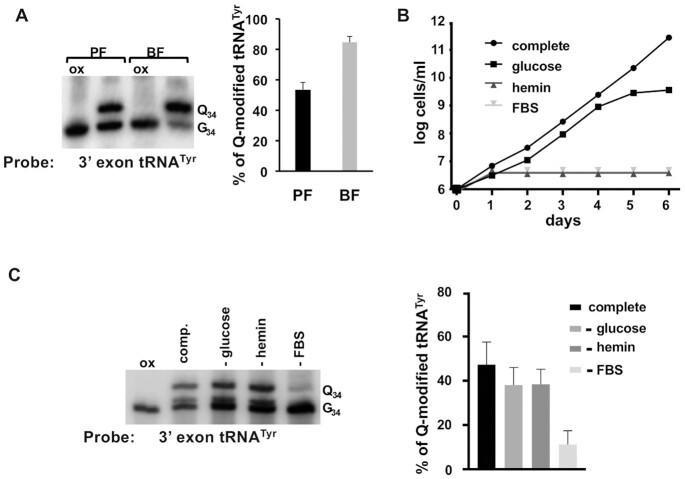
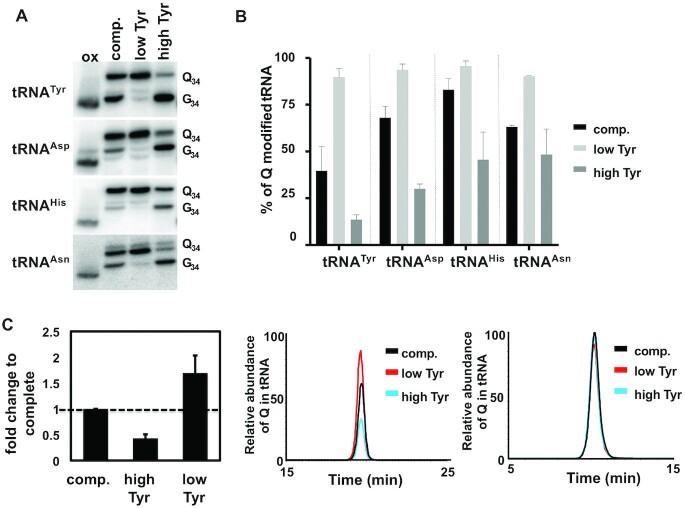
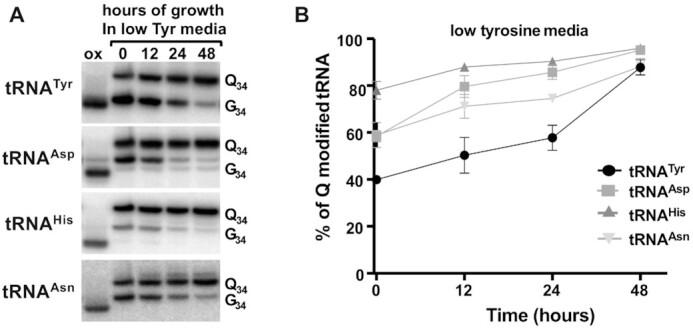
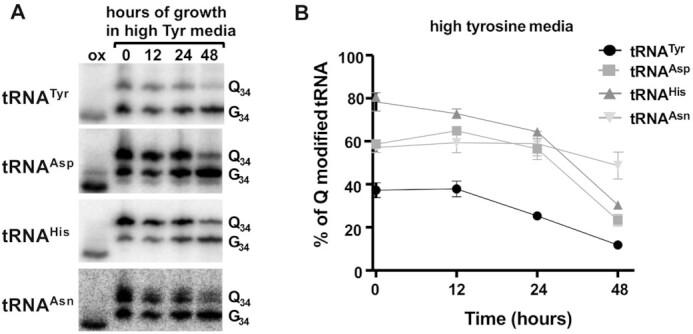
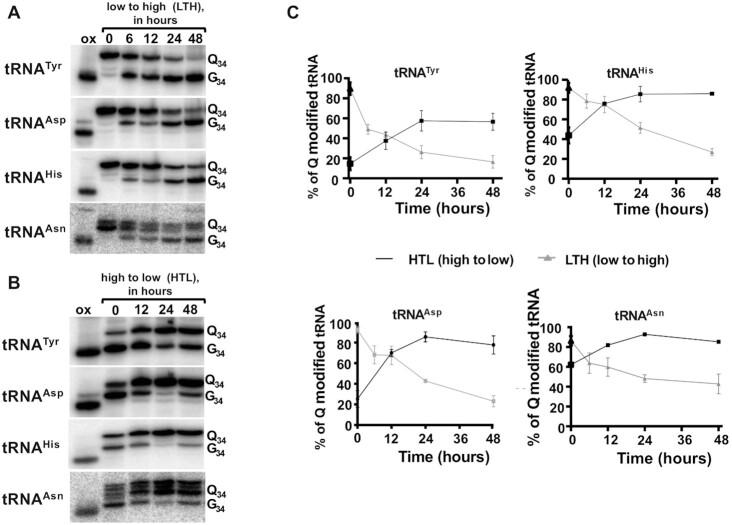
Every type of nucleic acid in cells undergoes programmed chemical post-transcriptional modification. Generally, modification enzymes use substrates derived from intracellular metabolism, one exception is queuine (q)/queuosine (Q), which eukaryotes obtain from their environment; made by bacteria and ultimately taken into eukaryotic cells via currently unknown transport systems. Here, we use a combination of molecular, cell biology and biophysical approaches to show that in Trypanosoma brucei tRNA Q levels change dynamically in response to concentration variations of a sub-set of amino acids in the growth media. Most significant were variations in tyrosine, which at low levels lead to increased Q content for all the natural tRNAs substrates of tRNA-guanine transglycosylase (TGT). Such increase results from longer nuclear dwell time aided by retrograde transport following cytoplasmic splicing. In turn high tyrosine levels lead to rapid decrease in Q content. Importantly, the dynamic changes in Q content of tRNAs have negligible effects on global translation or growth rate but, at least, in the case of tRNATyr it affected codon choice. These observations have implications for the occurrence of other tunable modifications important for 'normal' growth, while connecting the intracellular localization of modification enzymes, metabolites and tRNAs to codon selection and implicitly translational output.
细胞中的每种核酸都经历程序性的化学转录后修饰。一般来说,修饰酶使用来自细胞内代谢的底物,一个例外是 Queuine(Q)/Queuosine(Q),真核生物从环境中获得;由细菌合成,并通过目前未知的运输系统最终进入真核细胞。在这里,我们结合分子、细胞生物学和生物物理方法,表明在 Trypanosoma brucei tRNA 中,Q 水平会根据生长培养基中一组氨基酸浓度的变化而动态变化。变化最显著的是酪氨酸,在低水平时,所有天然 tRNA 底物的 Q 含量都会增加 tRNA-鸟嘌呤转移酶(TGT)。这种增加是由于核内停留时间延长,并在细胞质剪接后进行逆行运输。反过来,高酪氨酸水平会导致 Q 含量迅速下降。重要的是,tRNA 的 Q 含量的动态变化对全局翻译或生长速率几乎没有影响,但至少在 tRNATyr 的情况下,它会影响密码子选择。这些观察结果对其他对“正常”生长很重要的可调修饰的发生具有重要意义,同时将修饰酶、代谢物和 tRNA 的细胞内定位与密码子选择和隐含的翻译输出联系起来。




 Zotero 插件