
微小RNA的miR-200家族:上皮-间质转化的精细调节因子及循环肿瘤生物标志物
The miR-200 Family of microRNAs: Fine Tuners of Epithelial-Mesenchymal Transition and Circulating Cancer Biomarkers.
作者信息
Cavallari Ilaria, Ciccarese Francesco, Sharova Evgeniya, Urso Loredana, Raimondi Vittoria, Silic-Benussi Micol, D'Agostino Donna M, Ciminale Vincenzo
机构信息
Veneto Institute of Oncology IOV-IRCCS, 35128 Padova, Italy.
Department of Surgery, Oncology and Gastroenterology, University of Padua, 35128 Padova, Italy.
出版信息
Cancers (Basel). 2021 Nov 23;13(23):5874. doi: 10.3390/cancers13235874.
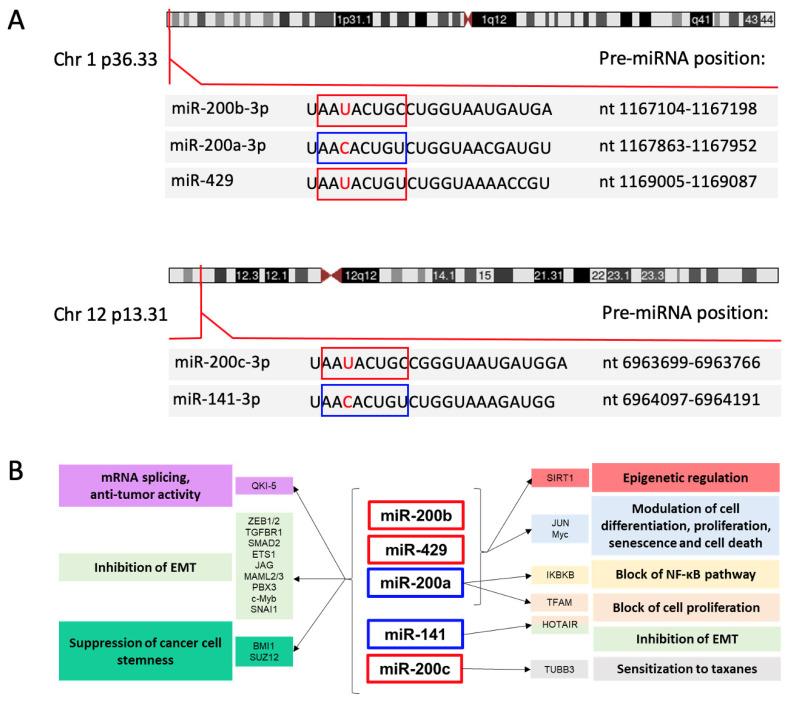
The miR-200 family of microRNAs (miRNAs) includes miR-200a, miR-200b, miR-200c, miR-141 and miR-429, five evolutionarily conserved miRNAs that are encoded in two clusters of hairpin precursors located on human chromosome 1 (miR-200b, miR-200a and miR-429) and chromosome 12 (miR-200c and miR-141). The mature -3p products of the precursors are abundantly expressed in epithelial cells, where they contribute to maintaining the epithelial phenotype by repressing expression of factors that favor the process of epithelial-to-mesenchymal transition (EMT), a key hallmark of oncogenic transformation. Extensive studies of the expression and interactions of these miRNAs with cell signaling pathways indicate that they can exert both tumor suppressor- and pro-metastatic functions, and may serve as biomarkers of epithelial cancers. This review provides a summary of the role of miR-200 family members in EMT, factors that regulate their expression, and important targets for miR-200-mediated repression that are involved in EMT. The second part of the review discusses the potential utility of circulating miR-200 family members as diagnostic/prognostic biomarkers for breast, colorectal, lung, ovarian, prostate and bladder cancers.
微小RNA(miRNA)的miR-200家族包括miR-200a、miR-200b、miR-200c、miR-141和miR-429,这五个在进化上保守的miRNA由位于人类1号染色体(miR-200b、miR-200a和miR-429)和12号染色体(miR-200c和miR-141)上的两个发夹前体簇编码。前体的成熟-3p产物在上皮细胞中大量表达,它们通过抑制有利于上皮-间质转化(EMT)过程的因子的表达来维持上皮表型,EMT是致癌转化的一个关键标志。对这些miRNA的表达及其与细胞信号通路相互作用的广泛研究表明,它们既可以发挥肿瘤抑制功能,也可以发挥促转移功能,并且可能作为上皮性癌症的生物标志物。本综述总结了miR-200家族成员在EMT中的作用、调节其表达的因子以及参与EMT的miR-200介导的抑制作用的重要靶点。综述的第二部分讨论了循环miR-200家族成员作为乳腺癌、结直肠癌、肺癌、卵巢癌、前列腺癌和膀胱癌诊断/预后生物标志物的潜在用途。

 Zotero 插件