
多基因风险评分在亚洲人群乳腺癌风险预测中的应用。
Polygenic risk scores for prediction of breast cancer risk in Asian populations.
机构信息
School of Mathematical Sciences, Faculty of Science and Engineering, University of Nottingham Malaysia, Selangor, Malaysia; Cancer Research Malaysia, Selangor, Malaysia.
Cancer Research Malaysia, Selangor, Malaysia.
出版信息
Genet Med. 2022 Mar;24(3):586-600. doi: 10.1016/j.gim.2021.11.008. Epub 2021 Dec 15.
PURPOSE
Non-European populations are under-represented in genetics studies, hindering clinical implementation of breast cancer polygenic risk scores (PRSs). We aimed to develop PRSs using the largest available studies of Asian ancestry and to assess the transferability of PRS across ethnic subgroups.
METHODS
The development data set comprised 138,309 women from 17 case-control studies. PRSs were generated using a clumping and thresholding method, lasso penalized regression, an Empirical Bayes approach, a Bayesian polygenic prediction approach, or linear combinations of multiple PRSs. These PRSs were evaluated in 89,898 women from 3 prospective studies (1592 incident cases).
RESULTS
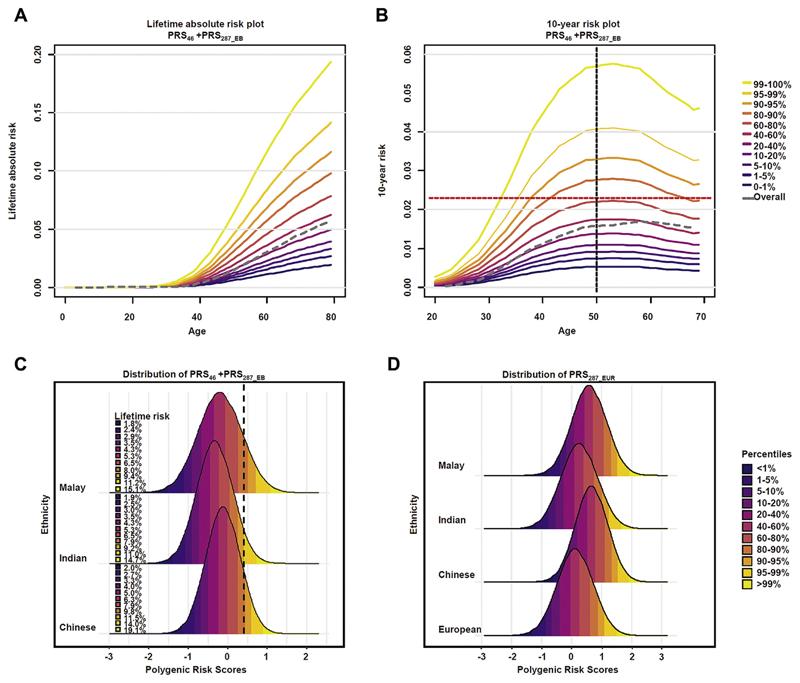
The best performing PRS (genome-wide set of single-nucleotide variations [formerly single-nucleotide polymorphism]) had a hazard ratio per unit SD of 1.62 (95% CI = 1.46-1.80) and an area under the receiver operating curve of 0.635 (95% CI = 0.622-0.649). Combined Asian and European PRSs (333 single-nucleotide variations) had a hazard ratio per SD of 1.53 (95% CI = 1.37-1.71) and an area under the receiver operating curve of 0.621 (95% CI = 0.608-0.635). The distribution of the latter PRS was different across ethnic subgroups, confirming the importance of population-specific calibration for valid estimation of breast cancer risk.
CONCLUSION
PRSs developed in this study, from association data from multiple ancestries, can enhance risk stratification for women of Asian ancestry.
目的
非欧洲人群在遗传学研究中代表性不足,这阻碍了乳腺癌多基因风险评分(PRS)在临床中的应用。我们旨在利用亚洲人群中最大规模的现有研究来开发 PRS,并评估 PRS 在不同种族亚组之间的可转移性。
方法
开发数据集包括来自 17 项病例对照研究的 138309 名女性。使用聚类和阈值方法、套索惩罚回归、经验贝叶斯方法、贝叶斯多基因预测方法或多个 PRS 的线性组合生成 PRS。这些 PRS 在来自 3 项前瞻性研究(1592 例病例)的 89898 名女性中进行了评估。
结果
表现最佳的 PRS(全基因组单核苷酸变异[原单核苷酸多态性])每单位 SD 的风险比为 1.62(95%CI=1.46-1.80),接收器操作曲线下面积为 0.635(95%CI=0.622-0.649)。亚洲和欧洲联合 PRS(333 个单核苷酸变异)每 SD 的风险比为 1.53(95%CI=1.37-1.71),接收器操作曲线下面积为 0.621(95%CI=0.608-0.635)。后者 PRS 的分布在不同的种族亚组之间存在差异,这证实了为有效估计乳腺癌风险进行人群特异性校准的重要性。
结论
本研究从多种血统的关联数据中开发的 PRS,可以增强亚洲血统女性的风险分层。


 Zotero 插件