
中年女性尿液中酚类和对羟基苯甲酸酯类物质的浓度与糖尿病发病情况:全国女性健康研究
Urinary concentrations of phenols and parabens and incident diabetes in midlife women: The Study of Women's Health Across the Nation.
作者信息
Lee Seulbi, Karvonen-Gutierrez Carrie, Mukherjee Bhramar, Herman William H, Harlow Siobán D, Park Sung Kyun
机构信息
Department of Epidemiology, School of Public Health, University of Michigan, Ann Arbor, Michigan.
Department of Biostatistics, School of Public Health, University of Michigan, Ann Arbor, Michigan.
出版信息
Environ Epidemiol. 2021 Oct 1;5(5):e171. doi: 10.1097/EE9.0000000000000171. eCollection 2021 Oct.
BACKGROUND
Environmental phenols have been suggested as diabetogens but evidence from prospective cohort studies is limited. We examined associations between urinary concentrations of phenols and parabens, assessed at two time-points, and incident diabetes in the Study of Women's Health Across the Nation (SWAN).
METHODS
We examined 1,299 women, aged 45-56 years, who were diabetes-free at baseline of the SWAN Multi-Pollutant Study (MPS) (1999-2000) and were followed through January 2017. Urinary concentrations of bisphenol-A, bisphenol-F, triclosan, 2,4-dichlorophenol, 2,5-dichlorophenol, benzophenone-3, methyl-paraben, ethyl-paraben, propyl-paraben, and butyl-paraben were measured twice at MPS baseline and 3 years later (2002-2003), and the two average concentrations were used as exposure variables. Associations of incident diabetes with individual phenols and parabens were examined using Cox regression. We evaluated the overall joint effects using quantile-based g-computation.
RESULTS
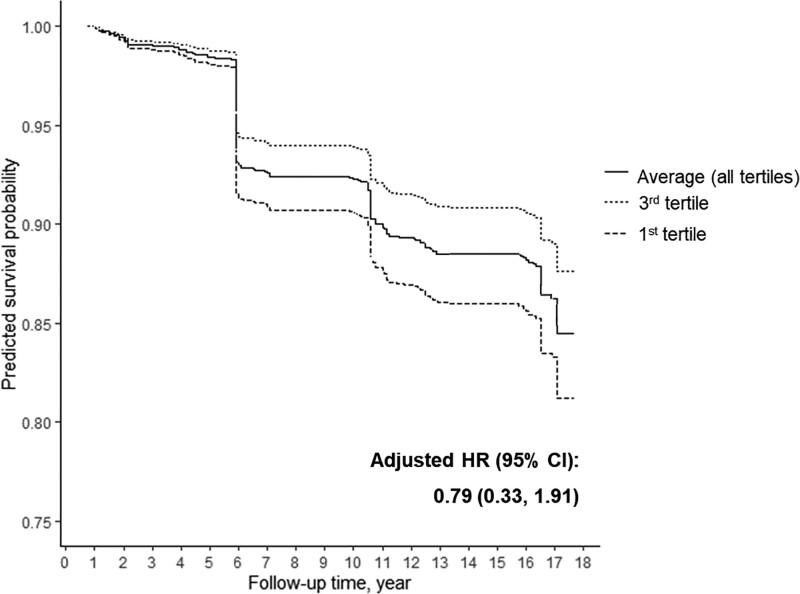
Adjusted hazard ratios (HRs) for incident diabetes of the third tertile compared with the first tertile of urinary concentrations were 0.40 (95% confidence interval [CI] = 0.29, 0.56) for methyl-paraben; 0.42 (0.30, 0.58) for propyl-paraben; 0.53 (0.38, 0.75) for 2,5-diclrorophenol; and 0.55 (0.39, 0.80) for benzophenone-3. Nonlinear associations were found for bisphenol-A and 2,4-dichlorophenol (significant positive associations in the second tertile but no associations in the third tertile compared with the first tertile). No significant associations were observed for the other individual chemicals or the joint effect of mixtures.
CONCLUSIONS
Our findings do not support diabetogenic effects of urinary parabens which were inversely associated with incident diabetes among mid-life women. Epidemiologic findings for biomarkers with short half-lives and high within-person variability need to be interpreted with caution.
背景
环境酚类物质被认为是糖尿病诱发因素,但前瞻性队列研究的证据有限。在全国女性健康研究(SWAN)中,我们研究了在两个时间点评估的尿酚和对羟基苯甲酸酯浓度与新发糖尿病之间的关联。
方法
我们研究了1299名年龄在45 - 56岁之间的女性,她们在SWAN多污染物研究(MPS)(1999 - 2000年)基线时无糖尿病,并随访至2017年1月。在MPS基线和3年后(2002 - 2003年)两次测量尿中双酚A、双酚F、三氯生、2,4 - 二氯酚、2,5 - 二氯酚、二苯甲酮 - 3、甲基对羟基苯甲酸酯、乙基对羟基苯甲酸酯、丙基对羟基苯甲酸酯和丁基对羟基苯甲酸酯的浓度,并将两个平均浓度用作暴露变量。使用Cox回归研究新发糖尿病与个体酚类和对羟基苯甲酸酯的关联。我们使用基于分位数的g计算评估总体联合效应。
结果
尿浓度第三分位数与第一分位数相比,甲基对羟基苯甲酸酯新发糖尿病的校正风险比(HRs)为0.40(95%置信区间[CI] = 0.29, 0.56);丙基对羟基苯甲酸酯为0.42(0.30, 0.58);2,5 - 二氯酚为0.53(0.38, 0.75);二苯甲酮 - 3为0.55(0.39, 0.80)。发现双酚A和2,4 - 二氯酚存在非线性关联(与第一分位数相比,第二分位数有显著正相关,但第三分位数无关联)。未观察到其他个体化学物质或混合物联合效应的显著关联。
结论
我们的研究结果不支持尿中对羟基苯甲酸酯具有糖尿病诱发作用,其与中年女性新发糖尿病呈负相关。对于半衰期短且个体内变异性高的生物标志物的流行病学研究结果需要谨慎解释。

 Zotero 插件