
GLIS3:胰岛 β 细胞生成中的关键转录因子。
GLIS3: A Critical Transcription Factor in Islet β-Cell Generation.
机构信息
Cell Biology Group, Immunity, Inflammation and Disease Laboratory, National Institute of Environmental Health Science, National Institutes of Health, Durham, NC 27709, USA.
出版信息
Cells. 2021 Dec 9;10(12):3471. doi: 10.3390/cells10123471.
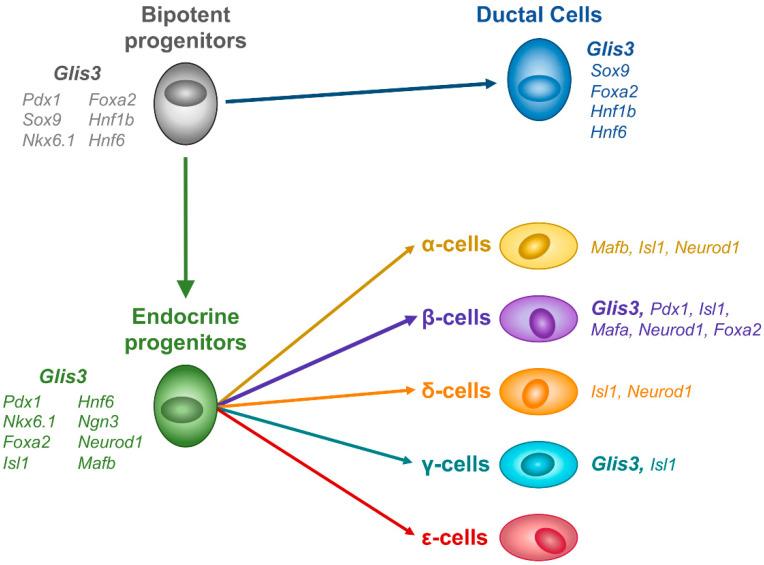
Understanding of pancreatic islet biology has greatly increased over the past few decades based in part on an increased understanding of the transcription factors that guide this process. One such transcription factor that has been increasingly tied to both β-cell development and the development of diabetes in humans is . Genetic deletion of in mice and humans induces neonatal diabetes, while single nucleotide polymorphisms (SNPs) in have been associated with both Type 1 and Type 2 diabetes. As a significant progress has been made in understanding some of 's roles in pancreas development and diabetes, we sought to compare current knowledge on within the pancreas to that of other islet enriched transcription factors. While appears to regulate similar genes and pathways to other transcription factors, its unique roles in β-cell development and maturation make it a key target for future studies and therapy.
在过去的几十年中,人们对胰岛生物学的理解有了很大的提高,部分原因是对指导这一过程的转录因子有了更多的了解。这样的转录因子之一,越来越多地与β细胞的发育和人类糖尿病的发展有关,是. 在小鼠和人类中敲除 会导致新生儿糖尿病,而 中的单核苷酸多态性 (SNP) 与 1 型和 2 型糖尿病都有关。随着人们对 在胰腺发育和糖尿病中的一些作用的理解取得了重大进展,我们试图将 在胰腺中的现有知识与其他胰岛富集转录因子进行比较。虽然 似乎与其他转录因子调节相似的基因和途径,但它在 β细胞发育和成熟中的独特作用使其成为未来研究和治疗的关键目标。

 Zotero 插件