
神经内分泌癌作为前列腺癌患者的独立预后因素:一项基于人群的研究。
Neuroendocrine Carcinoma as an Independent Prognostic Factor for Patients With Prostate Cancer: A Population-Based Study.
机构信息
The State Key Laboratory for Diagnosis and Treatment of Infectious Diseases, Collaborative Innovation Center for Diagnosis and Treatment of Infectious Diseases, National Clinical Research Center for Infectious Diseases, The First Affiliated Hospital, College of Medicine, Zhejiang University, Hangzhou, China.
出版信息
Front Endocrinol (Lausanne). 2021 Dec 8;12:778758. doi: 10.3389/fendo.2021.778758. eCollection 2021.
BACKGROUND
Neuroendocrine carcinoma (NEC) is a rare and highly malignant variation of prostate adenocarcinoma. We aimed to investigate the prognostic value of NEC in prostate cancer.
METHODS
A total of 530440 patients of prostate cancer, including neuroendocrine prostate cancer (NEPC) and adenocarcinoma from 2004 to 2018 were obtained from the national Surveillance, Epidemiology, and End Results (SEER) database. Propensity score matching (PSM), multivariable Cox proportional hazard model, Kaplan-Meier method and subgroup analysis were performed in our study.
RESULTS
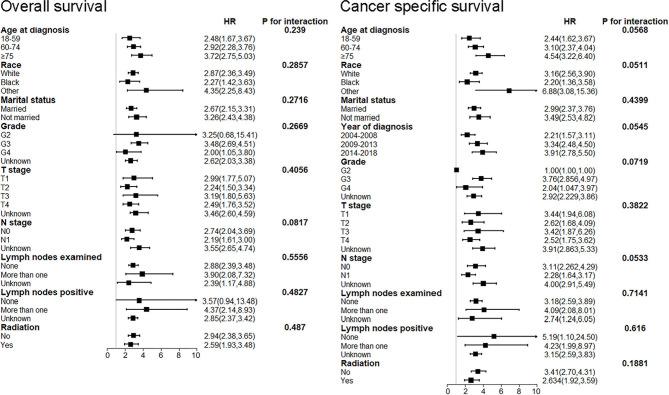
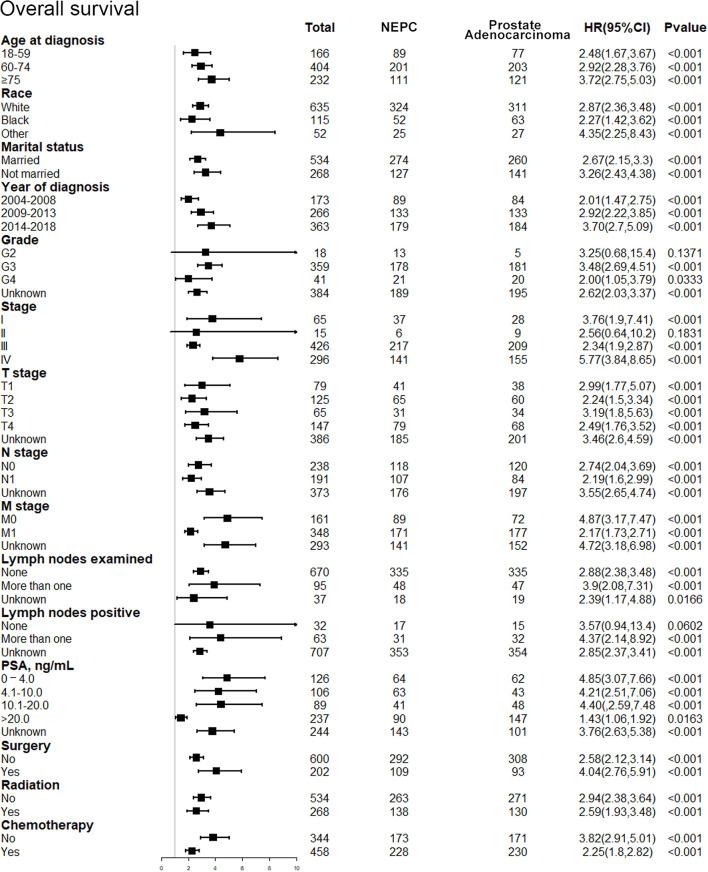
NEPC patients were inclined to be older at diagnosis (Median age, 69(61-77) vs. 65(59-72), P< 0.001) and had higher rates of muscle invasive disease (30.9% vs. 9.2%, P < 0.001), lymph node metastasis (32.2% vs. 2.2%, P < 0.001), and distal metastasis (45.7% vs. 3.6%, P < 0.001) compared with prostate adenocarcinoma patients. However, the proportion of NEPC patients with PSA levels higher than 4.0 ng/mL was significantly less than adenocarcinoma patients (47.3% vs. 72.9%, P<0.001). NEPC patients had a lower rate of receiving surgery treatment (28.8% vs. 43.9%, P<0.001), but they had an obviously higher rate of receiving chemotherapy (57.9% vs. 1.0%, P<0.001). A Cox regression analysis demonstrated that the NEPC patients faced a remarkably worse OS (HR = 2.78, 95% CI = 2.34-3.31, P < 0.001) and CSS (HR = 3.07, 95% CI = 2.55-3.71, P < 0.001) compared with adenocarcinoma patients after PSM. Subgroup analyses further suggested that NEPC patients obtained significantly poorer prognosis across nearly all subgroups.
CONCLUSION
The prognosis of NEPC was worse than that of adenocarcinoma among patients with prostate cancer. The histological subtype of NEC is an independent prognostic factor for patients with prostate cancer.
背景
神经内分泌癌(NEC)是一种罕见的、高度恶性的前列腺腺癌变异。我们旨在研究 NEC 在前列腺癌中的预后价值。
方法
我们从国家监测、流行病学和最终结果(SEER)数据库中获得了 2004 年至 2018 年间共 530440 例前列腺癌患者的数据,包括神经内分泌前列腺癌(NEPC)和腺癌。本研究采用倾向评分匹配(PSM)、多变量 Cox 比例风险模型、Kaplan-Meier 方法和亚组分析。
结果
NEPC 患者在诊断时更倾向于年龄较大(中位年龄,69[61-77]岁比 65[59-72]岁,P<0.001),并且更倾向于患有肌肉浸润性疾病(30.9%比 9.2%,P<0.001)、淋巴结转移(32.2%比 2.2%,P<0.001)和远处转移(45.7%比 3.6%,P<0.001)。然而,与前列腺腺癌患者相比,NEPC 患者 PSA 水平高于 4.0ng/ml 的比例明显较低(47.3%比 72.9%,P<0.001)。NEPC 患者接受手术治疗的比例较低(28.8%比 43.9%,P<0.001),但接受化疗的比例明显较高(57.9%比 1.0%,P<0.001)。Cox 回归分析表明,在 PSM 后,NEPC 患者的 OS(HR=2.78,95%CI=2.34-3.31,P<0.001)和 CSS(HR=3.07,95%CI=2.55-3.71,P<0.001)明显更差。亚组分析进一步表明,NEPC 患者在几乎所有亚组中均获得了明显更差的预后。
结论
在前列腺癌患者中,NEPC 的预后比腺癌差。NEC 的组织学亚型是前列腺癌患者的独立预后因素。



 Zotero 插件