
芝麻酚对高脂饮食诱导的肝脂肪变性中肝脏氧化应激和炎症的保护作用。
Protective Effects of Sesamol against Liver Oxidative Stress and Inflammation in High-Fat Diet-Induced Hepatic Steatosis.
机构信息
Department of Nutrition Science and Food Hygiene, Xiangya School of Public Health, Central South University, 110 Xiangya Road, Changsha 410078, China.
Changsha Center for Disease Control and Prevention, 509 Wanjiali North Road, Changsha 410005, China.
出版信息
Nutrients. 2021 Dec 15;13(12):4484. doi: 10.3390/nu13124484.
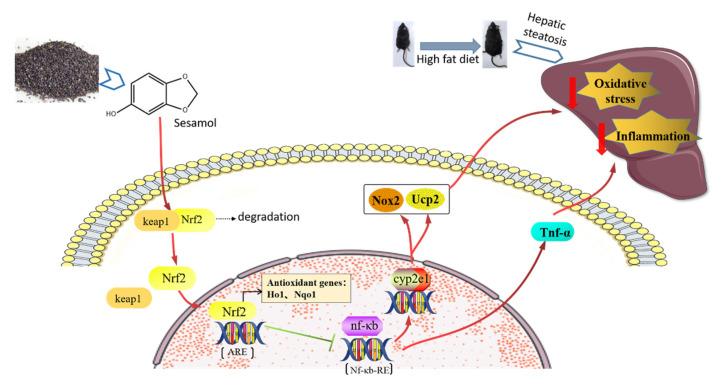
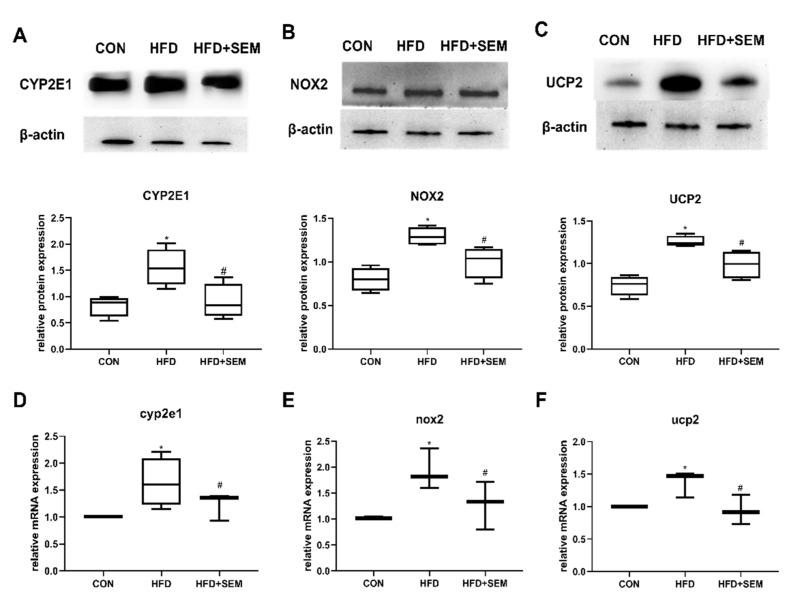
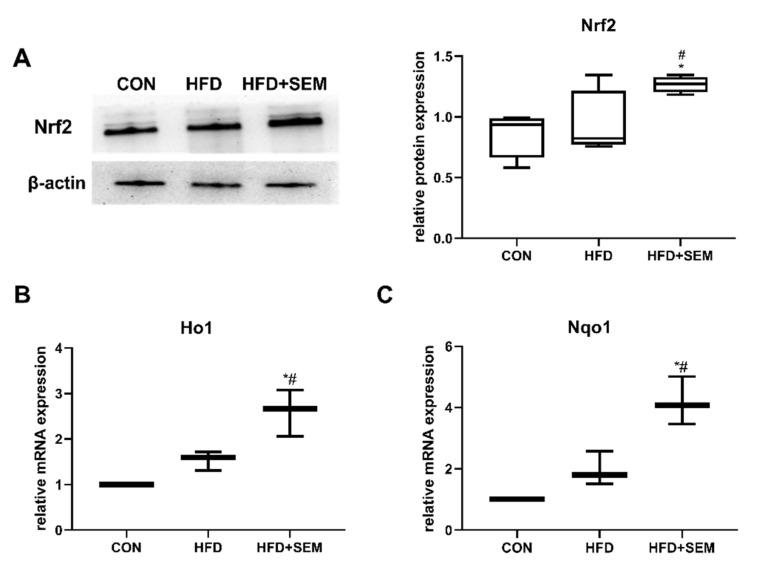
Chronic high-fat diet (HFD) is associated with the onset and progression of hepatic steatosis, and oxidative stress is highly involved in this process. The potential role of sesamol (SEM) against oxidative stress and inflammation at the transcriptional level in a mice model of hepatic steatosis is not known. In this study, we aimed to investigate the scavenging effects of SEM towards reactive oxygen generated by lipid accumulation in the liver of obese mice and to explore the mechanisms of protection. Markers of oxidative stress, vital enzymes involved in stimulating oxidative stress or inflammation, and nuclear transcription of Nrf2 were examined. Our results showed that SEM significantly inhibited the activity of the HFD-induced hepatic enzymes CYP2E1 and NOX2, associated with oxidative stress generation. Additionally, SEM reversed HFD-induced activation of NF-κB, a redox-sensitive transcription factor, and attenuated the expression of hepatic TNF-α, a proinflammatory molecule. Moreover, SEM enhanced HFD-induced hepatic Nrf2 nuclear transcription and increased the levels of its downstream target genes and , which indicated antiinflammation and antioxidant properties. Our study suggests that chronic HFD led to hepatic steatosis, while SEM exhibited protective effects on the liver by counteracting the oxidative stress and inflammation induced by HFD. The underlying mechanism might involve multiple pathways at the transcriptional level; the antioxidant defense mechanism was in partly mediated by the upregulation of Nrf2.
慢性高脂肪饮食(HFD)与肝脂肪变性的发生和进展有关,氧化应激在此过程中高度参与。Sesamol(SEM)在肝脂肪变性小鼠模型中针对转录水平的氧化应激和炎症的潜在作用尚不清楚。在这项研究中,我们旨在研究 SEM 对肥胖小鼠肝脏中由脂质积累产生的活性氧的清除作用,并探讨其保护机制。研究了氧化应激的标志物、参与刺激氧化应激或炎症的重要酶以及 Nrf2 的核转录。我们的结果表明,SEM 显著抑制了与氧化应激产生相关的 HFD 诱导的肝酶 CYP2E1 和 NOX2 的活性。此外,SEM 逆转了 HFD 诱导的 NF-κB(一种氧化还原敏感的转录因子)的激活,并减弱了肝 TNF-α(一种促炎分子)的表达。此外,SEM 增强了 HFD 诱导的肝 Nrf2 核转录,并增加了其下游靶基因 和 的水平,这表明了 SEM 具有抗炎和抗氧化特性。我们的研究表明,慢性 HFD 导致肝脂肪变性,而 SEM 通过抵消 HFD 诱导的氧化应激和炎症对肝脏表现出保护作用。潜在机制可能涉及转录水平的多个途径;抗氧化防御机制部分由 Nrf2 的上调介导。

 Zotero 插件