
印度北部一家三级肿瘤学中心的经验:胆囊癌的多模态管理可带来更好的结果。
Multimodality management of gallbladder cancer can lead to a better outcome: Experience from a tertiary care oncology centre in North India.
机构信息
Department of GI and HPB Oncosurgery, Rajiv Gandhi Cancer Institute and Research Center, Delhi 110085, Delhi, India.
Department of Medical Oncology, Rajiv Gandhi Cancer Institute and Research Center, Delhi 110085, Delhi, India.
出版信息
World J Gastroenterol. 2021 Dec 7;27(45):7813-7830. doi: 10.3748/wjg.v27.i45.7813.
BACKGROUND
Surgical resection is a treatment of choice for gallbladder cancer (GBC) patients but only 10% of patients have a resectable disease at presentation. Even after surgical resection, overall survival (OS) has been poor due to high rates of recurrence. Combination of surgery and systemic therapy can improve outcomes in this aggressive disease.
AIM
To summarize our single-center experience with multimodality management of resectable GBC patients.
METHODS
Data of all patients undergoing surgery for suspected GBC from January 2012 to December 2018 was retrieved from a prospectively maintained electronic database. Information extracted included demographics, operative and perioperative details, histopathology, neoadjuvant/adjuvant therapy, follow-up, and recurrence. To know the factors associated with recurrence and OS, univariate and multivariate analysis was done using log rank test and cox proportional hazard analysis for categorical and continuous variables, respectively. Multivariate analysis was done using multiple regression analysis.
RESULTS
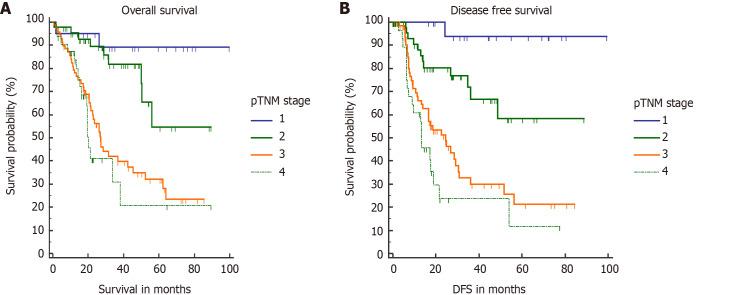
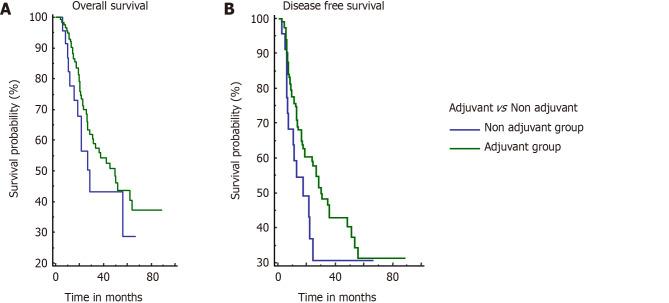
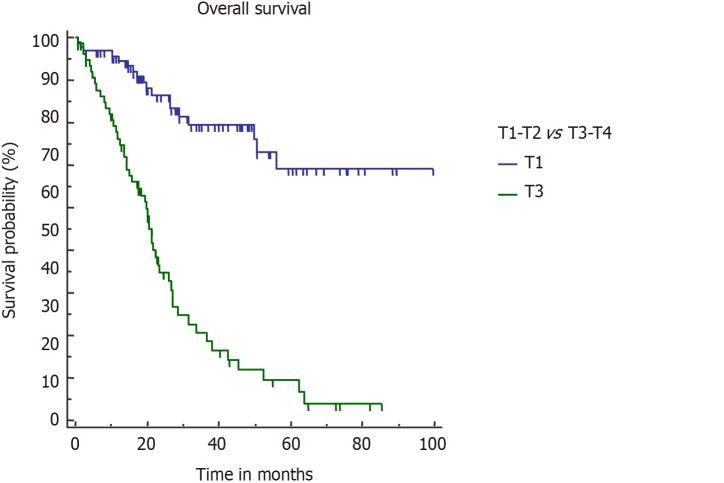
Of 274 patients with GBC taken up for surgical resection, 172 (62.7%) were female and the median age was 56 years. On exploration, 102 patients were found to have a metastatic or unresectable disease (distant metastasis in 66 and locally unresectable in 34). Of 172 patients who finally underwent surgery, 93 (54%) underwent wedge resection followed by anatomical segment IVb/V resection in 66 (38.4%) and modified extended right hepatectomy in 12 (7%) patients. The postoperative mortality at 90 d was 4.6%. During a median follow-up period of 20 mo, 71 (41.2%) patients developed recurrence. Estimated 1-, 3-, and 5-years OS rates were 86.5%, 56%, and 43.5%, respectively. Estimated 1- and 3-year disease free survival (DFS) rates were 75% and 49.2%, respectively. On multivariate analysis, inferior OS was seen with pT3/T4 tumor ( = 0.0001), perineural invasion ( = 0.0096), and R+ resection ( = 0.0125). However, only pT3/T4 tumors were associated with a poor DFS ( < 0.0001).
CONCLUSION
Multimodality treatment significantly improves the 5-year survival rate of patients with GBC up to 43%. R+ resection, higher T stage, and perineural invasion adversely affect the outcome and should be considered for systemic therapy in addition to surgery to optimize the outcomes. Multimodality treatment of GBC has potential to improve the survival of GBC patients.
背景
手术切除是胆囊癌(GBC)患者的首选治疗方法,但只有 10%的患者在就诊时存在可切除的疾病。即使进行了手术切除,由于复发率高,总体生存率(OS)仍然很差。手术联合系统治疗可以改善这种侵袭性疾病的预后。
目的
总结我们中心对可切除 GBC 患者进行多模式管理的经验。
方法
从一个前瞻性维护的电子数据库中检索了 2012 年 1 月至 2018 年 12 月期间因疑似 GBC 而接受手术的所有患者的数据。提取的信息包括人口统计学、手术和围手术期细节、组织病理学、新辅助/辅助治疗、随访和复发情况。为了了解与复发和 OS 相关的因素,使用对数秩检验和 Cox 比例风险分析分别对分类变量和连续变量进行单变量和多变量分析。多变量分析采用多元回归分析。
结果
在 274 例接受手术切除的 GBC 患者中,172 例(62.7%)为女性,中位年龄为 56 岁。在探查时,有 102 例患者发现存在转移性或不可切除的疾病(远处转移 66 例,局部不可切除 34 例)。在最终接受手术的 172 例患者中,93 例(54%)接受楔形切除术,随后行解剖性 IVb/V 段切除术 66 例(38.4%)和改良扩大右半肝切除术 12 例(7%)。90 天的术后死亡率为 4.6%。在中位随访 20 个月期间,71 例(41.2%)患者出现复发。估计 1、3 和 5 年 OS 率分别为 86.5%、56%和 43.5%。估计 1 年和 3 年无病生存率(DFS)分别为 75%和 49.2%。多变量分析显示,pT3/T4 肿瘤( = 0.0001)、神经周围侵犯( = 0.0096)和 R+切除( = 0.0125)与较差的 OS 相关。然而,只有 pT3/T4 肿瘤与较差的 DFS 相关( < 0.0001)。
结论
多模式治疗可将 GBC 患者的 5 年生存率提高至 43%。R+切除、较高的 T 分期和神经周围侵犯会影响预后,除手术外还应考虑全身治疗,以优化预后。GBC 的多模式治疗有可能改善 GBC 患者的生存。



 Zotero 插件