
一项阿扎胞苷联合或不联合度伐利尤单抗作为高危骨髓增生异常综合征一线治疗的随机 2 期临床试验。
A randomized phase 2 trial of azacitidine with or without durvalumab as first-line therapy for higher-risk myelodysplastic syndromes.
机构信息
Yale University and Yale Cancer Center, New Haven, CT.
Bristol Myers Squibb, Princeton, NJ.
出版信息
Blood Adv. 2022 Apr 12;6(7):2207-2218. doi: 10.1182/bloodadvances.2021005487.
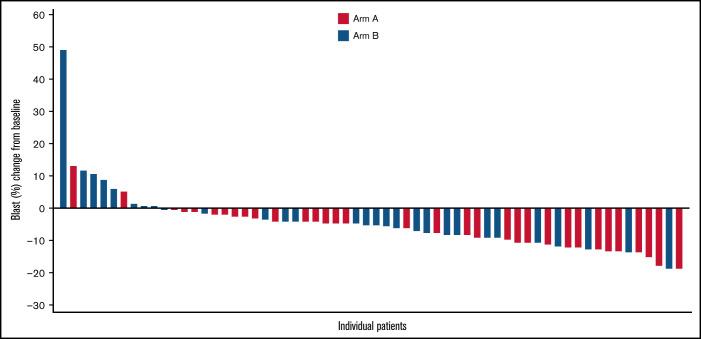
Azacitidine-mediated hypomethylation promotes tumor cell immune recognition but may increase the expression of inhibitory immune checkpoint molecules. We conducted the first randomized phase 2 study of azacitidine plus the immune checkpoint inhibitor durvalumab vs azacitidine monotherapy as first-line treatment for higher-risk myelodysplastic syndromes (HR-MDS). In all, 84 patients received 75 mg/m2 subcutaneous azacitidine (days 1-7 every 4 weeks) combined with 1500 mg intravenous durvalumab on day 1 every 4 weeks (Arm A) for at least 6 cycles or 75 mg/m² subcutaneous azacitidine alone (days 1-7 every 4 weeks) for at least 6 cycles (Arm B). After a median follow-up of 15.25 months, 8 patients in Arm A and 6 in Arm B remained on treatment. Patients in Arm A received a median of 7.9 treatment cycles and those in Arm B received a median of 7.0 treatment cycles with 73.7% and 65.9%, respectively, completing ≥4 cycles. The overall response rate (primary end point) was 61.9% in Arm A (26 of 42) and 47.6% in Arm B (20 of 42; P = .18), and median overall survival was 11.6 months (95% confidence interval, 9.5 months to not evaluable) vs 16.7 months (95% confidence interval, 9.8-23.5 months; P = .74). Durvalumab-related adverse events (AEs) were reported by 71.1% of patients; azacitidine-related AEs were reported by 82% (Arm A) and 81% (Arm B). Grade 3 or 4 hematologic AEs were reported in 89.5% (Arm A) vs 68.3% (Arm B) of patients. Patients with TP53 mutations tended to have a worse response than patients without these mutations. Azacitidine increased programmed cell death ligand 1 (PD-L1 [CD274]) surface expression on bone marrow granulocytes and monocytes, but not blasts, in both arms. In summary, combining azacitidine with durvalumab in patients with HR-MDS was feasible but with more toxicities and without significant improvement in clinical outcomes over azacitidine alone. This trial was registered at www.clinicaltrials.gov as #NCT02775903.
阿扎胞苷介导的低甲基化促进肿瘤细胞免疫识别,但可能增加抑制性免疫检查点分子的表达。我们进行了第一项随机 2 期研究,比较了阿扎胞苷联合免疫检查点抑制剂度伐利尤单抗与阿扎胞苷单药作为高危骨髓增生异常综合征(HR-MDS)的一线治疗。共有 84 例患者接受了 75mg/m2 皮下阿扎胞苷(每 4 周第 1-7 天)联合每 4 周第 1 天 1500mg 静脉注射度伐利尤单抗(A 组)至少 6 个周期,或单独接受 75mg/m2 皮下阿扎胞苷(每 4 周第 1-7 天)至少 6 个周期(B 组)。中位随访 15.25 个月后,A 组 8 例和 B 组 6 例患者仍在接受治疗。A 组患者接受中位 7.9 个治疗周期,B 组患者接受中位 7.0 个治疗周期,分别有 73.7%和 65.9%的患者完成了≥4 个周期。A 组(42 例中的 26 例)的总体缓解率(主要终点)为 61.9%,B 组为 47.6%(42 例中的 20 例;P=0.18),中位总生存期为 11.6 个月(95%置信区间,9.5 个月至不可评估)vs 16.7 个月(95%置信区间,9.8-23.5 个月;P=0.74)。71.1%的患者报告了与度伐利尤单抗相关的不良事件(AEs);82%(A 组)和 81%(B 组)的患者报告了与阿扎胞苷相关的 AEs。89.5%(A 组)vs 68.3%(B 组)的患者报告了 3 级或 4 级血液学 AEs。有 TP53 突变的患者的反应似乎比没有这些突变的患者差。阿扎胞苷增加了骨髓粒细胞和单核细胞表面程序性死亡配体 1(PD-L1[CD274])的表达,但对骨髓blasts 没有影响,在两组中均如此。总之,在 HR-MDS 患者中联合使用阿扎胞苷和度伐利尤单抗是可行的,但毒性更大,与单独使用阿扎胞苷相比,临床结局没有显著改善。该试验在 www.clinicaltrials.gov 上注册为 #NCT02775903。




 Zotero 插件