
与 COVID-19 大流行相关的恰尔港地区陆地和水生环境中的个人防护装备污染及其相关健康影响。
PPE pollution in the terrestrial and aquatic environment of the Chittagong city area associated with the COVID-19 pandemic and concomitant health implications.
机构信息
Faculty of Public Health, Thammasat University, Bangkok, 10200, Thailand.
Centre for Applied Physics and Radiation Technologies, School of Engineering and Technology, Sunway University, 47500, Bandar Sunway, Selangor, Malaysia.
出版信息
Environ Sci Pollut Res Int. 2022 Apr;29(18):27521-27533. doi: 10.1007/s11356-021-17859-8. Epub 2022 Jan 4.
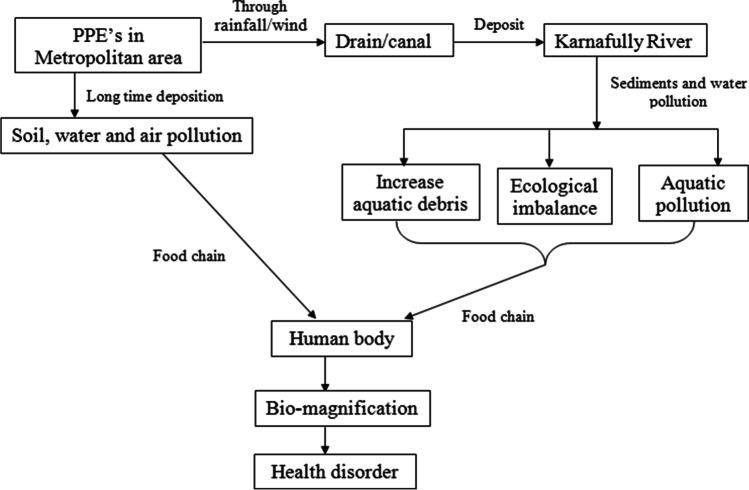
The present study focuses on the indiscriminate disposal of personal protective equipment (PPEs) and resulting environmental contamination during the 3rd wave of COVID-19-driven global pandemic in the Chittagong metropolitan area, Bangladesh. Because of the very high rate of infection by the delta variant of this virus, the use of PPEs by the public is increased significantly to protect the ingestion/inhalation of respiratory droplets in the air. However, it is a matter of solicitude that general people throw away the PPEs to the dwelling environment unconsciously. With the increase of inappropriate disposal of PPEs (i.e., mostly the disposable face masks made from plastic microfibers), the possibility of transmission of the virus to the general public cannot be neglected completely. This is because this virus can survive for several days on the inanimate matter like plastics and fibers. At the same time, the result of environmental contamination by microplastic/microfiber has been widespread which eventually creates the worst impact on ecosystems and organisms. The present results may help to increase public perception of the use and subsequent disposal of PPEs, especially the face masks.
本研究关注的是孟加拉国吉大港都会区在第三次 COVID-19 驱动的全球大流行期间,个人防护设备(PPE)的随意处置和由此导致的环境污染问题。由于这种病毒的 delta 变体感染率非常高,公众使用 PPE 的频率显著增加,以防止吸入空气中的呼吸飞沫。然而,令人担忧的是,人们会无意识地将 PPE 丢弃到居住环境中。随着 PPE (即大部分由塑料微纤维制成的一次性口罩)的不当处置增加,病毒传播给公众的可能性也不容忽视。这是因为这种病毒在塑料和纤维等无生命物质上可以存活数天。同时,微塑料/微纤维造成的环境污染后果也已经广泛存在,最终对生态系统和生物造成了最坏的影响。本研究结果可能有助于提高公众对 PPE (特别是口罩)使用和后续处置的认识。



 Zotero 插件