
慢性束缚应激降低下丘脑促黑素细胞激素神经元的兴奋性并增加食物摄入量。
Chronic Restraint Stress Decreases the Excitability of Hypothalamic POMC Neuron and Increases Food Intake.
作者信息
Ha Go Eun, Cheong Eunji
机构信息
Department of Biotechnology, College of Life Science and Biotechnology, Yonsei University, Seoul 03722, Korea.
出版信息
Exp Neurobiol. 2021 Dec 31;30(6):375-386. doi: 10.5607/en21037.
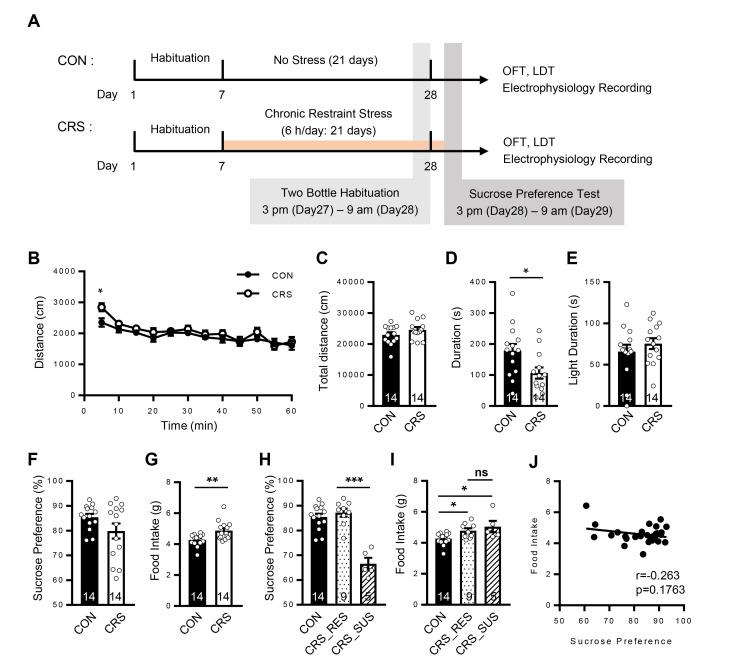
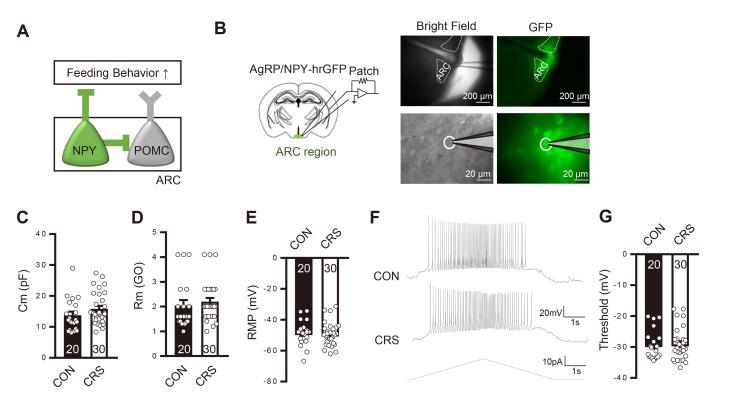
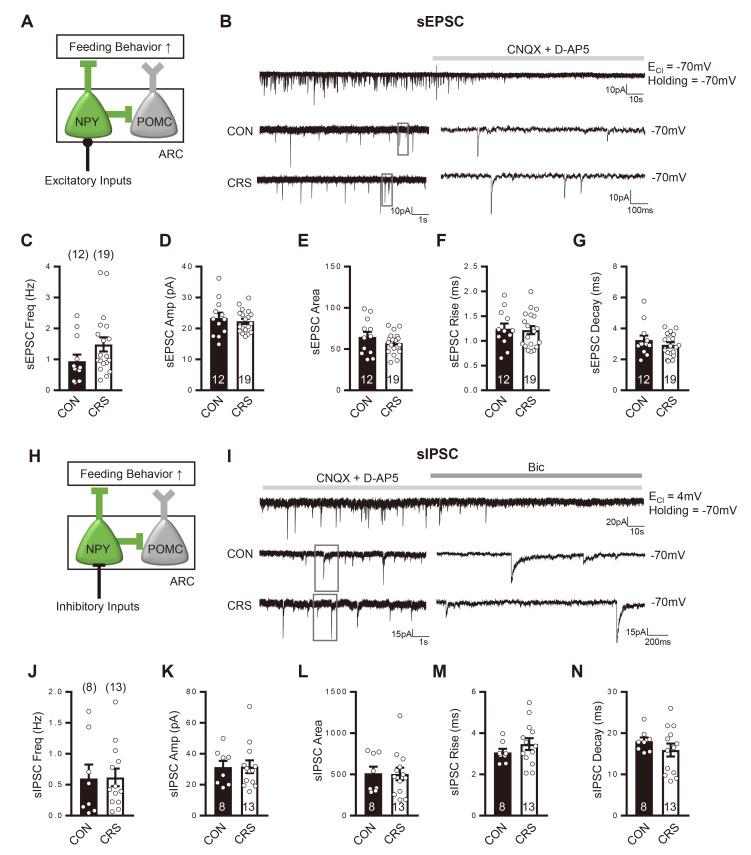
Stress activates the hypothalamic-pituitary-adrenal system, and induces the release of glucocorticoids, stress hormones, into circulation. Many studies have shown that stress affects feeding behavior, however, the underlying circuitry and molecular mechanisms are not fully understood. The balance between orexigenic (simulating appetite) and anorexigenic (loss of appetite) signals reciprocally modulate feeding behavior. It is suggested that proopiomelanocortin (POMC) and neuropeptide Y (NPY) neurons in the arcuate nucleus (ARC) of the hypothalamus are the first-order neurons that respond to the circulating signals of hunger and satiety. Here, we examined a chronic restraint stress model and observed an increase in food intake, which was not correlated with anhedonia. We investigated whether stress affects the properties of POMC and NPY neurons and found that chronic restraint stress reduced the excitatory inputs onto POMC neurons and increased the action potential threshold. Therefore, our study suggests that chronic stress modulates the intrinsic excitability and excitatory inputs in POMC neurons, leading to changes in feeding behavior.
应激会激活下丘脑-垂体-肾上腺系统,并促使糖皮质激素(应激激素)释放进入循环系统。许多研究表明,应激会影响进食行为,然而,其潜在的神经回路和分子机制尚未完全明确。促食欲信号和抑食欲信号之间的平衡相互调节进食行为。有研究表明,下丘脑弓状核(ARC)中的阿黑皮素原(POMC)神经元和神经肽Y(NPY)神经元是对饥饿和饱腹感循环信号作出反应的一级神经元。在此,我们研究了慢性束缚应激模型,并观察到食物摄入量增加,这与快感缺失无关。我们研究了应激是否会影响POMC和NPY神经元的特性,发现慢性束缚应激会减少POMC神经元上的兴奋性输入,并提高动作电位阈值。因此,我们的研究表明,慢性应激会调节POMC神经元的内在兴奋性和兴奋性输入,从而导致进食行为发生改变。


 Zotero 插件