
睡眠剥夺与中枢食欲调节。
Sleep Deprivation and Central Appetite Regulation.
机构信息
Department of Child and Adolescent Health, School of Public Health, China Medical University, Shenyang 110122, China.
Experimental Center for School of Public Health, China Medical University, Shenyang 110122, China.
出版信息
Nutrients. 2022 Dec 7;14(24):5196. doi: 10.3390/nu14245196.
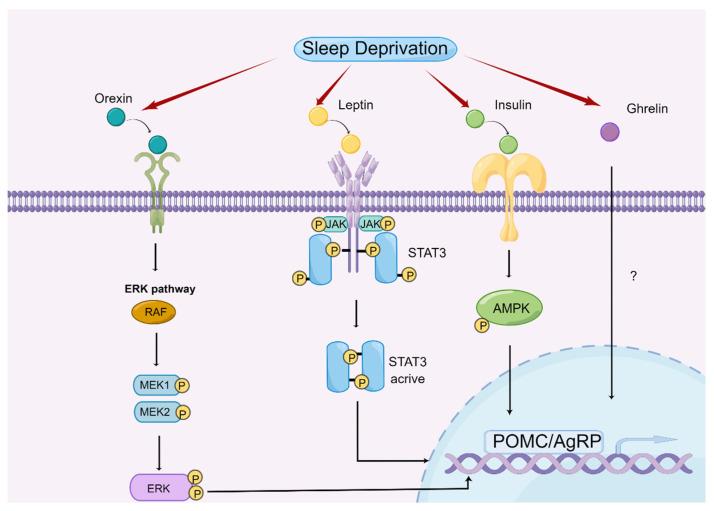
Research shows that reduced sleep duration is related to an increased risk of obesity. The relationship between sleep deprivation and obesity, type 2 diabetes, and other chronic diseases may be related to the imbalance of appetite regulation. To comprehensively illustrate the specific relationship between sleep deprivation and appetite regulation, this review introduces the pathophysiology of sleep deprivation, the research cutting edge of animal models, and the central regulatory mechanism of appetite under sleep deprivation. This paper summarizes the changes in appetite-related hormones orexin, ghrelin, leptin, and insulin secretion caused by long-term sleep deprivation based on the epidemiology data and animal studies that have established sleep deprivation models. Moreover, this review analyzes the potential mechanism of associations between appetite regulation and sleep deprivation, providing more clues on further studies and new strategies to access obesity and metabolic disease.
研究表明,睡眠时间减少与肥胖风险增加有关。睡眠不足与肥胖、2 型糖尿病和其他慢性疾病之间的关系可能与食欲调节失衡有关。为了全面阐述睡眠不足与食欲调节之间的具体关系,本综述介绍了睡眠不足的病理生理学、动物模型的研究前沿以及睡眠不足下食欲的中枢调节机制。本文基于建立了睡眠剥夺模型的流行病学数据和动物研究,总结了长期睡眠剥夺引起的食欲相关激素食欲素、胃饥饿素、瘦素和胰岛素分泌的变化。此外,本综述分析了食欲调节与睡眠不足之间关联的潜在机制,为进一步研究和开发肥胖和代谢性疾病的新策略提供了更多线索。

 Zotero 插件