
临床实践中 SARS-CoV-2 抗体的血清学检测:一项比较诊断准确性研究。
Serological testing for SARS-CoV-2 antibodies in clinical practice: A comparative diagnostic accuracy study.
机构信息
University Institute of Clinical Chemistry, Inselspital University Hospital, Bern, Switzerland.
Department of Rheumatology, Immunology, and Allergology, Inselspital University Hospital, Bern, Switzerland.
出版信息
Allergy. 2022 Jul;77(7):2090-2103. doi: 10.1111/all.15206. Epub 2022 Jan 11.
BACKGROUND
Serological tests are a powerful tool in the monitoring of infectious diseases and the detection of host immunity. However, manufacturers often provide diagnostic accuracy data generated through biased studies, and the performance in clinical practice is essentially unclear.
OBJECTIVES
We aimed to determine the diagnostic accuracy of various serological testing strategies for (a) identification of patients with previous coronavirus disease-2019 (COVID-19) and (b) prediction of neutralizing antibodies against SARS-CoV-2 in real-life clinical settings.
METHODS
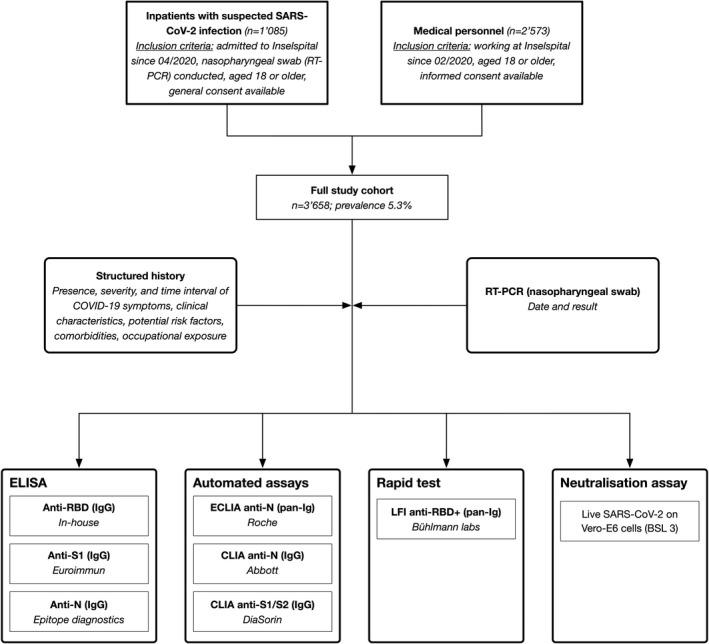
We prospectively included 2573 consecutive health-care workers and 1085 inpatients with suspected or possible previous COVID-19 at a Swiss University Hospital. Various serological immunoassays based on different analytical techniques (enzyme-linked immunosorbent assays, ELISA; chemiluminescence immunoassay, CLIA; electrochemiluminescence immunoassay, ECLIA; and lateral flow immunoassay, LFI), epitopes of SARS-CoV-2 (nucleocapsid, N; receptor-binding domain, RBD; extended RBD, RBD+; S1 or S2 domain of the spike [S] protein, S1/S2), and antibody subtypes (IgG, pan-Ig) were conducted. A positive real-time PCR test from a nasopharyngeal swab was defined as previous COVID-19. Neutralization assays with live SARS-CoV-2 were performed in a subgroup of patients to assess neutralization activity (n = 201).
RESULTS
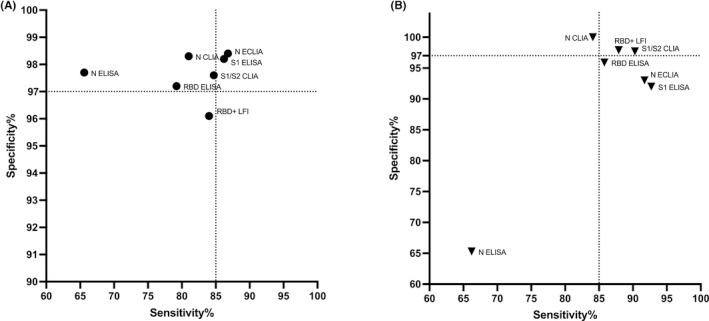
The sensitivity to detect patients with previous COVID-19 was ≥85% in anti-N ECLIA (86.8%) and anti-S1 ELISA (86.2%). Sensitivity was 84.7% in anti-S1/S2 CLIA, 84.0% in anti-RBD+LFI, 81.0% in anti-N CLIA, 79.2% in anti-RBD ELISA, and 65.6% in anti-N ELISA. The specificity was 98.4% in anti-N ECLIA, 98.3% in anti-N CLIA, 98.2% in anti-S1 ELISA, 97.7% in anti-N ELISA, 97.6% in anti-S1/S2 CLIA, 97.2% in anti-RBD ELISA, and 96.1% in anti-RBD+LFI. The sensitivity to detect neutralizing antibodies was ≥85% in anti-S1 ELISA (92.7%), anti-N ECLIA (91.7%), anti-S1/S2 CLIA (90.3%), anti-RBD+LFI (87.9%), and anti-RBD ELISA (85.8%). Sensitivity was 84.1% in anti-N CLIA and 66.2% in anti-N ELISA. The specificity was ≥97% in anti-N CLIA (100%), anti-S1/S2 CLIA (97.7%), and anti-RBD+LFI (97.9%). Specificity was 95.9% in anti-RBD ELISA, 93.0% in anti-N ECLIA, 92% in anti-S1 ELISA, and 65.3% in anti-N ELISA. Diagnostic accuracy measures were consistent among subgroups.
CONCLUSIONS
The diagnostic accuracy of serological tests for SARS-CoV-2 antibodies varied remarkably in clinical practice, and the sensitivity to identify patients with previous COVID-19 deviated substantially from the manufacturer's specifications. The data presented here should be considered when using such tests to estimate the infection burden within a specific population and determine the likelihood of protection against re-infection.
背景
血清学检测是监测传染病和宿主免疫的有力工具。然而,制造商通常提供通过有偏差的研究产生的诊断准确性数据,而临床实践中的性能基本上是不清楚的。
目的
我们旨在确定各种血清学检测策略在(a)识别以前患有冠状病毒病-2019(COVID-19)的患者和(b)预测针对 SARS-CoV-2 的中和抗体方面的诊断准确性,用于真实临床环境。
方法
我们前瞻性地纳入了瑞士大学医院的 2573 名连续的医护人员和 1085 名疑似或可能以前患有 COVID-19 的住院患者。基于不同分析技术(酶联免疫吸附测定,ELISA;化学发光免疫测定,CLIA;电化学发光免疫测定,ECLIA;和侧向流动免疫测定,LFI),使用针对 SARS-CoV-2 的不同血清学免疫测定(核衣壳,N;受体结合域,RBD;扩展 RBD,RBD+;S 蛋白的 S1 或 S2 结构域,S1/S2)和抗体亚型(IgG,pan-Ig)进行检测。鼻咽拭子的实时 PCR 检测阳性定义为以前患有 COVID-19。在患者亚组中进行活 SARS-CoV-2 的中和测定,以评估中和活性(n=201)。
结果
抗-N ECLIA(86.8%)和抗-S1 ELISA(86.2%)检测以前患有 COVID-19 的患者的敏感性≥85%。抗-S1/S2 CLIA 的敏感性为 84.7%,抗-RBD+LFI 为 84.0%,抗-N CLIA 为 81.0%,抗-RBD ELISA 为 81.0%,抗-N ELISA 为 79.2%。特异性为抗-N ECLIA 为 98.4%,抗-N CLIA 为 98.3%,抗-S1 ELISA 为 98.2%,抗-N ELISA 为 97.7%,抗-S1/S2 CLIA 为 97.7%,抗-RBD ELISA 为 97.2%,抗-RBD+LFI 为 96.1%。抗-S1 ELISA(92.7%)、抗-N ECLIA(91.7%)、抗-S1/S2 CLIA(90.3%)、抗-RBD+LFI(87.9%)和抗-RBD ELISA(85.8%)检测中和抗体的敏感性≥85%。抗-N CLIA 为 84.1%,抗-N ELISA 为 66.2%。特异性≥97%的有抗-N CLIA(100%)、抗-S1/S2 CLIA(97.7%)和抗-RBD+LFI(97.9%)。抗-RBD ELISA 的特异性为 95.9%,抗-RBD ELISA 的特异性为 93.0%,抗-S1 ELISA 的特异性为 92%,抗-N ELISA 的特异性为 65.3%。在亚组中,诊断准确性测量结果一致。
结论
血清学检测 SARS-CoV-2 抗体的诊断准确性在临床实践中差异显著,并且识别以前患有 COVID-19 的患者的敏感性与制造商的规格有很大差异。在使用这些检测来估计特定人群中的感染负担并确定对再感染的保护可能性时,应考虑此处提供的数据。


 Zotero 插件