
从医疗服务提供者角度看卢旺达术后疼痛管理的障碍与促进因素:计划行为理论的情境化分析
Barriers and facilitators to postoperative pain management in Rwanda from the perspective of health care providers: A contextualization of the theory of planned behavior.
作者信息
Nyirigira Gaston, Wilson Rosemary A, VanDenKerkhof Elizabeth G, Goldstein David H, Twagirumugabe Theogene, Mahaffey Ryan, Parlow Joel, Johnson Ana P
机构信息
Anaesthesia, Critical Care and Pain, Butare University Teaching Hospital, Butare, Rwanda.
School of Nursing, Queen's University, Kingston, Ontario, Canada.
出版信息
Can J Pain. 2018 Apr 12;2(1):87-102. doi: 10.1080/24740527.2018.1451251. eCollection 2018.
AIMS
Identify opportunities to improve knowledge translation for post-operative pain management in Rwanda by exploring clinician and environmental factors affecting this practice.
METHODS
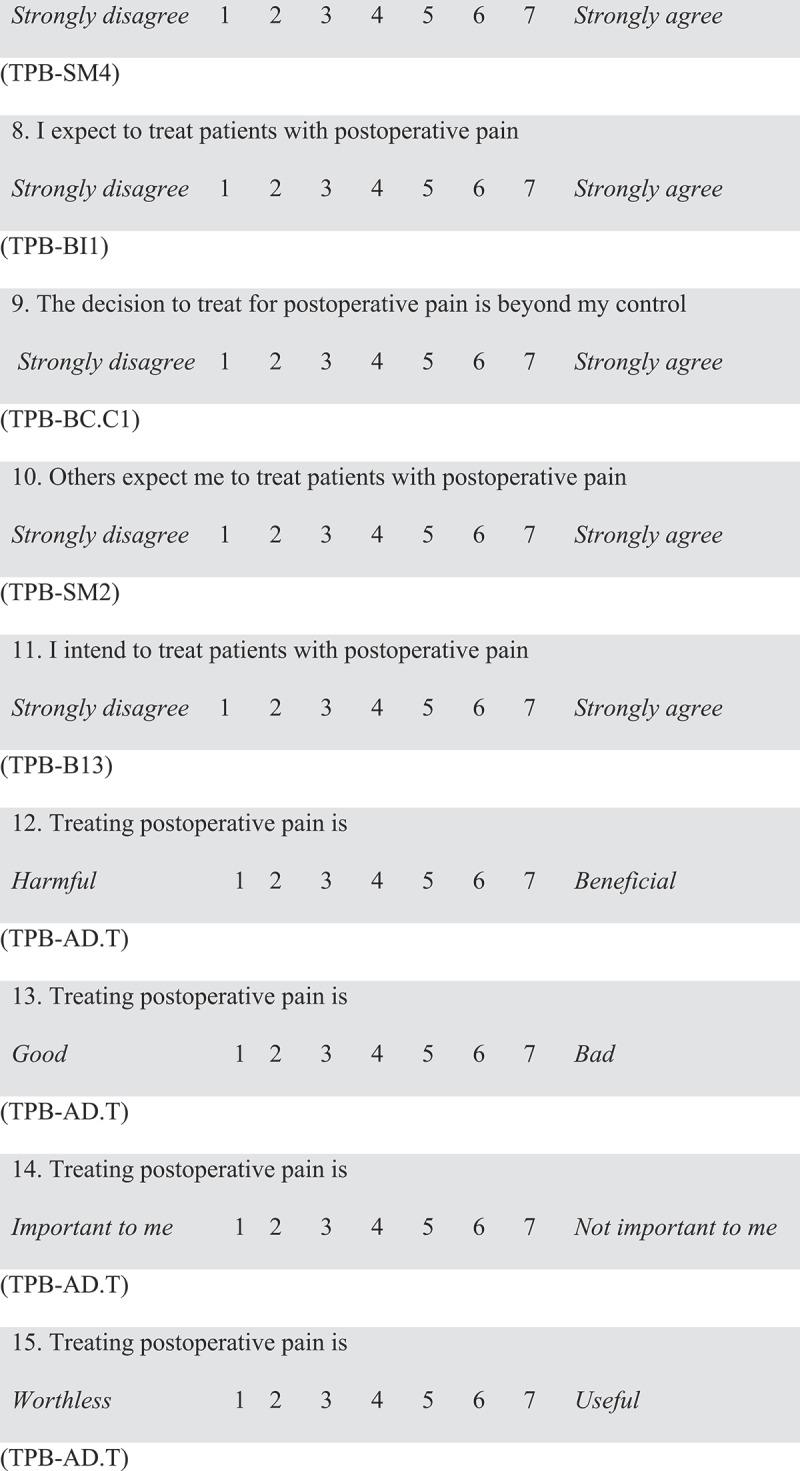
The theory of planned behavior (TPB) guided development of a questionnaire to measure intent to assess and treat postoperative pain. Focus groups and individual interviews were used to contextualize the final questionnaire and generate questions related to pain management practice. Health care providers from two Rwandan teaching hospitals involved in postoperative pain management completed the TPB questionnaire in May 2015. TPB subscale scores were analyzed to identify demographic and practice characteristics associated with intention to treat pain. The general linear model was used to test effect of attitudes, subjective norms, and perceived control on behavioral intent to treat pain.
RESULTS
Forty-six percent of participants ( = 131) had training in acute pain management, 56% used a pain protocol, and 74% used pain scales. Tramadol (78%), morphine (79%), and paracetamol (75%) were used most often to treat pain. Drug availability was the most frequently reported barrier to treating pain. Though intention to treat pain was high, only attitudes and perceived control about assessing pain were associated with intention to treat pain. The theme of fear of the adverse effects of pain medications was consistent across focus groups and interviews in both sites.
CONCLUSIONS
System and knowledge barriers exist: interventions to address these barriers may lead to improved postoperative pain care. Further validation of the TPB questionnaire is required to address cultural and language factors specific to the Rwandan context.
目的
通过探索影响卢旺达术后疼痛管理实践的临床医生和环境因素,确定改善知识转化的机会。
方法
计划行为理论(TPB)指导了一份问卷的开发,以测量评估和治疗术后疼痛的意图。焦点小组和个人访谈用于将最终问卷置于具体情境中,并生成与疼痛管理实践相关的问题。卢旺达两家参与术后疼痛管理的教学医院的医护人员于2015年5月完成了TPB问卷。分析TPB分量表得分,以确定与治疗疼痛意图相关的人口统计学和实践特征。使用一般线性模型测试态度、主观规范和感知控制对治疗疼痛行为意图的影响。
结果
46%的参与者(n = 131)接受过急性疼痛管理培训,56%使用疼痛治疗方案,74%使用疼痛量表。曲马多(78%)、吗啡(79%)和对乙酰氨基酚(75%)是最常用于治疗疼痛的药物。药物供应是治疗疼痛最常报告的障碍。尽管治疗疼痛的意图很高,但只有对评估疼痛的态度和感知控制与治疗疼痛的意图相关。在两个地点的焦点小组和访谈中,对止痛药不良反应的恐惧这一主题是一致的。
结论
存在系统和知识障碍:解决这些障碍的干预措施可能会改善术后疼痛护理。需要对TPB问卷进行进一步验证,以解决卢旺达背景下特有的文化和语言因素。




 Zotero 插件