
住院的 2019 冠状病毒病(COVID-19)患者 C 反应蛋白与白蛋白比值的临床和预后意义:来自一家三级中心的 2309 例患者数据及在独立队列中的验证。
Clinical and prognostic significance of C-reactive protein to albumin ratio in hospitalized coronavirus disease 2019 (COVID-19) patients : Data on 2309 patients from a tertiary center and validation in an independent cohort.
机构信息
Hematology Department, University Hospital Dubrava, Av. Gojka Suska 6, 10000, Zagreb, Croatia.
Primary respiratory and intensive care center, University Hospital Dubrava, Zagreb, Croatia.
出版信息
Wien Klin Wochenschr. 2022 May;134(9-10):377-384. doi: 10.1007/s00508-021-01999-5. Epub 2022 Jan 17.
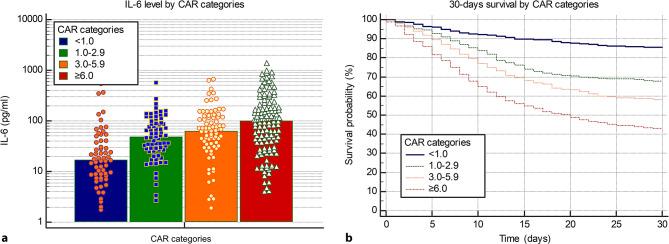
C‑reactive protein (CRP) and albumin are inflammation sensitive parameters that are regulated by interleukin‑6 inflammatory pathways. The CRP to albumin ratio (CAR) integrates these two into a potent clinical parameter whose clinical and prognostic association in the context of coronavirus disease 2019 (COVID-19) have not been well defined. We aimed to investigate the clinical and prognostic significance of CAR in the context of COVID-19 infection.We retrospectively analyzed 2309 consecutive COVID-19 patients hospitalized at a tertiary level hospital in the period from March 2020 to March 2021 who had baseline data for a CAR assessment. Findings were validated in an independent cohort of 1155 patients hospitalized from March 2021 to June 2021.The majority of patients (85.8%) had severe or critical COVID-19 on admission. Median CRP, albumin and CAR levels were 91 mg/L, 32 g/L and 2.92, respectively. Higher CAR was associated with a tendency for respiratory deterioration during hospitalization, increased requirement of high-flow oxygen treatment and mechanical ventilation, higher occurrence of bacteriemia, higher occurrence of deep venous thrombosis, lower occurrence of myocardial infarction, higher 30-day mortality and higher postdischarge mortality rates. We defined and validated four CAR prognostic categories (< 1.0, 1.0-2.9, 3.0-5.9 and ≥ 6.0) with distinct 30-day survival. In the series of multivariate Cox regression models we could demonstrate robust prognostic properties of CAR that was associated with inferior 30-day survival independently of COVID-19 severity, age and comorbidities and additionally independently of COVID-19 severity, CURB-65 and VACO index in both development and validation cohorts.The CAR seems to have a good potential to improve prognostication of hospitalized COVID-19 patients.
C-反应蛋白(CRP)和白蛋白是受白细胞介素-6 炎症途径调节的炎症敏感参数。CRP 与白蛋白比值(CAR)将这两个参数整合为一个强大的临床参数,其在 2019 年冠状病毒病(COVID-19)背景下的临床和预后相关性尚未得到很好的定义。我们旨在研究 CAR 在 COVID-19 感染背景下的临床和预后意义。
我们回顾性分析了 2020 年 3 月至 2021 年 3 月期间在一家三级医院住院的 2309 例连续 COVID-19 患者的基线数据,这些患者有 CAR 评估的基线数据。研究结果在 2021 年 3 月至 6 月期间住院的 1155 例患者的独立队列中得到验证。
大多数患者(85.8%)入院时患有严重或危重症 COVID-19。中位 CRP、白蛋白和 CAR 水平分别为 91mg/L、32g/L 和 2.92。较高的 CAR 与住院期间呼吸恶化的趋势、需要高流量氧气治疗和机械通气的风险增加、菌血症发生率增加、深静脉血栓形成发生率降低、心肌梗死发生率降低、30 天死亡率增加和出院后死亡率增加相关。我们定义并验证了四个具有不同 30 天生存率的 CAR 预后类别(<1.0、1.0-2.9、3.0-5.9 和≥6.0)。在多变量 Cox 回归模型系列中,我们能够证明 CAR 具有稳健的预后特性,与 COVID-19 严重程度、年龄和合并症无关,并且在发展和验证队列中还与 COVID-19 严重程度、CURB-65 和 VACO 指数独立相关。
CAR 似乎具有改善住院 COVID-19 患者预后的良好潜力。
 Zotero 插件