
在FLT3-ITD急性髓系白血病中,自噬靶向与血液动员通过诱导定向白血病细胞凋亡降低再增殖能力和复发率。
Autophagy Targeting and Hematological Mobilization in FLT3-ITD Acute Myeloid Leukemia Decrease Repopulating Capacity and Relapse by Inducing Apoptosis of Committed Leukemic Cells.
作者信息
Dupont Marine, Huart Mathilde, Lauvinerie Claire, Bidet Audrey, Guitart Amélie Valérie, Villacreces Arnaud, Vigon Isabelle, Desplat Vanessa, El Habhab Ali, Pigneux Arnaud, Ivanovic Zoran, Brunet De la Grange Philippe, Dumas Pierre-Yves, Pasquet Jean-Max
机构信息
Cellules Souches Hématopoïétiques Normales et Leucémiques, INSERM U1312 BRIC, Université de Bordeaux, Bat TP 4e étage, 146 rue Léo Saignat, 33076 Bordeaux, France.
Service d'Hématologie Biologique, CHU Bordeaux, 33000 Bordeaux, France.
出版信息
Cancers (Basel). 2022 Jan 17;14(2):453. doi: 10.3390/cancers14020453.
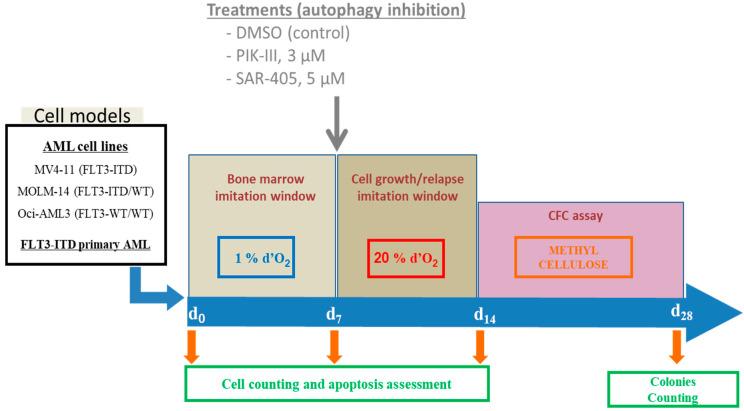
Targeting FLT3-ITD in AML using TKI against FLT3 cannot prevent relapse even in the presence of complete remission, suggesting the resistance and/or the persistence of leukemic-initiating cells in the hematopoietic niche. By mimicking the hematopoietic niche condition with cultures at low oxygen concentrations, we demonstrate in vitro that FLT3-ITD AML cells decrease their repopulating capacity when Vps34 is inhibited. Ex vivo, AML FLT3-ITD blasts treated with Vps34 inhibitors recovered proliferation more slowly due to an increase an apoptosis. In vivo, mice engrafted with FLT3-ITD AML MV4-11 cells have the invasion of the bone marrow and blood in 2 weeks. After 4 weeks of FLT3 TKI treatment with gilteritinib, the leukemic burden had strongly decreased and deep remission was observed. When treatment was discontinued, mice relapsed rapidly. In contrast, Vps34 inhibition strongly decreased the relapse rate, and even more so in association with mobilization by G-CSF and AMD3100. These results demonstrate that remission offers the therapeutic window for a regimen using Vps34 inhibition combined with mobilization to target persistent leukemic stem cells and thus decrease the relapse rate.
使用针对FLT3的酪氨酸激酶抑制剂(TKI)靶向急性髓系白血病(AML)中的FLT3-ITD,即使在完全缓解的情况下也无法预防复发,这表明白血病起始细胞在造血微环境中具有抗性和/或持久性。通过在低氧浓度下培养来模拟造血微环境条件,我们在体外证明,当Vps34被抑制时,FLT3-ITD AML细胞的再增殖能力会降低。在体外,用Vps34抑制剂处理的AML FLT3-ITD原始细胞由于凋亡增加,其增殖恢复更慢。在体内,移植了FLT3-ITD AML MV4-11细胞的小鼠在2周内出现骨髓和血液浸润。在用吉列替尼进行4周的FLT3 TKI治疗后,白血病负担显著降低,并观察到深度缓解。当治疗停止时,小鼠迅速复发。相比之下,Vps34抑制显著降低了复发率,与G-CSF和AMD3100动员联合使用时效果更明显。这些结果表明,缓解为使用Vps34抑制联合动员以靶向持续存在的白血病干细胞从而降低复发率的治疗方案提供了治疗窗口。



 Zotero 插件