
基于最小临床重要差异值,中等剂量的他尼珠单抗可能是治疗髋或膝骨关节炎的更好选择:一项随机对照试验的荟萃分析。
Based on minimal clinically important difference values, a moderate dose of tanezumab may be a better option for treating hip or knee osteoarthritis: a meta-analysis of randomized controlled trials.
作者信息
Zhao Di, Luo Ming-Hui, Pan Jian-Ke, Zeng Ling-Feng, Liang Gui-Hong, Han Yan-Hong, Liu Jun, Yang Wei-Yi
机构信息
The Second Clinical School of Guangzhou University of Chinese Medicine, Guangzhou, China.
Bone and Joint Research Team of Degeneration and Injury, Guangdong Provincial Academy of Chinese Medical Sciences, Guangzhou, China.
出版信息
Ther Adv Musculoskelet Dis. 2022 Jan 19;14:1759720X211067639. doi: 10.1177/1759720X211067639. eCollection 2022.
BACKGROUND
Tanezumab is a nerve growth factor monoclonal antibody that may regulate pain in hip or knee osteoarthritis (OA). This meta-analysis was performed to evaluate the efficacy and safety of low and moderate doses of tanezumab in treating hip or knee OA.
METHODS
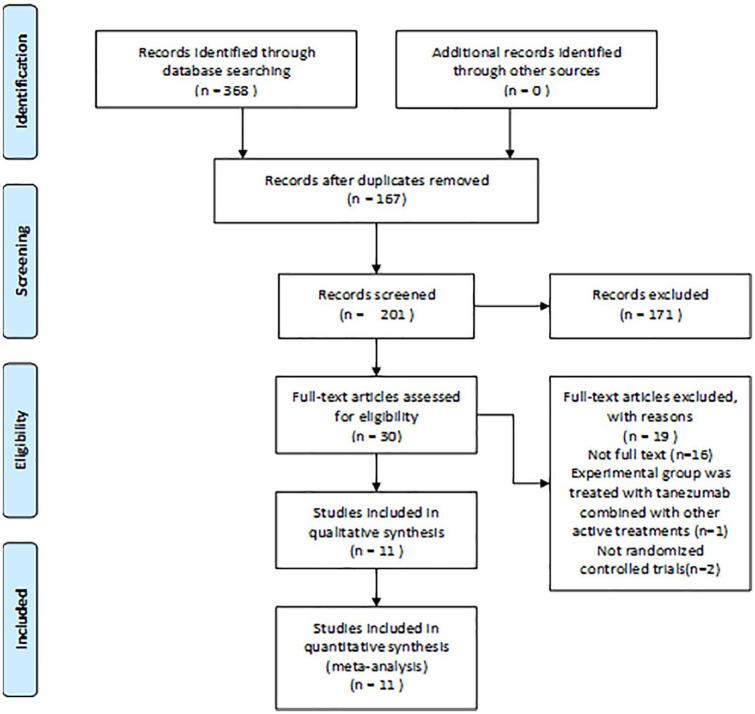
PubMed, EMBASE, the Cochrane Library, and Web of Science were comprehensively searched for clinical trials published before 1 May 2021. Patients were assessed efficacy and safety outcomes.
RESULTS
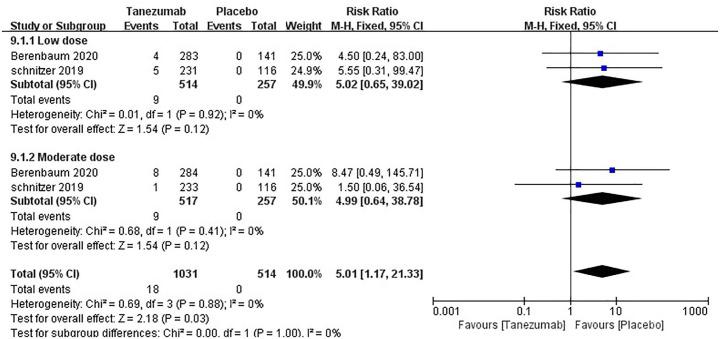
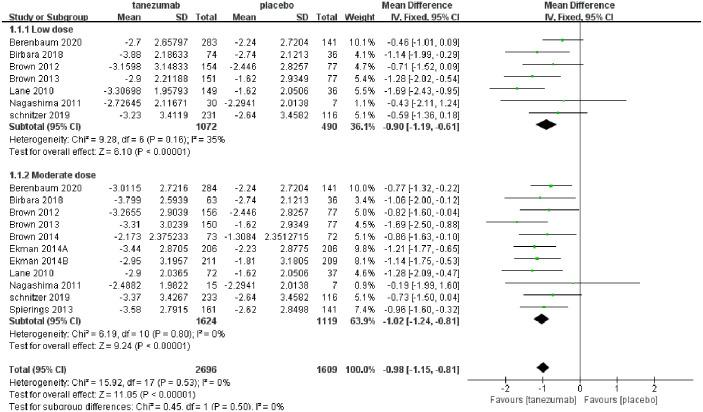
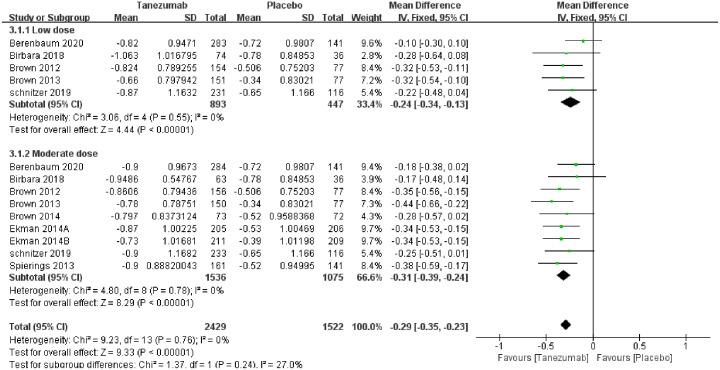
Twelve randomized controlled trials including 6022 patients were identified. Both low and moderate doses of tanezumab significantly improved efficacy outcomes. However, only the point estimates (mean difference, MD) of moderate-dose tanezumab significantly exceeded the minimal clinically important differences (MCIDs). There were no significant differences in the incidence of treatment-related adverse events (AEs), withdrawals due to AEs, serious AEs, and total joint replacement between the tanezumab and placebo groups, whereas the incidence of AEs was higher in the tanezumab group (relative risk, RR = 1.10; 95% confidence interval, 95% CI = 1.04-1.17). The incidence of rapidly progressive OA was significantly higher in the combined low- and moderate-dose tanezumab groups than in the placebo group (RR = 5.01; 95% CI = 1.17-21.33). Furthermore, both low and moderate doses of tanezumab significantly increased the incidence of abnormal peripheral sensation (RR = 1.99, 95% CI = 1.21-3.28; RR = 2.64, 95% CI = 1.91-3.67, respectively). Compared with nonsteroidal anti-inflammatory drugs (NSAIDs) and opioids, tanezumab showed significantly improved efficacy outcomes ( < 0.05). However, the point estimates (MD) of tanezumab were not greater than the MCID. Pooled analysis showed no significant differences between tanezumab and NSAIDs and opioids in safety outcomes ( > 0.05).
CONCLUSION
Tanezumab is efficacious in patients with hip or knee OA. Tanezumab is relatively well tolerated and safe but increases the incidence of AEs and reversible abnormal peripheral sensation. Additional studies on the occurrence of rapidly progressive OA are needed. A moderate dose of tanezumab may maximize the benefits for hip or knee OA.
背景
他奈珠单抗是一种神经生长因子单克隆抗体,可能调节髋或膝骨关节炎(OA)的疼痛。本荟萃分析旨在评估低剂量和中等剂量他奈珠单抗治疗髋或膝OA的疗效和安全性。
方法
全面检索了PubMed、EMBASE、Cochrane图书馆和Web of Science,以查找2021年5月1日前发表的临床试验。对患者的疗效和安全性结果进行评估。
结果
共纳入12项随机对照试验,包括6022例患者。低剂量和中等剂量的他奈珠单抗均显著改善了疗效结果。然而,只有中等剂量他奈珠单抗的点估计值(平均差,MD)显著超过最小临床重要差异(MCID)。他奈珠单抗组和安慰剂组在治疗相关不良事件(AE)的发生率、因AE停药、严重AE和全关节置换方面无显著差异,而他奈珠单抗组AE的发生率更高(相对风险,RR = 1.10;95%置信区间,95%CI = 1.04 - 1.17)。低剂量和中等剂量他奈珠单抗联合组快速进展性OA的发生率显著高于安慰剂组(RR = 5.01;95%CI = 1.17 - 21.33)。此外,低剂量和中等剂量的他奈珠单抗均显著增加了外周感觉异常的发生率(RR分别为1.99,95%CI = 1.21 - 3.28;RR = 2.64,95%CI = 1.91 - 3.67)。与非甾体抗炎药(NSAIDs)和阿片类药物相比,他奈珠单抗的疗效结果显著改善(P < 0.05)。然而,他奈珠单抗的点估计值(MD)不大于MCID。汇总分析显示,他奈珠单抗与NSAIDs和阿片类药物在安全性结果方面无显著差异(P > 0.05)。
结论
他奈珠单抗对髋或膝OA患者有效。他奈珠单抗耐受性相对良好且安全,但会增加AE和可逆性外周感觉异常的发生率。需要对快速进展性OA的发生进行更多研究。中等剂量的他奈珠单抗可能使髋或膝OA的获益最大化。

 Zotero 插件