
黑色素瘤免疫检查点抑制剂治疗反应或耐药的新型分子决定因素。
Novel Molecular Determinants of Response or Resistance to Immune Checkpoint Inhibitor Therapies in Melanoma.
机构信息
Department of Health Statistics, Key Laboratory of Medicine and Health in Shandong Province, School of Public Health, Weifang Medical University, Weifang, China.
Tianjin Cancer Institute, National Clinical Research Center for Cancer, Key Laboratory of Cancer Prevention and Therapy of Tianjin, Tianjin Medical University Cancer Institute and Hospital, Tianjin, China.
出版信息
Front Immunol. 2022 Jan 11;12:798474. doi: 10.3389/fimmu.2021.798474. eCollection 2021.
BACKGROUND
Immune checkpoint inhibitor (ICI) therapy dramatically prolongs melanoma survival. Currently, the identified ICI markers are sometimes ineffective. The objective of this study was to identify novel determinants of ICI efficacy.
METHODS
We comprehensively curated pretreatment somatic mutational profiles and clinical information from 631 melanoma patients who received blockade therapy of immune checkpoints (i.e., CTLA-4, PD-1/PD-L1, or a combination). Significantly mutated genes (SMGs), mutational signatures, and potential molecular subtypes were determined. Their association with ICI responses was assessed simultaneously.
RESULTS
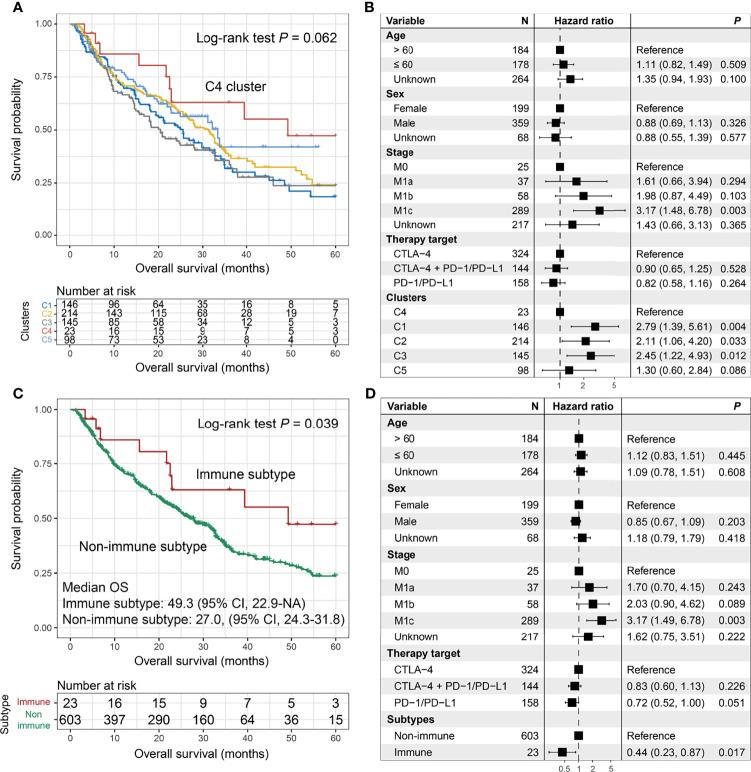
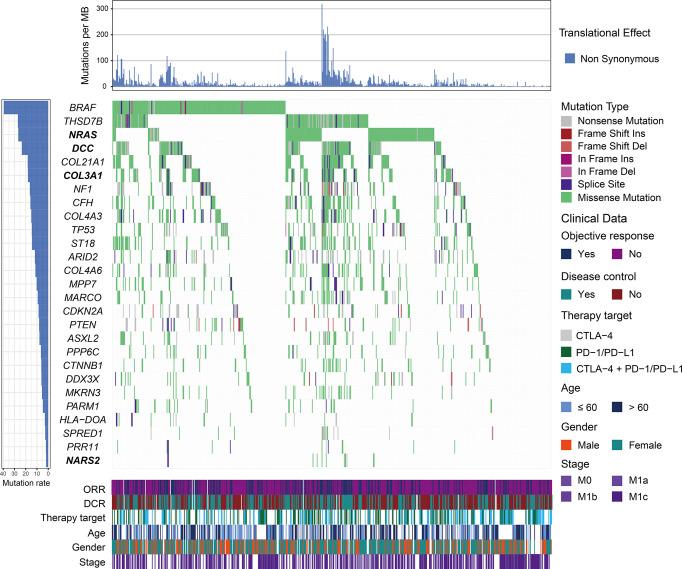
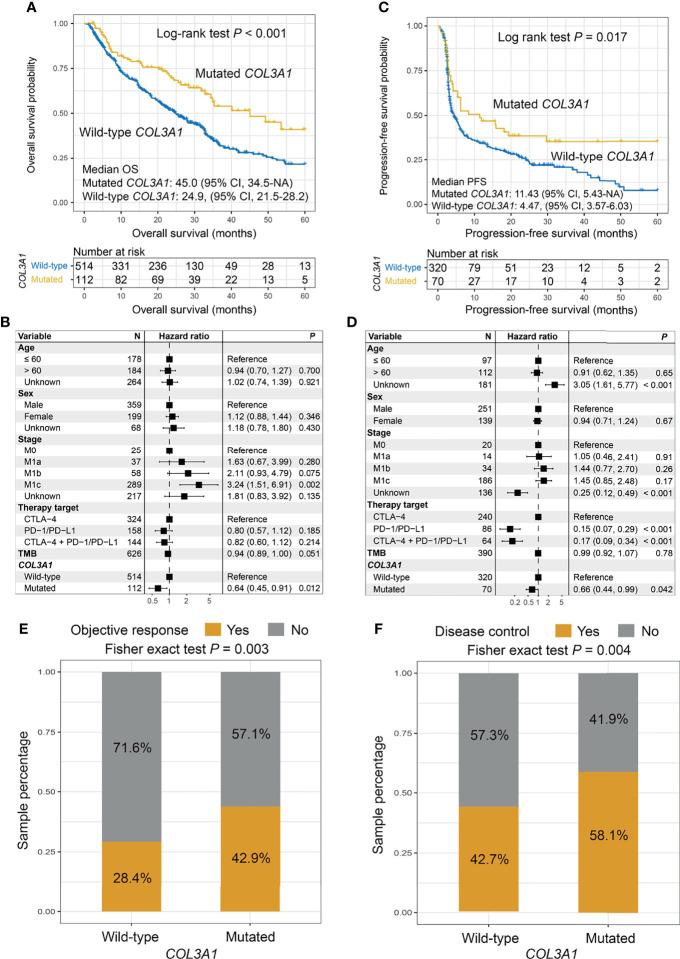
We identified 27 SMGs, including four novel SMGs (, , , and ) that are associated with ICI efficacy and well-known driver genes. mutations were associated with improved ICI overall survival (hazard ratio (HR): 0.64, 95% CI: 0.45-0.91, = 0.012), whereas immune resistance was observed in patients with mutations (HR: 1.42, 95% CI: 1.10-1.82, = 0.006). The presence of the tobacco smoking-related signature was significantly correlated with inferior prognoses (HR: 1.42, 95% CI: 1.11-1.82, = 0.005). In addition, the signature resembling that of alkylating agents and a newly discovered signature both exhibited extended prognoses (both HR < 1, < 0.05). Based on the activities of the extracted 6 mutational signatures, we identified one immune subtype that was significantly associated with better ICI outcomes (HR: 0.44, 95% CI: 0.23-0.87, = 0.017).
CONCLUSION
We uncovered several novel SMGs and re-annotated mutational signatures that are linked to immunotherapy response or resistance. In addition, an immune subtype was found to exhibit favorable prognoses. Further studies are required to validate these findings.
背景
免疫检查点抑制剂(ICI)治疗显著延长了黑色素瘤患者的生存期。目前,已确定的 ICI 标志物有时并不有效。本研究的目的是确定新的 ICI 疗效决定因素。
方法
我们全面整理了 631 名接受免疫检查点(即 CTLA-4、PD-1/PD-L1 或联合)阻断治疗的黑色素瘤患者的预处理体细胞突变谱和临床信息。确定了显著突变基因(SMGs)、突变特征和潜在的分子亚型。同时评估了它们与 ICI 反应的相关性。
结果
我们确定了 27 个 SMGs,其中包括四个与 ICI 疗效和已知驱动基因相关的新 SMGs(、、、)。突变与改善 ICI 总生存相关(风险比(HR):0.64,95%置信区间(CI):0.45-0.91,=0.012),而在携带突变的患者中观察到免疫抵抗(HR:1.42,95%CI:1.10-1.82,=0.006)。烟草相关签名的存在与较差的预后显著相关(HR:1.42,95%CI:1.11-1.82,=0.005)。此外,类似于烷化剂的特征和新发现的特征均表现出延长的预后(两者 HR<1,<0.05)。基于提取的 6 个突变特征的活性,我们确定了一个与更好的 ICI 结果显著相关的免疫亚型(HR:0.44,95%CI:0.23-0.87,=0.017)。
结论
我们发现了一些新的 SMGs 和重新注释的与免疫治疗反应或抵抗相关的突变特征。此外,还发现了一种免疫亚型具有良好的预后。需要进一步的研究来验证这些发现。


 Zotero 插件