
骨关节炎中重度成人患者使用替扎尼定对健康状况、非工作活动和工作生产力的影响。
Impact of tanezumab on health status, non-work activities and work productivity in adults with moderate-to-severe osteoarthritis.
机构信息
Leeds Institute of Rheumatic and Musculoskeletal Medicine, University of Leeds and NIHR Leeds Biomedical Research Centre, Leeds, UK.
Leeds Institute of Rheumatic and Musculoskeletal Medicine, Chapel Allerton Hospital, Leeds, LS7 4SA, UK.
出版信息
BMC Musculoskelet Disord. 2022 Feb 1;23(1):106. doi: 10.1186/s12891-022-05029-x.
BACKGROUND
To evaluate the impact of tanezumab on health status, non-work activities, and work productivity in a pooled analysis of two large phase 3 osteoarthritis (OA) studies.
METHODS
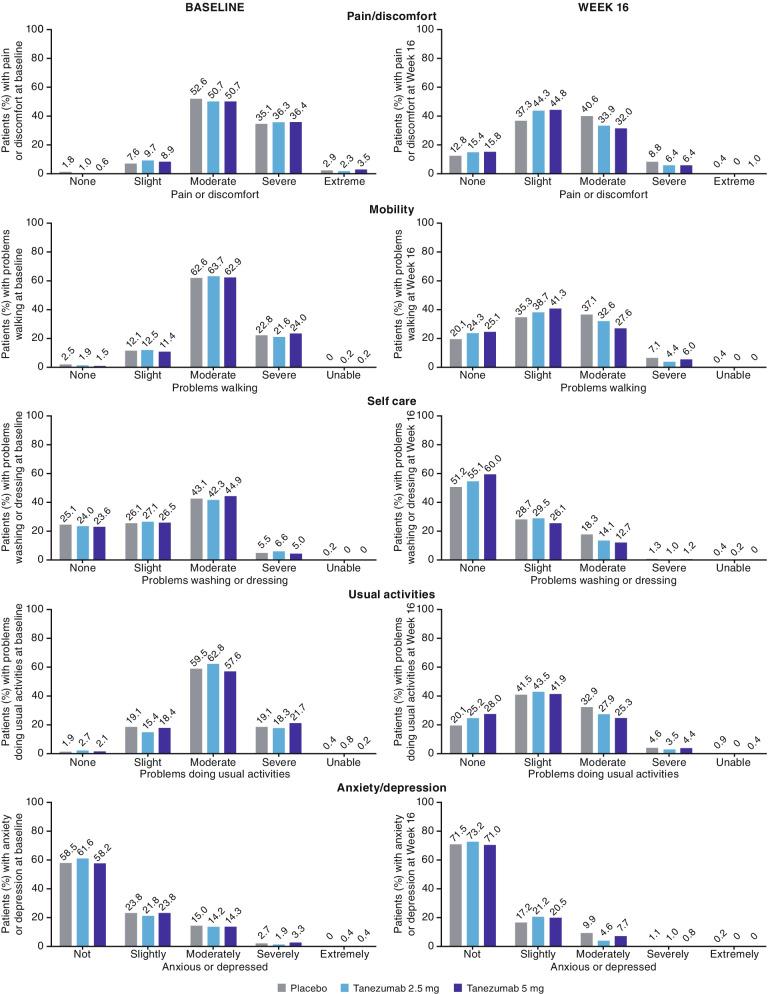
Subcutaneous tanezumab (2.5 mg and 5 mg) was tested in double-blind, placebo-controlled, 16-week (NCT02697773) and 24-week (NCT02709486) clinical trials in patients with moderate-to-severe OA of the hip or knee. At baseline and week 16, all patients completed EQ-5D-5L and the Work Productivity and Activity Impairment-OA (WPAI-OA) activity impairment item. Those currently employed also completed WPAI-OA work time missed, impairment while working, and overall work impairment items. Between-group differences in least squares (LS) mean changes from baseline at week 16 were tested using analysis of covariance.
RESULTS
Of 1545 pooled patients, 576 were employed at baseline. Improvements in EQ-5D-5L index value at week 16 were significantly greater for the tanezumab 2.5-mg group (difference in LS means [95% confidence interval (CI), 0.03 [0.01, 0.05]; p = 0.0083) versus placebo. Percent improvements (95% CI) in activity impairment (- 5.92 [- 8.87, - 2.98]; p < 0.0001), impairment while working (- 7.34 [- 13.01, - 1.68]; p = 0.0112), and overall work impairment (- 7.44 [- 13.22, - 1.67]; p = 0.0116) at week 16 were significantly greater for the tanezumab 2.5-mg group versus placebo. Results for the tanezumab 5-mg group were generally comparable to the tanezumab 2.5-mg group, although, compared with placebo, percent improvement (95% CI) in work time missed was significantly greater for the tanezumab 5-mg group (- 3.40 [- 6.47, - 0.34]; p = 0.0294), but not the tanezumab 2.5-mg group (- 0.66 [- 3.63, 2.32]; p = 0.6637).
CONCLUSIONS
These pooled analyses showed that health status, non-work activities, and work productivity were significantly improved following tanezumab administration, compared with placebo.
TRIAL REGISTRATION
ClinicalTrials.gov: NCT02697773, NCT02709486.
背景
在两项大型 3 期骨关节炎(OA)研究的汇总分析中,评估了替纳珠单抗对健康状况、非工作活动和工作生产力的影响。
方法
替纳珠单抗(2.5mg 和 5mg)在两项双盲、安慰剂对照、16 周(NCT02697773)和 24 周(NCT02709486)的临床试验中进行了测试,入组的患者为髋或膝关节中至重度 OA。所有患者在基线和第 16 周时均完成 EQ-5D-5L 和工作生产力和活动障碍-OA(WPAI-OA)活动障碍项目。当前在职的患者还完成了 WPAI-OA 工作时间损失、工作时障碍和整体工作障碍项目。使用协方差分析检验从基线到第 16 周的最小二乘(LS)均值变化的组间差异。
结果
在汇总的 1545 名患者中,576 名患者在基线时就业。替纳珠单抗 2.5mg 组的 EQ-5D-5L 指数值在第 16 周时的改善明显大于安慰剂组(LS 均值差值[95%置信区间(CI),0.03[0.01,0.05];p=0.0083)。在活动障碍(-5.92[-8.87,-2.98];p<0.0001)、工作时障碍(-7.34[-13.01,-1.68];p=0.0112)和整体工作障碍(-7.44[-13.22,-1.67])方面,替纳珠单抗 2.5mg 组在第 16 周时的改善百分比明显大于安慰剂组(p<0.0001)。替纳珠单抗 5mg 组的结果与替纳珠单抗 2.5mg 组大致相似,但是,与安慰剂相比,替纳珠单抗 5mg 组的工作时间损失改善百分比明显更大(-3.40[-6.47,-0.34];p=0.0294),而替纳珠单抗 2.5mg 组则没有明显改善(-0.66[-3.63,2.32];p=0.6637)。
结论
这些汇总分析表明,与安慰剂相比,替纳珠单抗治疗后健康状况、非工作活动和工作生产力均显著改善。
试验注册
ClinicalTrials.gov:NCT02697773,NCT02709486。

 Zotero 插件