
用于指导实体瘤儿科患者给药的TQ-B3101群体药代动力学建模与模拟
Population Pharmacokinetic Modeling and Simulation of TQ-B3101 to Inform Dosing in Pediatric Patients With Solid Tumors.
作者信息
Yang Fen, Wu Huali, Bo Yunhai, Lu Ye, Pan Hong, Li Su, Lu Qin, Xie Simin, Liao Harry, Wang Bing
机构信息
Key Laboratory of Carcinogenesis and Translational Research (Ministry of Education), National Drug Clinical Trial Center, Peking University Cancer Hospital & Institute, Beijing, China.
Amador Bioscience, Hangzhou, China.
出版信息
Front Pharmacol. 2022 Jan 18;12:782518. doi: 10.3389/fphar.2021.782518. eCollection 2021.
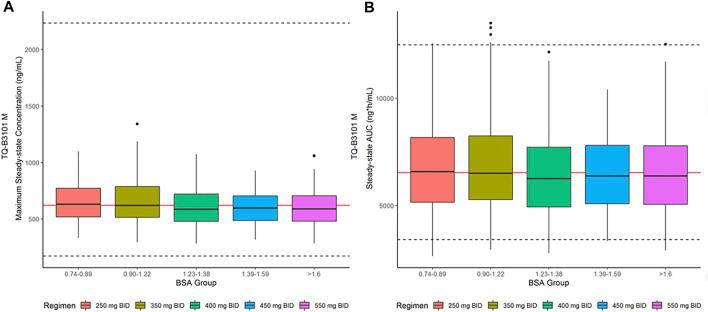
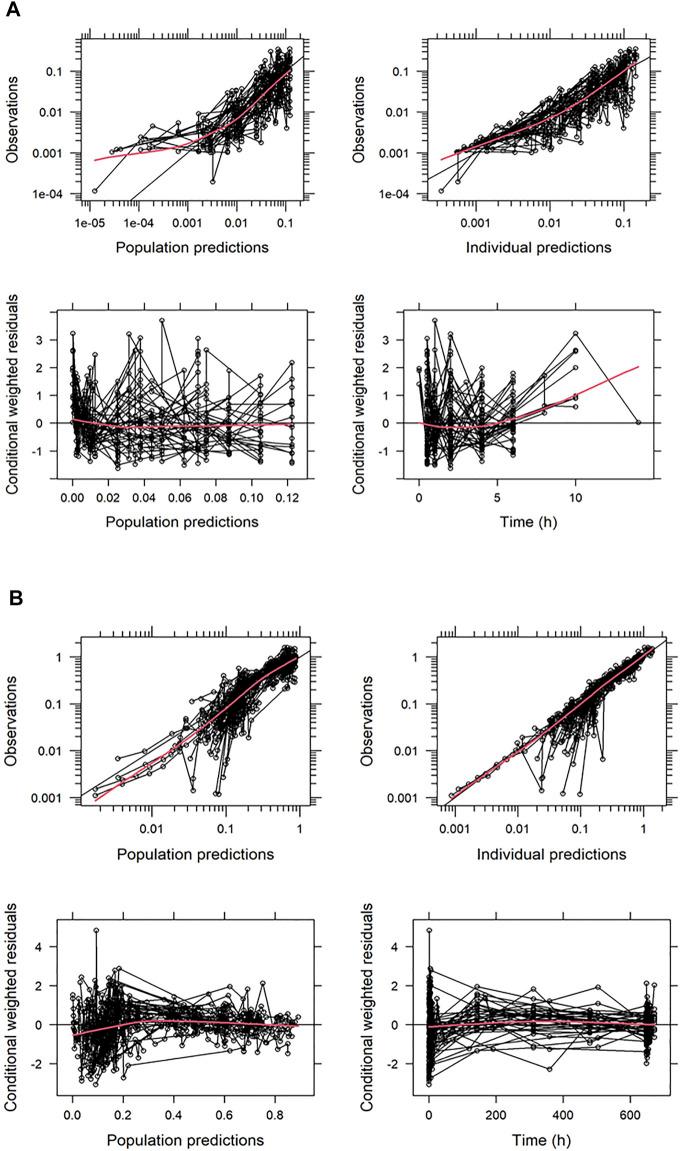
TQ-B3101 is a novel kinase inhibitor currently in development for the treatment of advanced malignant solid tumor and relapsed or refractory ALK-positive anaplastic large cell lymphoma. A population pharmacokinetic model was developed using data collected from a Phase 1 study and a Phase 2 study to characterize the pharmacokinetic of TQ-B3101 and its active metabolite (TQ-B3101M). The final model was used to optimize dosing of TQ-B3101 for pediatric patients (6-<18 years) with anaplastic large cell lymphoma. The pharmacokinetic of TQ-B3101 and TQ-B3101M was adequately described by a 1-compartment model with first-order absorption and elimination for parent drug coupled with a 2-compartment model with time-dependent clearance for the metabolite. The clearance of TQ-B3101M decreased over time with a maximum fractional reduction of 0.41. The estimated apparent clearance and apparent volume of distribution of TQ-B3101 were 2850 L/h and 4200 L, respectively. The elimination half-life of TQ-B3101 was 1.0 h. The distribution and elimination half-lives of TQ-B3101M at steady state were 4.9 and 39.4 h, respectively. The projected exposure of TQ-B3101M in virtual pediatric population following the body surface area tiered dosing regimen was similar to that in children pediatric patients after the recommended pediatric dose of crizotinib (280 mg/m2 twice daily), an analog of TQ-B3101M. A population pharmacokinetic model was developed to provide optimal dose of regimen for further development of TQ-B3101 in pediatric patients with anaplastic large cell lymphoma.
TQ-B3101是一种新型激酶抑制剂,目前正处于研发阶段,用于治疗晚期恶性实体瘤以及复发或难治性ALK阳性间变性大细胞淋巴瘤。利用从1期研究和2期研究中收集的数据建立了群体药代动力学模型,以表征TQ-B3101及其活性代谢产物(TQ-B3101M)的药代动力学特征。最终模型用于优化TQ-B3101在患有间变性大细胞淋巴瘤的儿科患者(6至<18岁)中的给药剂量。TQ-B3101和TQ-B3101M的药代动力学通过一个具有一级吸收和消除的单室模型对母体药物进行充分描述,同时对代谢产物采用一个具有时间依赖性清除率的双室模型。TQ-B3101M的清除率随时间下降,最大分数降低为0.41。TQ-B3101的估计表观清除率和表观分布容积分别为2850 L/h和4200 L。TQ-B3101的消除半衰期为1.0小时。TQ-B3101M在稳态时的分布半衰期和消除半衰期分别为4.9小时和39.4小时。按照体表面积分层给药方案,TQ-B3101M在虚拟儿科人群中的预测暴露量与TQ-B3101M的类似物克唑替尼(280 mg/m²,每日两次)的推荐儿科剂量给药后儿科患者中的暴露量相似。建立了群体药代动力学模型,为TQ-B3101在患有间变性大细胞淋巴瘤的儿科患者中的进一步研发提供最佳给药方案。


 Zotero 插件