
Delta 和 Kappa SARS-CoV-2 变体中 Spike 蛋白适应性增强的结构和生化基础。
Structural and biochemical rationale for enhanced spike protein fitness in delta and kappa SARS-CoV-2 variants.
机构信息
Department of Biochemistry and Molecular Biology, University of British Columbia, Vancouver, BC, V6T 1Z3, Canada.
BC Centre for Disease Control, Vancouver, BC, V5Z 4R4, Canada.
出版信息
Nat Commun. 2022 Feb 8;13(1):742. doi: 10.1038/s41467-022-28324-6.
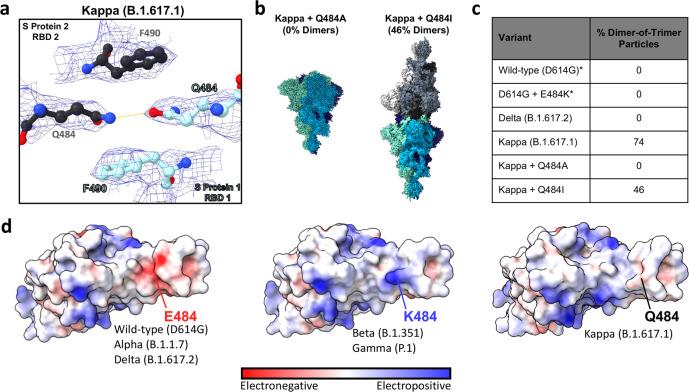
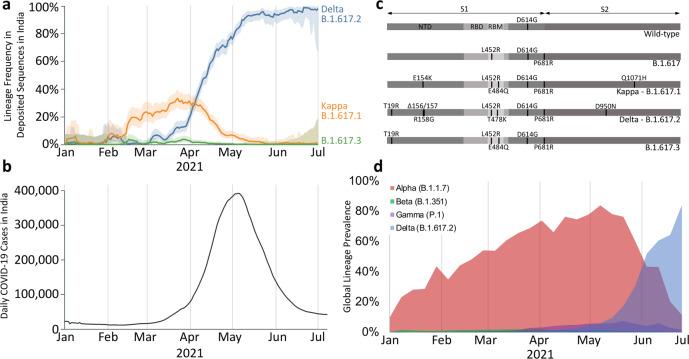
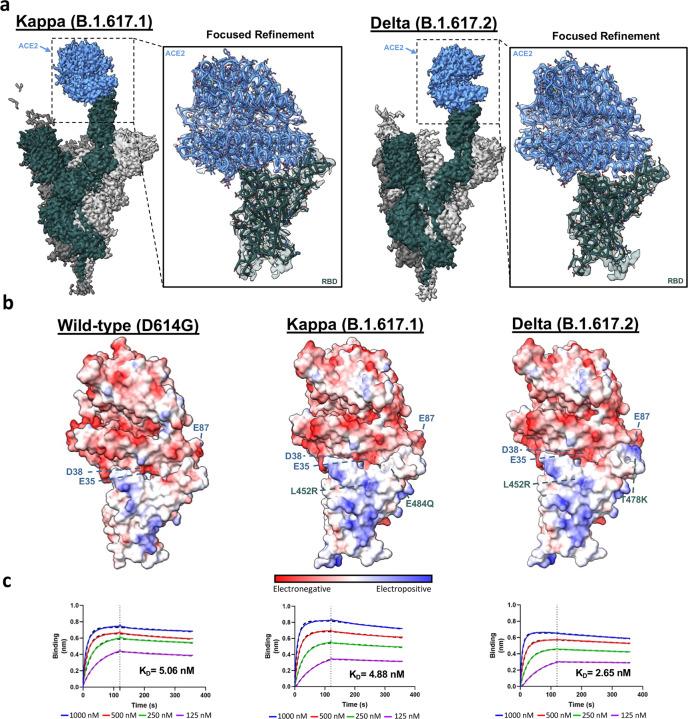
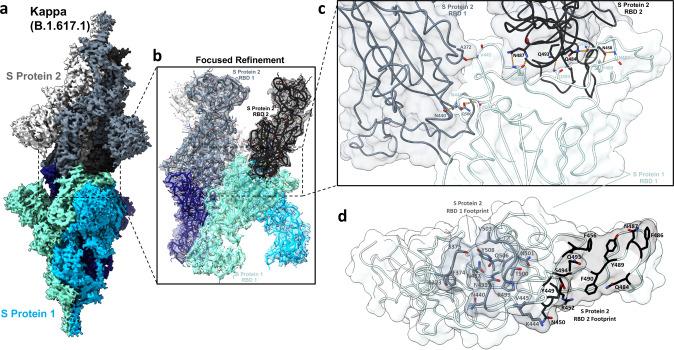
The Delta and Kappa variants of SARS-CoV-2 co-emerged in India in late 2020, with the Delta variant underlying the resurgence of COVID-19, even in countries with high vaccination rates. In this study, we assess structural and biochemical aspects of viral fitness for these two variants using cryo-electron microscopy (cryo-EM), ACE2-binding and antibody neutralization analyses. Both variants demonstrate escape of antibodies targeting the N-terminal domain, an important immune hotspot for neutralizing epitopes. Compared to wild-type and Kappa lineages, Delta variant spike proteins show modest increase in ACE2 affinity, likely due to enhanced electrostatic complementarity at the RBD-ACE2 interface, which we characterize by cryo-EM. Unexpectedly, Kappa variant spike trimers form a structural head-to-head dimer-of-trimers assembly, which we demonstrate is a result of the E484Q mutation and with unknown biological implications. The combination of increased antibody escape and enhanced ACE2 binding provides an explanation, in part, for the rapid global dominance of the Delta variant.
德尔塔和卡帕变异株于 2020 年底在印度同时出现,其中德尔塔变异株是导致 COVID-19 再次流行的原因,即使在疫苗接种率较高的国家也是如此。在这项研究中,我们使用冷冻电镜(cryo-EM)、ACE2 结合和抗体中和分析评估了这两种变异株的病毒适应性的结构和生化方面。这两种变异株都表现出对靶向 N 端结构域的抗体的逃逸,N 端结构域是中和表位的一个重要免疫热点。与野生型和卡帕谱系相比,德尔塔变异株的刺突蛋白与 ACE2 的亲和力略有增加,这可能是由于 RBD-ACE2 界面上增强的静电互补性所致,我们通过 cryo-EM 对其进行了表征。出乎意料的是,卡帕变异株的刺突三聚体形成了结构上的头对头三聚体二聚体组装,我们证明这是 E484Q 突变的结果,其具有未知的生物学意义。抗体逃逸能力的增强和 ACE2 结合能力的增强,部分解释了德尔塔变异株在全球迅速占据主导地位的原因。

 Zotero 插件