
外周免疫与认知、神经影像学和阿尔茨海默病病理的关联。
Association of peripheral immunity with cognition, neuroimaging, and Alzheimer's pathology.
机构信息
Department of Neurology, Qingdao Municipal Hospital, Qingdao University, Qingdao, 266071, China.
Department of Neurology and Institute of Neurology, Huashan Hospital, Shanghai Medical College, Fudan University, 12th Wulumuqi Zhong Road, Shanghai, 200040, China.
出版信息
Alzheimers Res Ther. 2022 Feb 9;14(1):29. doi: 10.1186/s13195-022-00968-y.
BACKGROUND
Neuroinflammation has been considered to be a driving force of Alzheimer's disease. However, the association between peripheral immunity and AD has been rarely investigated.
METHODS
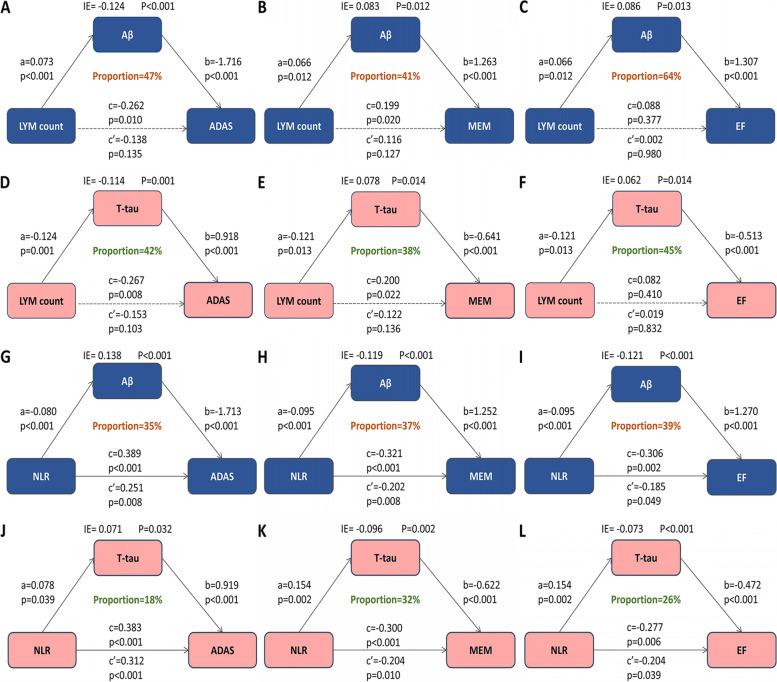
Separate regression analyses were conducted to explore the associations among peripheral immune markers and cognition, neuroimaging, and AD pathology. Causal mediation analyses were used to investigate whether the associations with cognition were mediated by AD pathology.
RESULTS
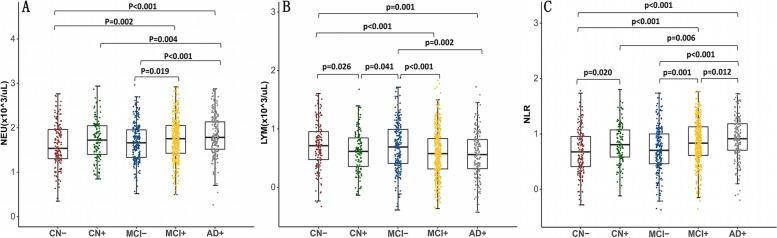
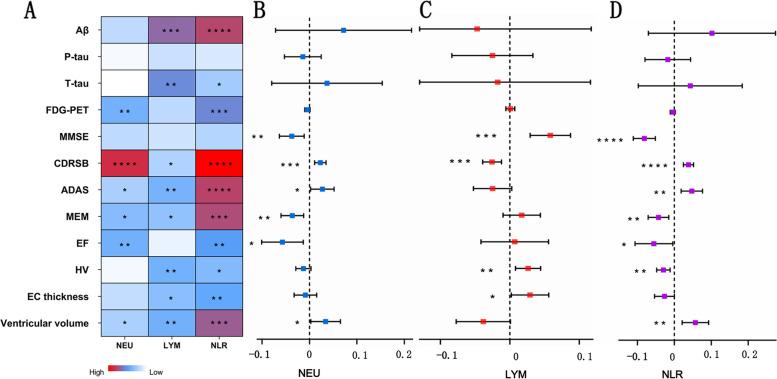
A total of 1107 participants (43.9% female, mean age of 73.2 years) from the Alzheimer's Disease Neuroimaging Initiative (ADNI) were included. Regression analyses indicated that elevated neutrophils (NEU) count and neutrophil-lymphocyte ratio (NLR) were associated with lower levels of global cognition, memory function (MEM), and executive function (EF), and reduced brain metabolism by 18F-fluorodeoxyglucose-positron emission tomography (FDG-PET) as well as greater ventricular volume. An elevated NLR was associated with a lower level of β-amyloid (Aβ) and a higher level of total tau (T-tau) in cerebrospinal fluid (CSF), smaller hippocampal volume (HV), and lesser entorhinal cortex (EC) thickness. On the contrary, an elevated level of lymphocytes (LYM) was associated with a higher level of Aβ and a lower level of T-tau in CSF, better cognition, and less atrophy of brain regions (ventricular volume, HV, and EC thickness). The associations of LYM and NLR with cognition were mediated by Aβ and T-tau pathology (proportion: 18%~64%; p < 0.05).
CONCLUSIONS
We revealed that two types of peripheral immune cells (NEU and LYM) and the ratio of these two cell types (NLR) had associations with cognition, neuroimaging, and AD pathology. The associations might be mediated by Aβ and tau pathology.
背景
神经炎症被认为是阿尔茨海默病的驱动因素。然而,外周免疫与 AD 之间的关联很少被研究。
方法
分别进行回归分析,以探讨外周免疫标志物与认知、神经影像学和 AD 病理学之间的关系。采用因果中介分析来研究与认知的关联是否通过 AD 病理学来介导。
结果
共纳入来自阿尔茨海默病神经影像学倡议(ADNI)的 1107 名参与者(43.9%为女性,平均年龄 73.2 岁)。回归分析表明,中性粒细胞(NEU)计数和中性粒细胞与淋巴细胞比值(NLR)升高与整体认知、记忆功能(MEM)和执行功能(EF)水平降低以及 18F-氟脱氧葡萄糖正电子发射断层扫描(FDG-PET)显示的脑代谢降低有关,同时还与脑室容积增大有关。NLR 升高与脑脊液(CSF)中β-淀粉样蛋白(Aβ)水平降低和总 tau(T-tau)水平升高、海马体积(HV)减小和内嗅皮层(EC)厚度减小有关。相反,淋巴细胞(LYM)水平升高与 CSF 中 Aβ水平升高和 T-tau 水平降低、认知能力提高以及脑区萎缩(脑室容积、HV 和 EC 厚度)减少有关。LYM 和 NLR 与认知的关联是由 Aβ 和 T-tau 病理介导的(比例:18%~64%;p<0.05)。
结论
我们发现两种类型的外周免疫细胞(NEU 和 LYM)及其两种细胞类型的比值(NLR)与认知、神经影像学和 AD 病理学有关。这些关联可能是由 Aβ 和 tau 病理介导的。
 Zotero 插件