
Vivifrail 多组分干预对功能能力的影响:一项多中心、随机对照试验。
Effects of Vivifrail multicomponent intervention on functional capacity: a multicentre, randomized controlled trial.
机构信息
Geriatric Department, Hospital Universitario de Navarra (HUN), Pamplona, Spain.
Navarrabiomed, Hospital Universitario de Navarra (HUN), Universidad Pública de Navarra (UPNA), IdiSNA, Pamplona, Spain.
出版信息
J Cachexia Sarcopenia Muscle. 2022 Apr;13(2):884-893. doi: 10.1002/jcsm.12925. Epub 2022 Feb 11.
BACKGROUND
Physical exercise is an effective strategy for preserving functional capacity and improving the symptoms of frailty in older adults. In addition to functional gains, exercise is considered to be a cornerstone for enhancing cognitive function in frail older adults with cognitive impairment and dementia. We assessed the effects of the Vivifrail exercise intervention for functional capacity, cognition, and well-being status in community-dwelling older adults.
METHODS
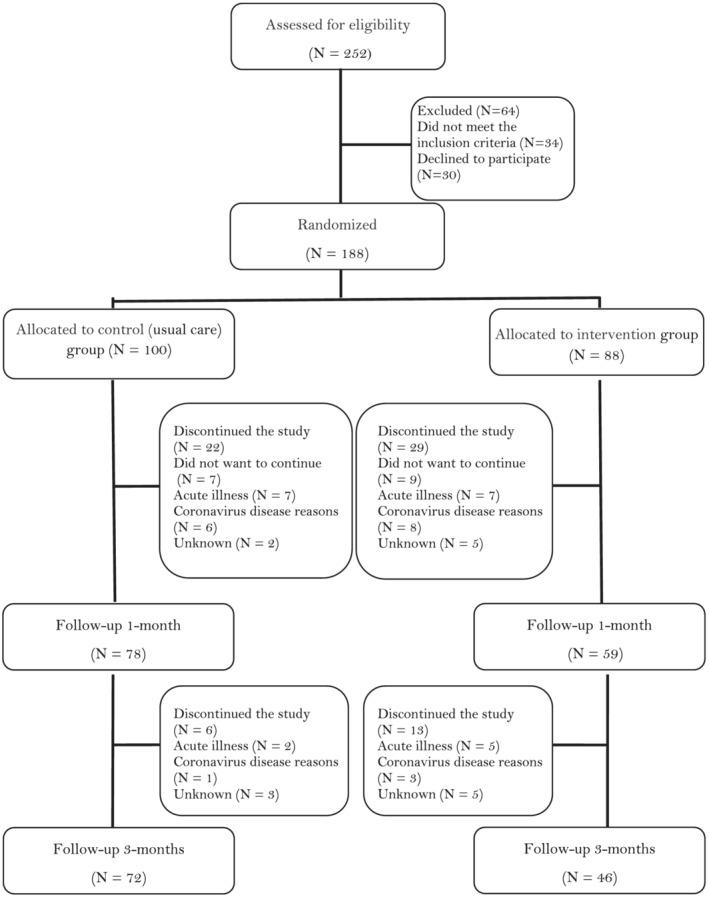
In a multicentre randomized controlled trial conducted in three tertiary hospitals in Spain, a total of 188 older patients with mild cognitive impairment or mild dementia (aged >75 years) were randomly assigned to an exercise intervention (n = 88) or a usual-care, control (n = 100) group. The intervention was based on the Vivifrail tailored multicomponent exercise programme, which included resistance, balance, flexibility (3 days/week), and gait-retraining exercises (5 days/week) and was performed for three consecutive months (http://vivifrail.com). The usual-care group received habitual outpatient care. The main endpoint was change in functional capacity from baseline to 1 and 3 months, assessed with the Short Physical Performance Battery (SPPB). Secondary endpoints were changes in cognitive function and handgrip strength after 1 and 3 months, and well-being status, falls, hospital admission rate, visits to the emergency department, and mortality after 3 months.
RESULTS
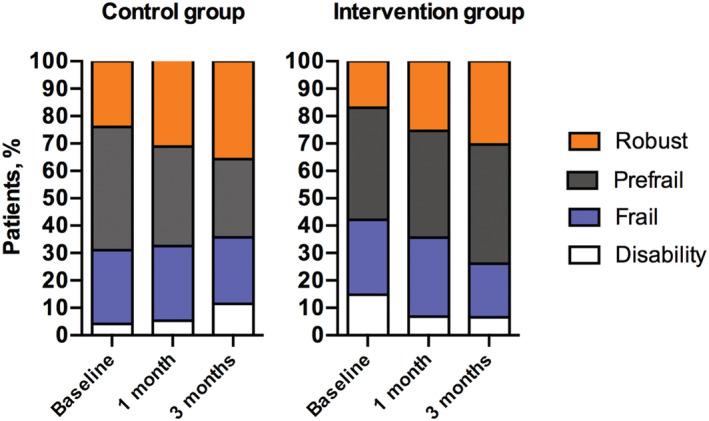
The Vivifrail exercise programme provided significant benefits in functional capacity over usual-care. The mean adherence to the exercise sessions was 79% in the first month and 68% in the following 2 months. The intervention group showed a mean increase (over the control group) of 0.86 points on the SPPB scale (95% confidence interval [CI] 0.32, 1.41 points; P < 0.01) after 1 month of intervention and 1.40 points (95% CI 0.82, 1.98 points; P < 0.001) after 3 months. Participants in the usual-care group showed no significant benefit in functional capacity (mean change of -0.17 points [95% CI -0.54, 0.19 points] after 1 month and -0.33 points [95% CI -0.70, 0.04 points] after 3 months), whereas the exercise intervention reversed this trend (0.69 points [95% CI 0.29, 1.09 points] after 1 month and 1.07 points [95% CI 0.63, 1.51 points] after 3 months). Exercise group also obtained significant benefits in cognitive function, muscle function, and depression after 3 months over control group (P < 0.05). No between-group differences were obtained in other secondary endpoints (P > 0.05).
CONCLUSIONS
The Vivifrail exercise training programme is an effective and safe therapy for improving functional capacity in community-dwelling frail/prefrail older patients with mild cognitive impairment or mild dementia and also seems to have beneficial effect on cognition, muscle function, and mood status.
背景
体育锻炼是保持功能能力和改善老年体弱人群症状的有效策略。除了功能上的获益,锻炼被认为是增强有认知障碍和痴呆的体弱老年人认知功能的基石。我们评估了 Vivifrail 运动干预对社区居住的轻度认知障碍或轻度痴呆老年人(>75 岁)的功能能力、认知和健康状况的影响。
方法
在西班牙的三家三级医院进行的多中心随机对照试验中,共有 188 名轻度认知障碍或轻度痴呆(>75 岁)的老年患者被随机分配到运动干预组(n=88)或常规护理对照组(n=100)。干预基于 Vivifrail 量身定制的多成分运动方案,包括阻力、平衡、灵活性(每周 3 天)和步态再训练(每周 5 天),并连续进行三个月(http://vivifrail.com)。常规护理组接受常规门诊护理。主要终点是从基线到 1 个月和 3 个月时功能能力的变化,采用短体适能电池(SPPB)评估。次要终点是 1 个月和 3 个月时认知功能和握力的变化,以及 3 个月时的健康状况、跌倒、住院率、急诊科就诊次数和死亡率。
结果
Vivifrail 运动方案在功能能力方面优于常规护理。第一个月的平均依从性为 79%,接下来的 2 个月为 68%。干预组在 SPPB 量表上的平均(与对照组相比)增加了 0.86 分(95%置信区间 [CI] 0.32, 1.41 分;P<0.01),在 3 个月后增加了 1.40 分(95% CI 0.82, 1.98 分;P<0.001)。常规护理组的功能能力没有明显改善(第一个月的平均变化为-0.17 分[95% CI -0.54, 0.19 分],第三个月为-0.33 分[95% CI -0.70, 0.04 分]),而运动干预扭转了这一趋势(第一个月为 0.69 分[95% CI 0.29, 1.09 分],第三个月为 1.07 分[95% CI 0.63, 1.51 分])。第三个月,与对照组相比,运动组在认知功能、肌肉功能和抑郁方面也有显著获益(P<0.05)。其他次要终点无组间差异(P>0.05)。
结论
Vivifrail 运动训练方案是一种有效且安全的治疗方法,可改善社区居住的虚弱/脆弱的轻度认知障碍或轻度痴呆老年患者的功能能力,似乎对认知、肌肉功能和情绪状态也有有益影响。

 Zotero 插件