
炎症调节造血干细胞及其龛位。
Inflammation Regulates Haematopoietic Stem Cells and Their Niche.
机构信息
Laboratory of Stem Cell Stress, International Research Center for Medical Sciences (IRCMS), Kumamoto University, Kumamoto 860-0811, Japan.
Center for Metabolic Regulation of Healthy Aging (CMHA), Kumamoto University, Kumamoto 860-0811, Japan.
出版信息
Int J Mol Sci. 2022 Jan 20;23(3):1125. doi: 10.3390/ijms23031125.
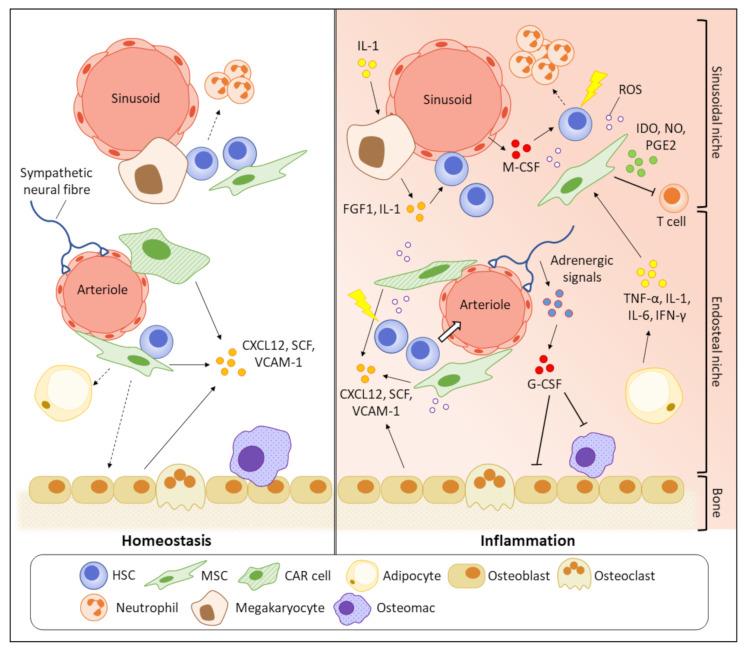
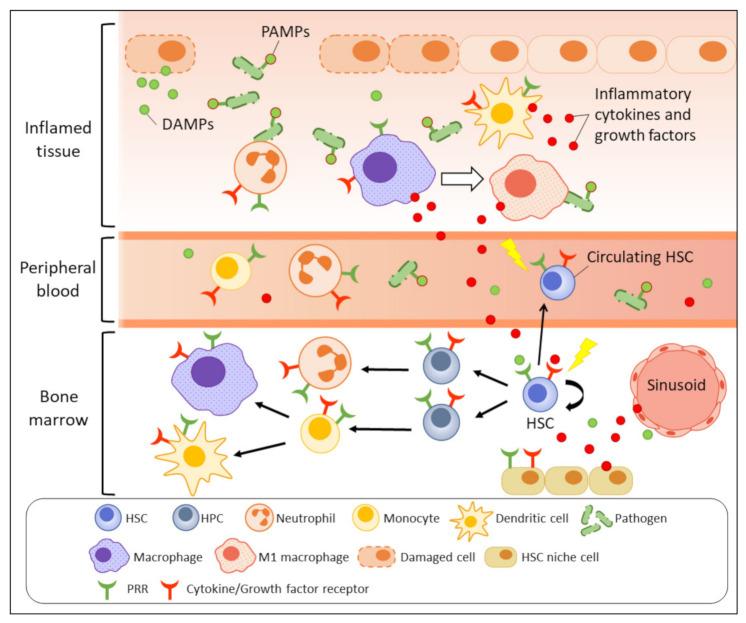
Haematopoietic stem cells (HSCs) reside in the bone marrow and are supported by the specialised microenvironment, a niche to maintain HSC quiescence. To deal with haematopoietic equilibrium disrupted during inflammation, HSCs are activated from quiescence directly and indirectly to generate more mature immune cells, especially the myeloid lineage cells. In the process of proliferation and differentiation, HSCs gradually lose their self-renewal potential. The extensive inflammation might cause HSC exhaustion/senescence and malignant transformation. Here, we summarise the current understanding of how HSC functions are maintained, damaged, or exhausted during acute, prolonged, and pathological inflammatory conditions. We also highlight the inflammation-altered HSC niche and its impact on escalating the insults on HSCs.
造血干细胞(HSCs)存在于骨髓中,并受到专门的微环境支持,这种微环境是维持 HSC 静止状态的龛位。为了应对炎症过程中造血平衡被打破的情况,HSCs 会被直接或间接地从静止状态中激活,从而产生更多成熟的免疫细胞,特别是髓系细胞。在增殖和分化过程中,HSCs 逐渐丧失自我更新的潜能。广泛的炎症可能导致 HSC 衰竭/衰老和恶性转化。在这里,我们总结了目前对 HSC 在急性、慢性和病理性炎症状态下如何维持、损伤或衰竭的功能的理解。我们还强调了炎症改变的 HSC 龛位及其对加剧 HSC 损伤的影响。
 Zotero 插件