
与 COVID-19 和合并症相关的潜在基因。
Potential Genes Associated with COVID-19 and Comorbidity.
机构信息
College of Medical Technology, Chengdu University of Traditional Chinese Medicine, Chengdu, Sichuan, China.
Non-coding RNA and Drug Discovery Key Laboratory of Sichuan Province, Chengdu Medical College, Chengdu, Sichuan, China.
出版信息
Int J Med Sci. 2022 Jan 24;19(2):402-415. doi: 10.7150/ijms.67815. eCollection 2022.
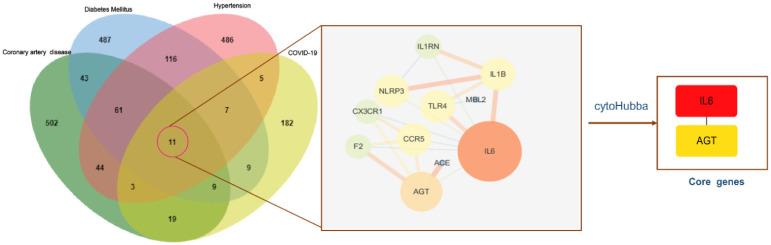
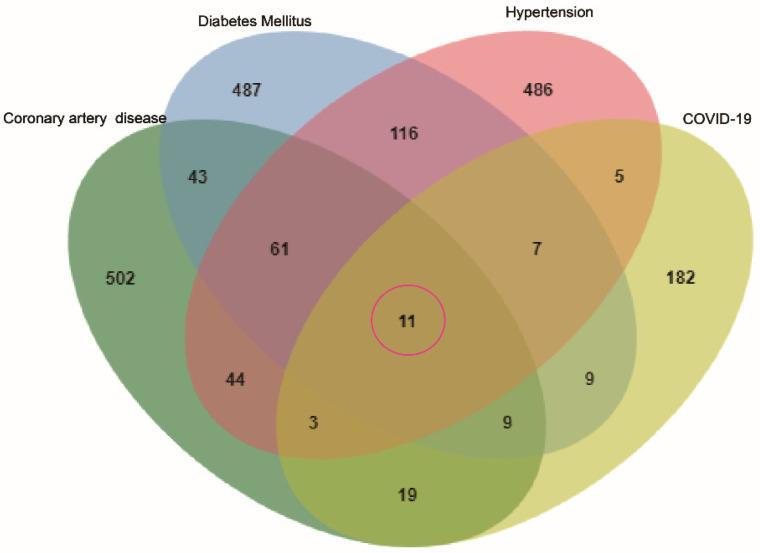
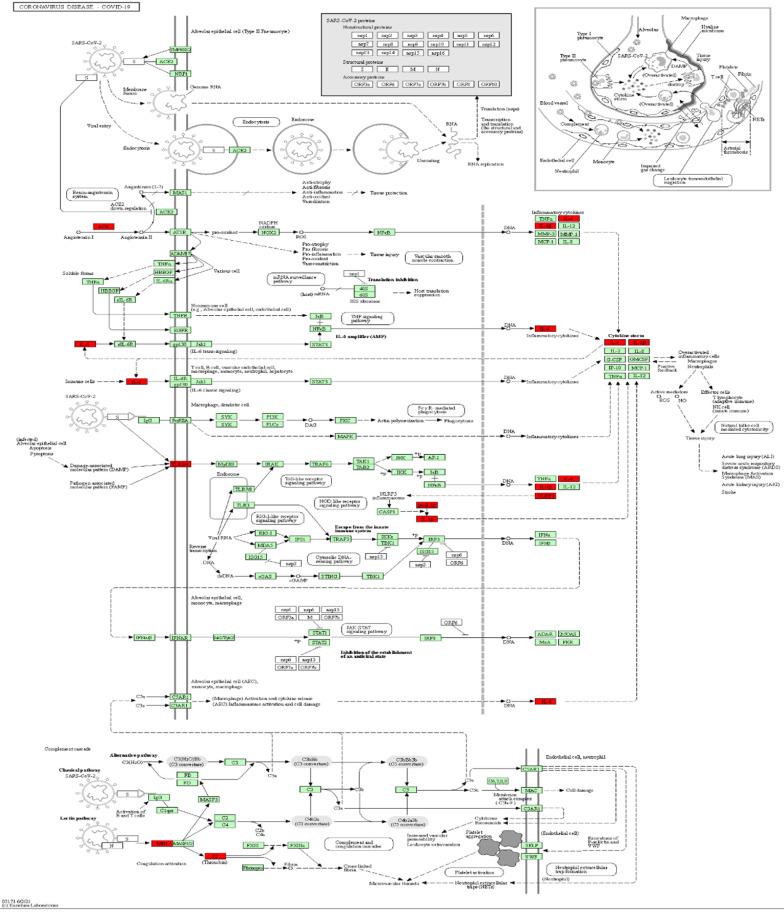
Hypertension, diabetes mellitus, and coronary artery disease are common comorbidities and dangerous factors for infection and serious COVID-19. Polymorphisms in genes associated with comorbidities may help observe susceptibility and disease severity variation. However, specific genetic factors and the extent to which they can explain variation in susceptibility of severity are unclear. Therefore, we evaluated candidate genes associated with COVID-19 and hypertension, diabetes mellitus, and coronary artery disease. In particular, we performed searches against OMIM, NCBI, and other databases, protein-protein interaction network construction, and GO and KEGG pathway enrichment analyses. Results showed that the associated overlapping genes were , , , , , , , , , , and . GO and KEGG analyses yielded 302 GO terms (q < 0.05) and 29 signaling pathways (q < 0.05), respectively, mainly including coronavirus disease-COVID-19 and cytokine-cytokine receptor interaction. and were central in the PPI, with 8 and 5 connections, respectively. In this study, we identified 11 genes associated with both COVID-19 and three comorbidities that may contribute to infection and disease severity. The key genes IL6 and AGT are involved in regulating immune response, cytokine activity, and viral infection. Therefore, RAAS inhibitors, AGT antisense nucleotides, cytokine inhibitors, vitamin D, fenofibrate, and vaccines regulating non-immune and immune factors could be potential strategies to prevent and cure COVID-19. The study provides a basis for further investigation of genes and pathways with predictive value for the risk of infection and prognosis and could help guide drug and vaccine development to improve treatment efficacy and the development of personalised treatments, especially for COVID-19 individuals with common comorbidities.
高血压、糖尿病和冠状动脉疾病是常见的合并症和感染及严重 COVID-19 的危险因素。与合并症相关的基因多态性可能有助于观察易感性和疾病严重程度的变化。然而,特定的遗传因素以及它们在多大程度上可以解释易感性和严重程度的变化尚不清楚。因此,我们评估了与 COVID-19 以及高血压、糖尿病和冠状动脉疾病相关的候选基因。特别是,我们针对 OMIM、NCBI 和其他数据库进行了搜索、构建蛋白质-蛋白质相互作用网络以及进行了 GO 和 KEGG 通路富集分析。结果显示,相关的重叠基因有、、、、、、、、、和。GO 和 KEGG 分析分别产生了 302 个 GO 术语(q<0.05)和 29 个信号通路(q<0.05),主要包括冠状病毒病 COVID-19 和细胞因子-细胞因子受体相互作用。在 PPI 中,和是中心节点,分别有 8 个和 5 个连接。在这项研究中,我们确定了 11 个与 COVID-19 和三种合并症都相关的基因,这些基因可能与感染和疾病严重程度有关。关键基因 IL6 和 AGT 参与调节免疫反应、细胞因子活性和病毒感染。因此,肾素-血管紧张素-醛固酮系统抑制剂、AGT 反义核苷酸、细胞因子抑制剂、维生素 D、非诺贝特和调节非免疫和免疫因素的疫苗可能是预防和治疗 COVID-19 的潜在策略。该研究为进一步研究具有感染和预后预测价值的基因和途径提供了依据,并可能有助于指导药物和疫苗的开发,以提高治疗效果和开发个体化治疗方法,特别是针对患有常见合并症的 COVID-19 个体。


 Zotero 插件