
具有性反转的自由放养蜥蜴的进化稳定性推断。
Evolutionary stability inferred for a free ranging lizard with sex-reversal.
机构信息
Centre for Conservation Ecology and Genomics, Institute for Applied Ecology, University of Canberra, Canberra, Australian Capital Territory, Australia.
Department of Biology, University of North Carolina Pembroke, Pembroke, North Carolina, USA.
出版信息
Mol Ecol. 2022 Apr;31(8):2281-2292. doi: 10.1111/mec.16404. Epub 2022 Feb 27.
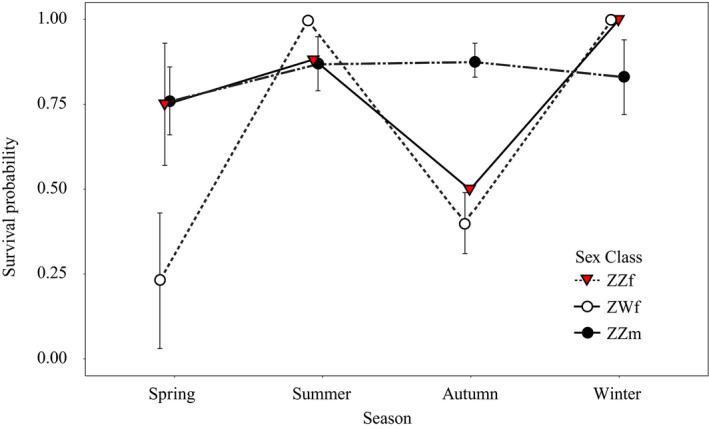
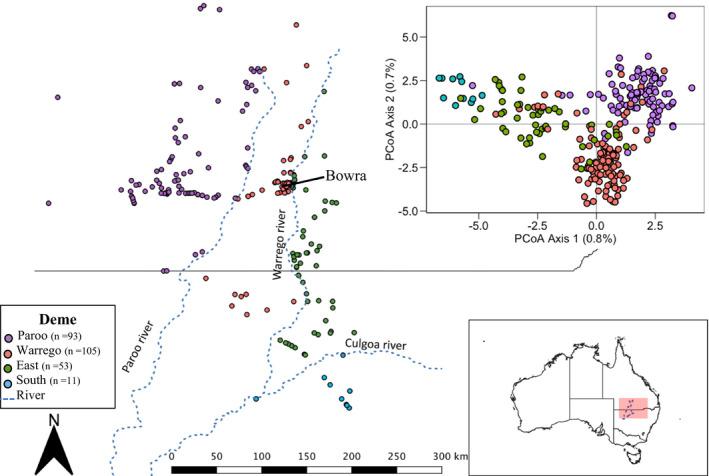
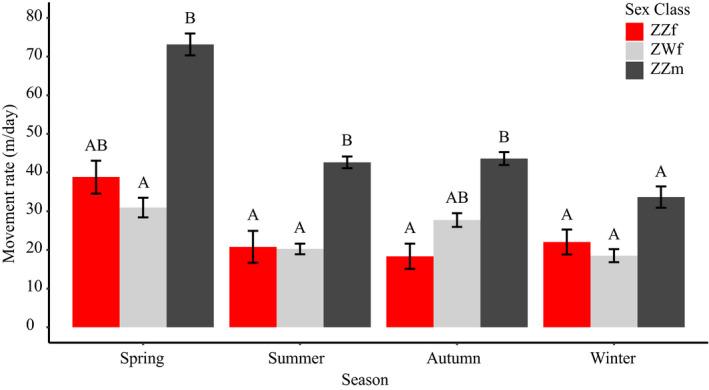
The sex of vertebrates is typically determined genetically, but reptile sex can also be determined by developmental temperature. In some reptiles, temperature interacts with genotype to reverse sex, potentially leading to transitions from a chromosomal to a temperature-dependent sex determining system. Transitions between such systems in nature are accelerated depending on the frequency and fitness of sex-reversed individuals. The Central Bearded Dragon, Pogona vitticeps, exhibits female heterogamety (ZZ/ZW) but can have its sex reversed from ZZ male to ZZ female by high incubation temperatures. The species exhibits sex-reversal in the wild and it has been suggested that climate change and fitness of sex-reversed individuals could be increasing the frequency of reversal within the species range. Transitions to temperature-dependent sex determination require low levels of dispersal and high (>50%) rates of sex-reversal. Here, we combine genotype-by-sequencing, identification of phenotypic and chromosomal sex, exhaustive field surveys, and radio telemetry to examine levels of genetic structure, rates of sex-reversal, movement, space use, and survival of P. vitticeps in a location previously identified as a hot spot for sex-reversal. We find that the species exhibits low levels of population structure (FST 0.001) and a modest (17%) rate of sex-reversal, and that sex-reversed and nonsex-reversed females have similar survival and behavioural characteristics to each other. Overall, our data indicate this system is evolutionary stable, although we do not rule out the prospect of a more gradual transition in sex-determining mechanisms in the future in a more fragmented landscape and as global temperatures increase.
脊椎动物的性别通常是由遗传决定的,但爬行动物的性别也可以由发育温度决定。在一些爬行动物中,温度与基因型相互作用,导致性别反转,可能导致从染色体性别决定系统向温度依赖性别决定系统的转变。在自然界中,这些系统之间的转变取决于性反转个体的频率和适应性。中央刺尾鬣蜥(Pogona vitticeps)表现出雌性异配性(ZZ/ZW),但可以通过高温孵化将 ZZ 雄性转变为 ZZ 雌性。该物种在野外存在性别反转现象,有人认为气候变化和性反转个体的适应性可能会增加该物种范围内反转的频率。向温度依赖的性别决定的转变需要低水平的扩散和高(>50%)的性别反转率。在这里,我们结合基因型测序、表型和染色体性别鉴定、详尽的实地调查和无线电遥测,研究了中央刺尾鬣蜥在一个先前被确定为性别反转热点的地点的遗传结构水平、性别反转率、移动、空间利用和生存情况。我们发现该物种的种群结构水平较低(FST0.001),性别反转率适中(17%),而且性别反转和非性别反转的雌性之间具有相似的生存和行为特征。总的来说,我们的数据表明该系统是进化稳定的,尽管我们不能排除在未来更碎片化的景观和全球温度升高的情况下,性别决定机制更渐进的转变的可能性。

 Zotero 插件