
内生真菌:促进植物生长和可持续农业发展的工具
Endophytic fungi: a tool for plant growth promotion and sustainable agriculture.
作者信息
Baron Noemi Carla, Rigobelo Everlon Cid
机构信息
Agricultural and Livestock Microbiology Post Graduation Program, Department of Plant Production Sciences, School of Agricultural and Veterinarian Sciences, São Paulo State University (UNESP), Access Way Prof. Paulo Donato Castellane, São Paulo, Brazil.
出版信息
Mycology. 2021 Jun 29;13(1):39-55. doi: 10.1080/21501203.2021.1945699. eCollection 2022.
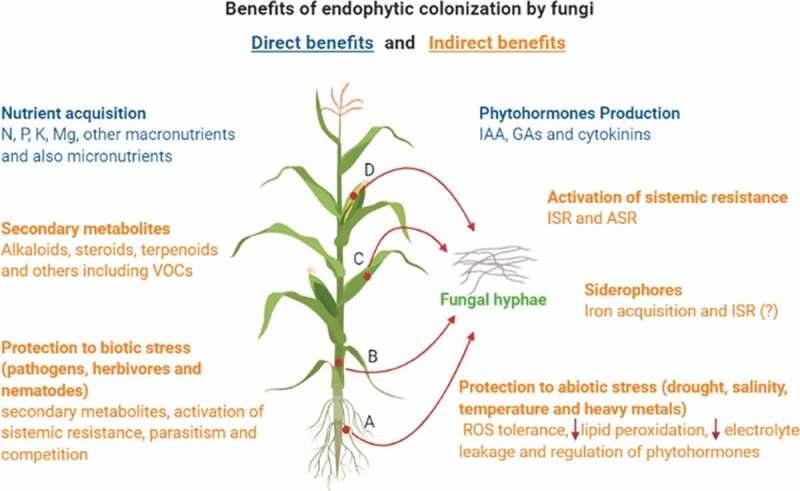
Endophytic fungi are found in most, if not all, plant species on the planet. They colonise inner plant tissues without causing symptoms of disease, thus providing benefits to the host plant while also benefiting from this interaction. The global concern for the development of more sustainable agriculture has increased in recent years, and research has been performed to decipher ecology and explore the potential of endophytic interactions in plant growth. To date, many studies point to the positive aspects of endophytic colonisation, and in this review, such research is summarised based on the direct (acquisition of nutrients and phytohormone production) and indirect (induced resistance, production of antibiotics and secondary metabolites, production of siderophores and protection for abiotic and biotic stresses) benefits of endophytic colonisation. An in-depth discussion of the mechanisms is also presented.
内生真菌存在于地球上大多数(即便不是全部)植物物种中。它们定殖于植物内部组织而不引发疾病症状,从而在为宿主植物带来益处的同时,自身也从这种相互作用中获益。近年来,全球对发展更可持续农业的关注有所增加,人们开展了相关研究来解读其生态学,并探索内生相互作用在植物生长中的潜力。迄今为止,许多研究都指向内生定殖的积极方面,在本综述中,此类研究是基于内生定殖的直接益处(获取养分和植物激素产生)和间接益处(诱导抗性、抗生素和次生代谢产物的产生、铁载体的产生以及对非生物和生物胁迫的保护)进行总结的。文中还对其机制进行了深入讨论。
 Zotero 插件