
根据特定心血管疾病,身体活动对全因死亡率的影响。
Impact of Physical Activity on All-Cause Mortality According to Specific Cardiovascular Disease.
作者信息
Kim Moon-Hyun, Sung Jung-Hoon, Jin Moo-Nyun, Jang Eunsun, Yu Hee Tae, Kim Tae-Hoon, Pak Hui-Nam, Lee Moon-Hyoung, Lip Gregory Y H, Yang Pil-Sung, Joung Boyoung
机构信息
Division of Cardiology, Department of Internal Medicine, Yonsei University College of Medicine, Seoul, South Korea.
Division of Cardiology, CHA Bundang Medical Center, CHA University, Seongnam, South Korea.
出版信息
Front Cardiovasc Med. 2022 Feb 4;9:811058. doi: 10.3389/fcvm.2022.811058. eCollection 2022.
BACKGROUND
Patients with cardiovascular disease (CVD) tend to have higher mortality rates and reduced physical activity (PA). We aimed to evaluate the effect of PA on mortality in older adults with specific CVD.
METHODS
We enrolled 68,223 participants ( = 23,871 with CVD, = 44,352 without CVD) aged ≥65 years with available physical activity data between 2005 and 2012 from the Korean National Health Insurance Service of Korea-Senior database. CVD was defined as a history of ischemic stroke, transient ischemic attack, heart failure, myocardial infarction, and peripheral artery disease.
RESULTS
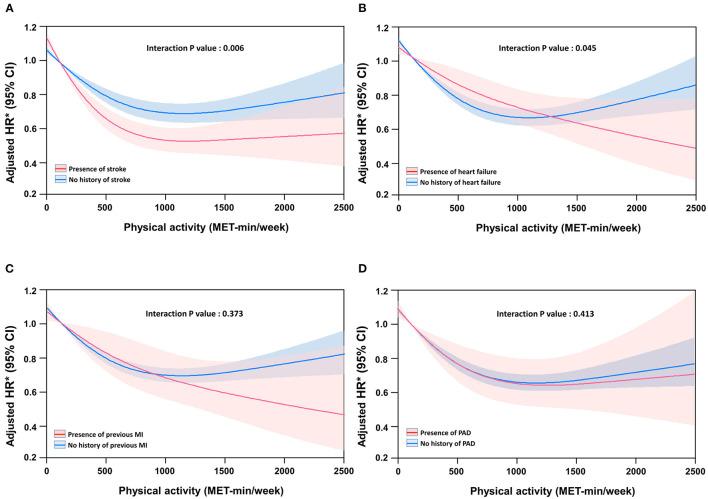
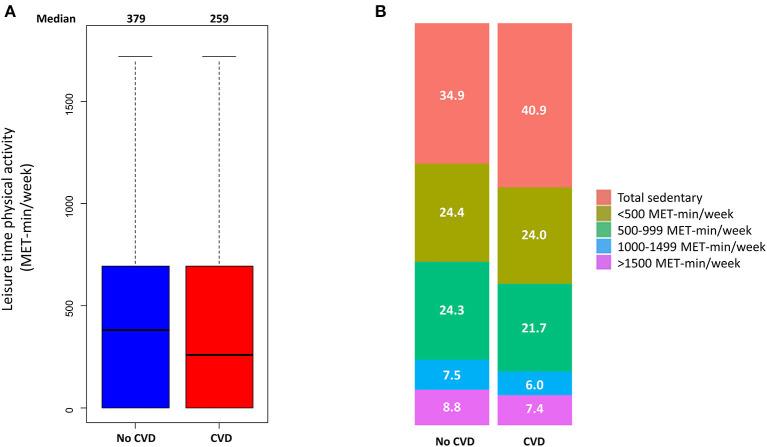
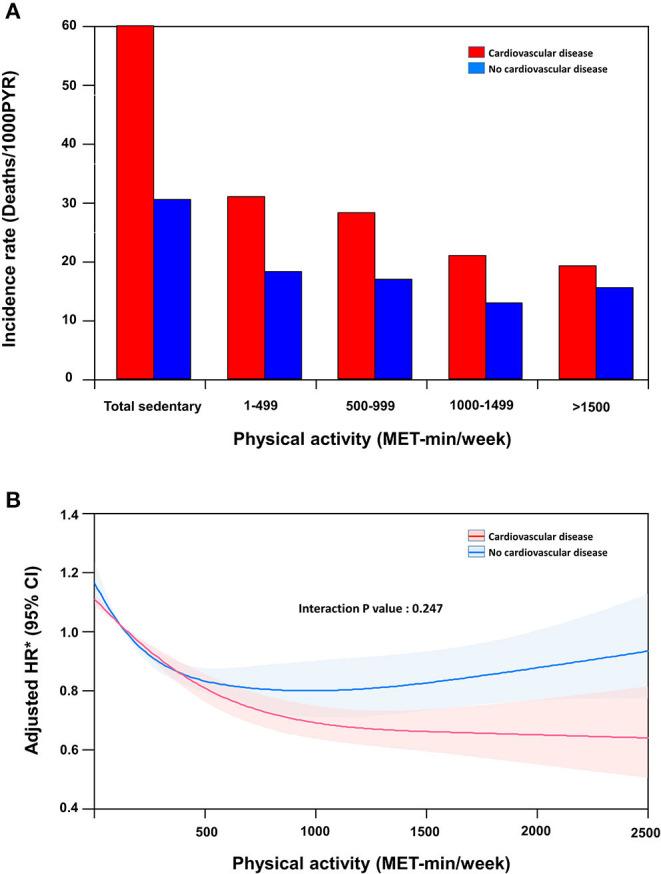
Patients with CVD were older than those without CVD. Compared with the sedentary group, the physically active groups with and without CVD had a lower incidence and risk of all-cause death during a median follow up period of 42 (interquartile range 30-51) months. A 500 metabolic equivalent task-min/week increase in PA resulted in an 11% and 16% reduction in the risk of mortality in the non-CVD and CVD groups, respectively. With regard to specific CVDs, the risk of mortality progressively reduced with increasing PA in patients with heart failure or myocardial infarction. However, the reduction reached a plateau in patients with stroke or peripheral artery disease, but was significantly greater in patients with stroke (20% vs. without stoke, 11%, P = 0.006) or heart failure (13% vs. without heart failure, 11%; P = 0.045).
CONCLUSIONS
PA was associated with a reduced risk of all-cause mortality in older adults with and without CVD. The benefits of PA in patients with CVD, especially patients with stroke or heart failure, were greater than those without.
背景
心血管疾病(CVD)患者往往死亡率更高且身体活动(PA)减少。我们旨在评估PA对患有特定CVD的老年人死亡率的影响。
方法
我们纳入了68223名年龄≥65岁的参与者(其中23871名患有CVD,44352名未患CVD),这些参与者来自韩国国民健康保险服务-老年人数据库,在2005年至2012年期间有可用的身体活动数据。CVD被定义为缺血性中风、短暂性脑缺血发作、心力衰竭、心肌梗死和外周动脉疾病史。
结果
患有CVD的患者比未患CVD的患者年龄更大。与久坐组相比,无论是否患有CVD,身体活动组在中位随访期42个月(四分位间距30 - 51个月)内全因死亡的发生率和风险更低。PA每周增加500代谢当量任务分钟,非CVD组和CVD组的死亡风险分别降低11%和16%。对于特定的CVD,心力衰竭或心肌梗死患者的死亡率风险随着PA增加而逐渐降低。然而,中风或外周动脉疾病患者的死亡率降低达到平台期,但中风患者(20% vs. 无中风患者,11%,P = 0.006)或心力衰竭患者(13% vs. 无心力衰竭患者,11%;P = 0.045)的降低幅度明显更大。
结论
PA与患有和未患有CVD的老年人全因死亡风险降低相关。PA对患有CVD的患者,尤其是中风或心力衰竭患者的益处大于未患CVD的患者。
 Zotero 插件