
心率变异性与疼痛:一项系统综述。
Heart Rate Variability and Pain: A Systematic Review.
作者信息
Forte Giuseppe, Troisi Giovanna, Pazzaglia Mariella, Pascalis Vilfredo De, Casagrande Maria
机构信息
Department of Psychology, "Sapienza" University of Rome, 00185 Rome, Italy.
Body and Action Lab, IRCCS Fondazione Santa Lucia, Via Ardeatina 306, 00179 Rome, Italy.
出版信息
Brain Sci. 2022 Jan 24;12(2):153. doi: 10.3390/brainsci12020153.
BACKGROUND AND OBJECTIVE
Heart rate variability (HRV) as an index of the autonomic nervous system appears to be related to reactivity to experimental pain stimuli. HRV could better explain the contributions of sympathetic and parasympathetic activity response to nociceptive stimulation. The aim of this study was to systematically review and synthesize the current evidence on HRV in relation to the experience of pain in experimental tasks. Databases and Data Treatment: Studies indexed in the PubMed, PsycINFO, MEDLINE, WebOfScience, and Scopus databases were reviewed for eligibility. Studies on the autonomic response (i.e., HRV) to experimentally induced pain in healthy adults were included. Different methods of pain induction were considered (e.g., thermal, pressure, and electrical). Data were synthesized considering the association between HRV and both pain induction and subjective measures of pain.
RESULTS
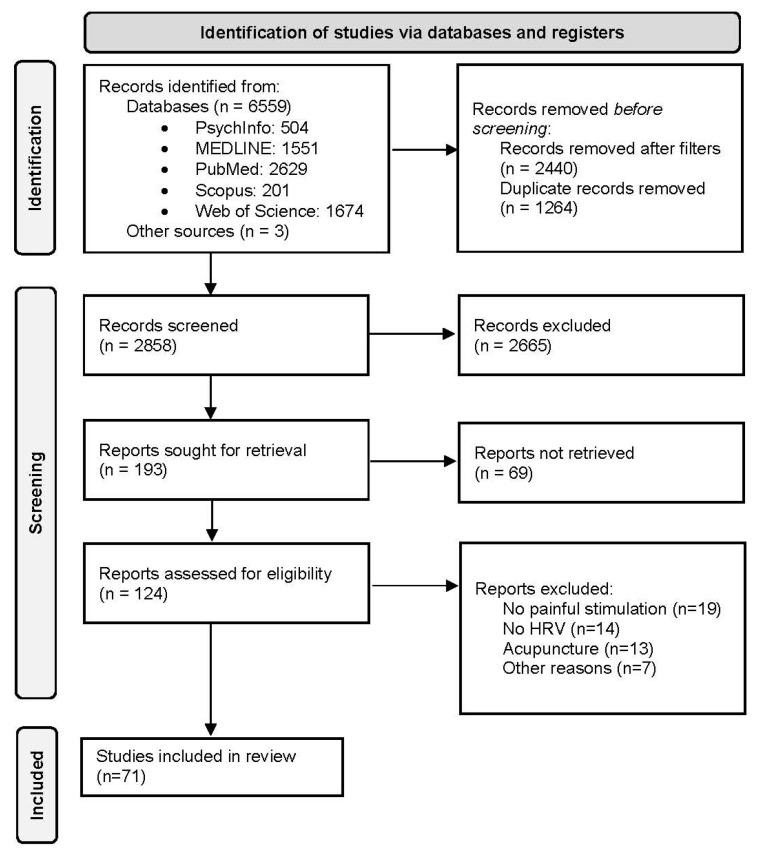
Seventy-one studies were included. The results underline significant change in both the sympathetic and parasympathetic autonomic nervous systems during the painful stimulation independent of the pain induction method. The autonomic reaction to pain could be affected by several factors, such as sex, age, body mass index, breathing patterns, the intensity of the stimulation, and the affective state. Moreover, an association between the autonomic nervous system and the subjective experience of pain was found. Higher parasympathetic activity was associated with better self-regulation capacities and, accordingly, a higher pain inhibition capacity.
CONCLUSIONS
HRV appears to be a helpful marker to evaluate nociceptive response in experimentally induced pain. Future studies are also needed in clinical samples to understand better the interindividual changes of autonomic response due to pain stimuli.
背景与目的
心率变异性(HRV)作为自主神经系统的一项指标,似乎与对实验性疼痛刺激的反应性有关。HRV能够更好地解释交感神经和副交感神经活动对伤害性刺激的反应。本研究的目的是系统回顾和综合当前关于HRV与实验任务中疼痛体验相关的证据。数据库与数据处理:对PubMed、PsycINFO、MEDLINE、WebOfScience和Scopus数据库中索引的研究进行资格审查。纳入关于健康成年人对实验性诱导疼痛的自主反应(即HRV)的研究。考虑了不同的疼痛诱导方法(如热、压力和电)。综合考虑HRV与疼痛诱导及疼痛主观测量之间的关联来合成数据。
结果
纳入71项研究。结果表明,无论疼痛诱导方法如何,在疼痛刺激期间交感和副交感自主神经系统均有显著变化。对疼痛的自主反应可能受多种因素影响,如性别、年龄、体重指数、呼吸模式、刺激强度和情感状态。此外,发现自主神经系统与疼痛的主观体验之间存在关联。较高的副交感神经活动与更好的自我调节能力相关,因此也与更高的疼痛抑制能力相关。
结论
HRV似乎是评估实验性诱导疼痛中伤害性反应的一个有用指标。未来还需要在临床样本中进行研究,以更好地了解疼痛刺激引起的自主反应的个体间变化。
 Zotero 插件