
新冠疫情是否影响了波兰新诊断为1型糖尿病儿童的糖尿病酮症酸中毒患病率?以波兰最大的儿科糖尿病中心(波兰上西里西亚省卡托维兹)为例。
Has the COVID-19 Pandemic Affected the Prevalence of Diabetic Ketoacidosis in Polish Children with Newly Diagnosed Type 1 Diabetes? An Example of the Largest Polish Pediatric Diabetes Center (Upper Silesia-Katowice, Poland).
作者信息
Rusak Ewa, Seget Sebastian, Macherski Maksymilian, Furgał Natalia, Dyś Przemysław, Jarosz-Chobot Przemysława
机构信息
Department of Children's Diabetology, Medical University of Silesia, 40-752 Katowice, Poland.
出版信息
Healthcare (Basel). 2022 Feb 11;10(2):348. doi: 10.3390/healthcare10020348.
PURPOSE
The aim of this study was to analyze the prevalence of diabetic ketoacidosis (DKA) in children with newly disclosed type 1 diabetes (T1D) during the COVID-19 pandemic in 2020 compared to 2019.
METHODS
A retrospective analysis of the history database of all hospitalized children in our department. The International Society for Pediatric and Adolescent Diabetes (ISPAD) guidelines were used for the diagnosis of DKA.
RESULTS
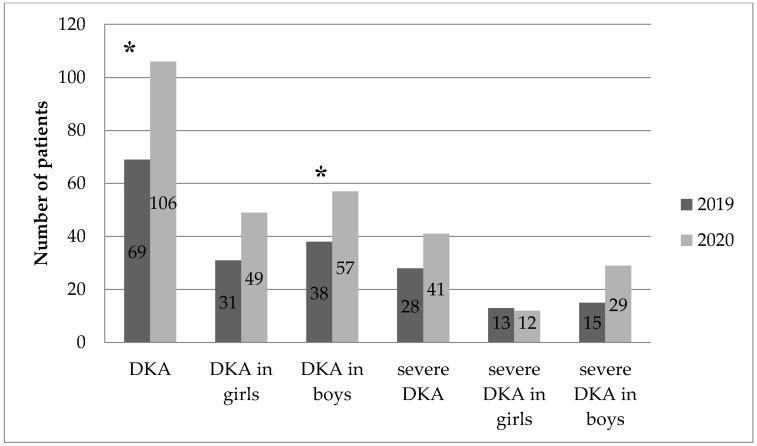
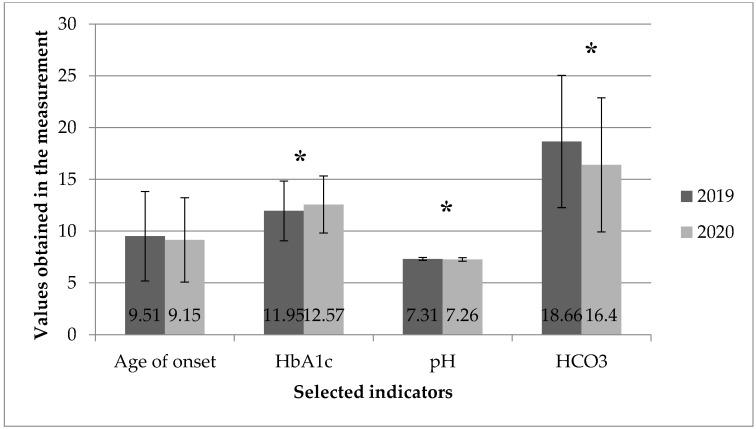
The database of children with newly disclosed T1D included 196 patients (89 girls and 107 boys) from 2019, and 223 patients (113 girls and 110 boys) from 2020 (a total of 419 patients-202 girls and 217 boys) aged 0 to 18 years. A significantly higher percentage of DKA was observed in 2020 compared to the previous year (47.53% vs. 35.2% [ = 0.005]). The percentage of severe DKA increased in 2020 compared to 2019 (18.39% vs. 14.07% [ = 0.118]). Compared to 2019, the average HbA1c level was higher in 2020 (12.57 ± 2.75% vs. 11.95 ± 2.89% [ < 0.025]), and the average pH level (7.26 vs. 7.31 [ = 0.002], and average HCO3 level (16.40 vs. 18.66 [ = 0.001]) were lower, respectively.
CONCLUSIONS
During the COVID-19 (2020) pandemic, the incidence of DKA increased in Polish children with newly diagnosed T1D. The conclusions from the analysis of the functioning of health systems during the pandemic should be used in the future to prevent, in similar periods, an increase in severe complications of delayed diagnosis of T1D.
目的
本研究旨在分析2020年新冠疫情期间新诊断为1型糖尿病(T1D)的儿童中糖尿病酮症酸中毒(DKA)的患病率,并与2019年进行比较。
方法
对我科所有住院儿童的病史数据库进行回顾性分析。采用国际儿童和青少年糖尿病学会(ISPAD)指南诊断DKA。
结果
新诊断为T1D的儿童数据库包括2019年的196例患者(89名女孩和107名男孩)以及2020年的223例患者(113名女孩和110名男孩)(共419例患者,202名女孩和217名男孩),年龄在0至18岁之间。与上一年相比,2020年观察到的DKA百分比显著更高(47.53%对35.2%[ = 0.005])。与2019年相比,2020年严重DKA的百分比有所增加(18.39%对14.07%[ = 0.118])。与2019年相比,2020年的平均糖化血红蛋白(HbA1c)水平更高(12.57±2.75%对11.95±2.89%[ < 0.025]),而平均pH值(7.26对7.31[ = 0.002])和平均碳酸氢盐(HCO3)水平(16.40对18.66[ = 0.001])则更低。
结论
在2020年新冠疫情期间,波兰新诊断为T1D的儿童中DKA的发病率有所增加。大流行期间卫生系统运作分析得出的结论应在未来用于预防类似时期T1D延迟诊断的严重并发症增加。

 Zotero 插件