
隐孢子虫病两个潜在药物靶点CpCDPK1和CpCDPK9的比较特征分析
Comparative Characterization of CpCDPK1 and CpCDPK9, Two Potential Drug Targets Against Cryptosporidiosis.
作者信息
Su Jiayuan, Shen Yiting, Li Na, Li Yu, Zhang Ziding, Xiao Lihua, Guo Yaqiong, Feng Yaoyu
机构信息
State Key Laboratory of Bioreactor Engineering, School of Resource and Environmental Engineering, East China University of Science and Technology, Shanghai 200237, China.
Center for Emerging and Zoonotic Diseases, College of Veterinary Medicine, South China Agricultural University, Guangzhou 510642, China.
出版信息
Microorganisms. 2022 Feb 1;10(2):333. doi: 10.3390/microorganisms10020333.
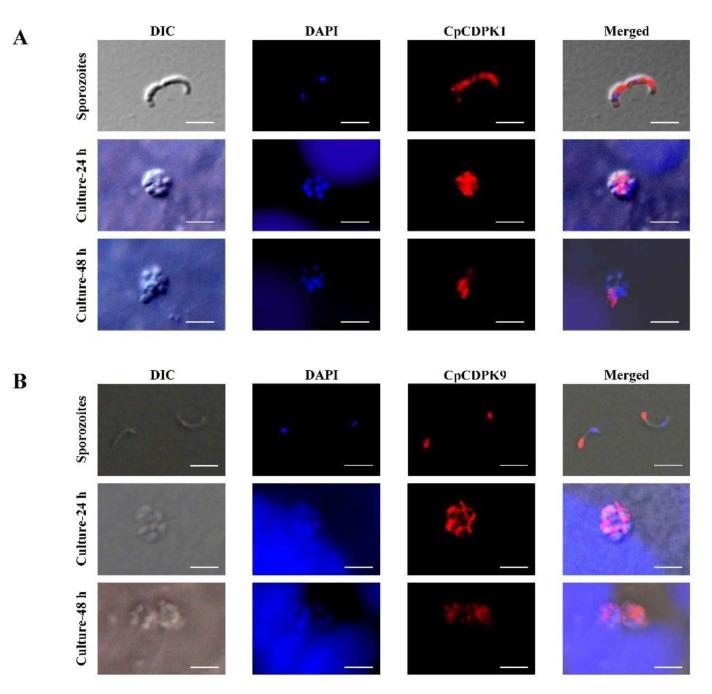
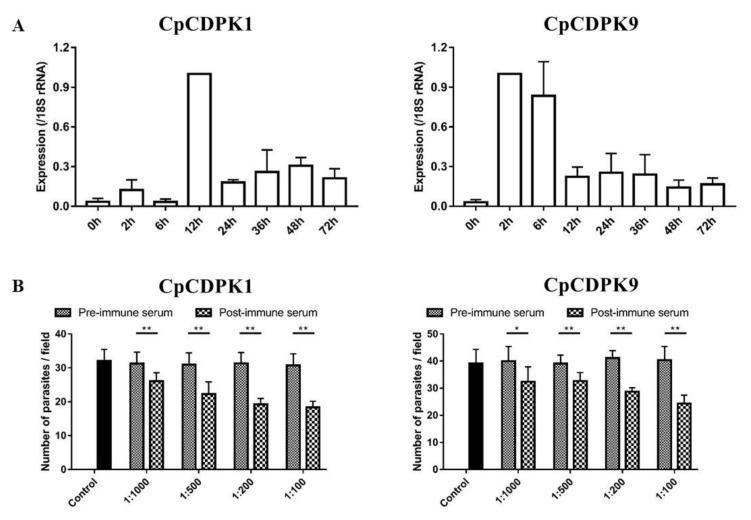
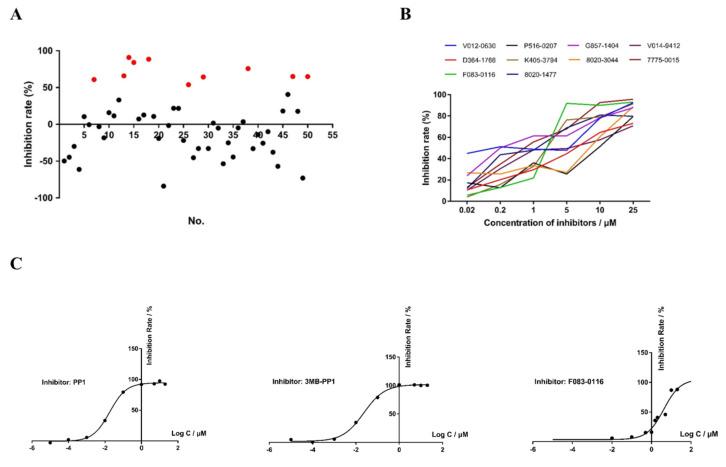
As the invasion, egress, and growth of spp. are regulated by the calcium ion, calcium-dependent protein kinases (CDPKs) are considered potential drug targets against these pathogens. In this study, we expressed CpCDPK1 of encoded by the cgd3_920 gene and CpCDPK9 encoded by the the cgd7_1260 gene in , and we conducted some comparative studies with quantitative PCR, immunofluorescence staining, and in vitro neutralization assays. By immunofluorescence microscopy, CpCDPK1 was expressed over the entirety of the sporozoites, while CpCDPK9 was mainly expressed in the apical region. The expression of the cgd3_920 gene was the highest at 12 h of the in vitro culture, whereas the expression of the cgd7_1260 gene peaked between 2 h and 6 h. Polyclonal antibodies against these two CpCDPK proteins had similar neutralization efficiency on growth, reaching approximately 40%. Of the 50 candidate compounds from the molecular docking of CpCDPK1, 10 had significant in vitro anti-cryptosporidial effects, but only one inhibited enzyme activity. For CpCDPK9, five of the forty-five candidate compounds showed significant in vitro anti-cryptosporidial effects. Results obtained from this study suggest that CpCDPK1 and CpCDPK9 might function differently in infection.
由于隐孢子虫属的入侵、逸出和生长受钙离子调控,钙依赖性蛋白激酶(CDPKs)被认为是针对这些病原体的潜在药物靶点。在本研究中,我们在大肠杆菌中表达了由cgd3_920基因编码的隐孢子虫CpCDPK1和由cgd7_1260基因编码的CpCDPK9,并通过定量PCR、免疫荧光染色和体外中和试验进行了一些比较研究。通过免疫荧光显微镜观察,CpCDPK1在整个子孢子中表达,而CpCDPK9主要在顶端区域表达。cgd3_920基因的表达在体外培养12小时时最高,而cgd7_1260基因的表达在2至6小时达到峰值。针对这两种CpCDPK蛋白的多克隆抗体对隐孢子虫生长具有相似的中和效率,达到约40%。在对CpCDPK1进行分子对接的50种候选化合物中,有10种具有显著的体外抗隐孢子虫作用,但只有一种抑制酶活性。对于CpCDPK9,45种候选化合物中的5种显示出显著的体外抗隐孢子虫作用。本研究结果表明,CpCDPK1和CpCDPK9在隐孢子虫感染中可能发挥不同的作用。


 Zotero 插件