
基于血液的肿瘤突变负荷检测对非小细胞肺癌免疫检查点抑制剂治疗的预测疗效:一项系统评价和荟萃分析
Predictive Efficacy of Blood-Based Tumor Mutation Burden Assay for Immune Checkpoint Inhibitors Therapy in Non-Small Cell Lung Cancer: A Systematic Review and Meta-Analysis.
作者信息
Zhang Nan, Zhang Jinwei, Wang Guoqing, He Xin, Mi Yin, Cao Ying, Yu Xiaoxu
机构信息
Department of Clinical Laboratory, First Teaching Hospital of Tianjin University of Traditional Chinese Medicine, National Clinical Research Center for Chinese Medicine Acupuncture and Moxibustion, Tianjin, China.
Department of Cardiothoracic Surgery, Tianjin Medical University General Hospital, Tianjin, China.
出版信息
Front Oncol. 2022 Feb 9;12:795933. doi: 10.3389/fonc.2022.795933. eCollection 2022.
BACKGROUND
In non-small cell lung cancer (NSCLC) patients treated by immune checkpoint inhibitors (ICIs), tumor mutation burden (TMB) has been found to have predictive potential for survival. When compared to TMB detection in tissue (tTMB), detecting TMB in the blood (bTMB) has practical advantages; yet, the results of various studies are conflicting. The question of whether bTMB can be utilized as a predictive biomarker is becoming increasingly contentious. To confirm the predictive efficacy of bTMB, researchers did a systematic review and meta-analysis to look into the relationship between ICIs and bTMB.
METHOD
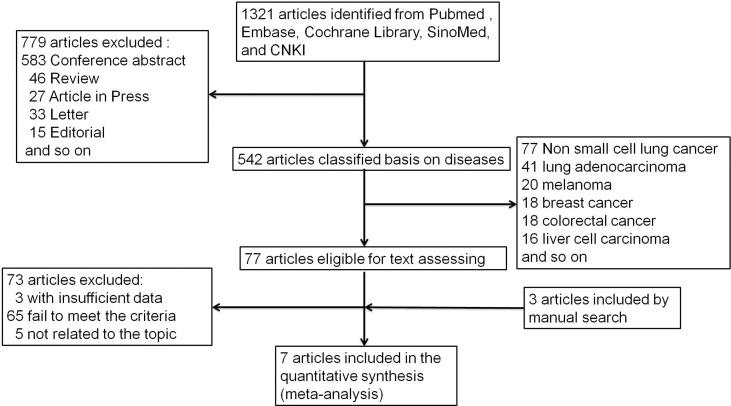
From the inception to March 2021, Cochrane Library, PubMed, EMBASE and other databases were systematically searched. The predictive value of bTMB in ICIs, or the efficacy of ICIs against chemotherapy, was studied. The results were presented as pooled ratio rate (RR) and hazard ratio (HR) with 95% confidence intervals for the Objective response rate (ORR), progression-free survival (PFS), and overall survival (OS). Subgroup analysis, heterogeneity analyses, and sensitivity analysis were also performed.
RESULTS
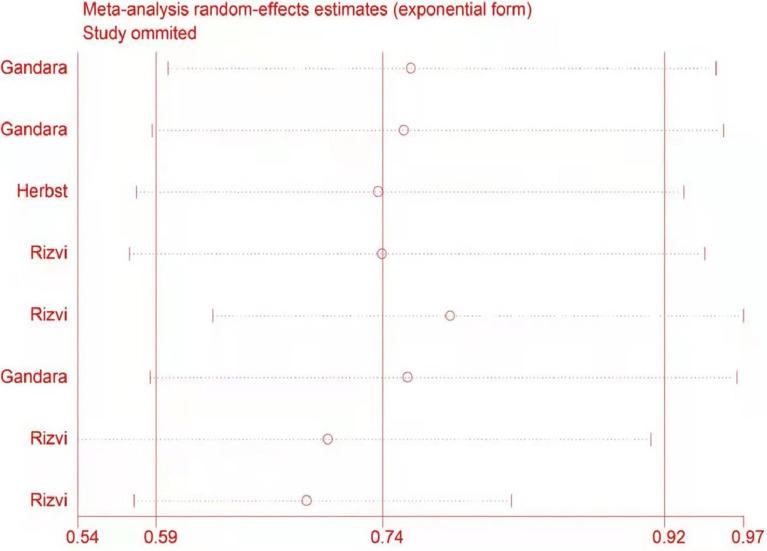
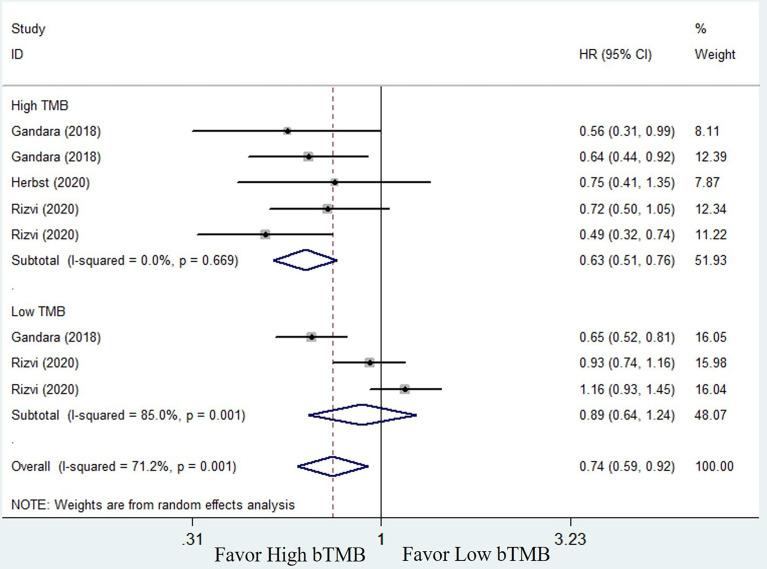
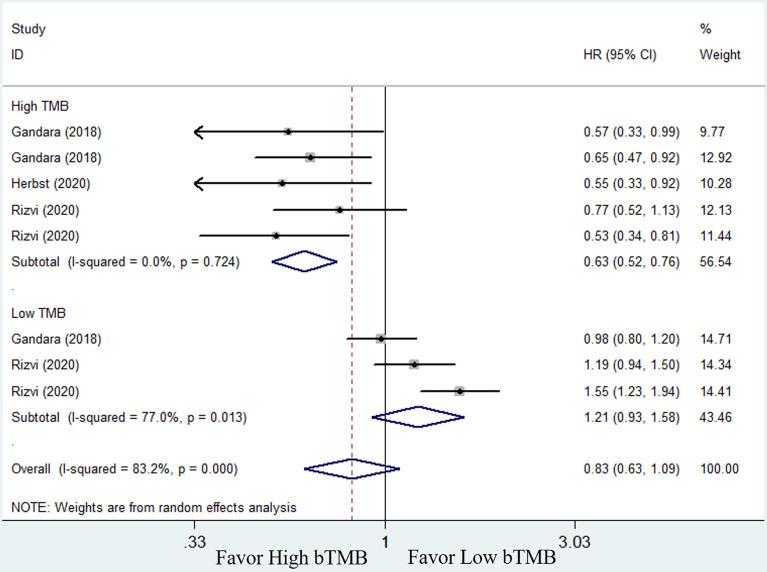
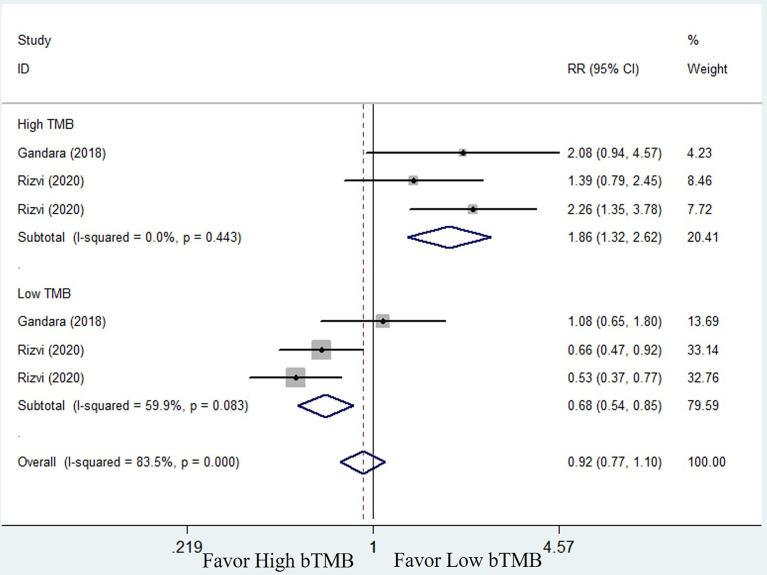
A total of 2,610 NSCLC patients were studied in seven trials. There were no significant differences in OS (HR = 1.09; 95% CI: 0.62-1.91, = 0.774) or PFS (HR = 0.73; 95% CI: 0.20-2.65, = 0.629) between high and low bTMB groups in the ICIs cohort. When ICIs were compared to chemotherapy, ICIs were found to enhance OS (HR = 0.74; 95% CI: 0.59-0.92, = 0.006), but the improvement in PFS and ORR was only a numerical trend (PFS: HR = 0.83; 95% CI: 0.63-1.09, = 0.173; ORR: RR = 0.92, 95% CI: 0.77-1.10, = 0.372). NSCLC patients treated with ICIs in the high bTMB group had better survival benefits than chemotherapy patients in terms of OS (HR = 0.63; 95% CI: 0.51-0.76, 0.001), PFS (HR = 0.63; 95% CI: 0.52-0.76, 0.001), and ORR (RR = 1.86; 95% CI: 1.32-2.62, 0.001), while in the low TMB group, the results were no different or even reversed (OS: HR = 0.89; 95% CI: 0.64-1.24, = 0.485; PFS: HR = 1.21, 95% CI: 0.93-1.58, = 0.154; ORR: RR = 0.68, 95% CI: 0.54-0.85, = 0.001).
CONCLUSIONS
TMB could predict the enhanced survival benefit of NSCLC patients treated with ICIs; however the role of bTMB is limited at this stage. For NSCLC patients with high TMB, ICIc may be a better option than chemotherapy.
背景
在接受免疫检查点抑制剂(ICI)治疗的非小细胞肺癌(NSCLC)患者中,肿瘤突变负荷(TMB)已被发现具有预测生存的潜力。与组织TMB检测(tTMB)相比,血液TMB检测(bTMB)具有实际优势;然而,各项研究结果相互矛盾。bTMB能否用作预测生物标志物的问题越来越有争议。为了证实bTMB的预测效力,研究人员进行了一项系统评价和荟萃分析,以探究ICI与bTMB之间的关系。
方法
从数据库建立至2021年3月,系统检索了Cochrane图书馆、PubMed、EMBASE等数据库。研究了bTMB在ICI中的预测价值,或ICI对比化疗的疗效。结果以合并率比(RR)和风险比(HR)以及客观缓解率(ORR)、无进展生存期(PFS)和总生存期(OS)的95%置信区间呈现。还进行了亚组分析、异质性分析和敏感性分析。
结果
七项试验共纳入2610例NSCLC患者。在ICI队列中,高bTMB组和低bTMB组之间的OS(HR = 1.09;95%CI:0.62 - 1.91,P = 0.774)或PFS(HR = 0.73;95%CI:0.20 - 2.65,P = 0.629)无显著差异。当将ICI与化疗进行比较时,发现ICI可改善OS(HR = 0.74;95%CI:0.59 - 0.92,P = 0.006),但PFS和ORR的改善仅为数值趋势(PFS:HR = 0.83;95%CI:0.63 - 1.09,P = 0.173;ORR:RR = 0.92,95%CI:0.77 - 1.10,P = 0.372)。高bTMB组接受ICI治疗的NSCLC患者在OS(HR = 0.63;95%CI:0.51 - 0.76,P = 0.001)、PFS(HR = 0.63;95%CI:0.52 - 0.76,P = 0.001)和ORR(RR = 1.86;95%CI:1.32 - 2.62,P = 0.001)方面比化疗患者具有更好的生存获益,而在低TMB组中,结果无差异甚至相反(OS:HR = 0.89;95%CI:0.64 - 1.24,P = 0.485;PFS:HR = 1.21,95%CI:0.93 - 1.58,P = 0.154;ORR:RR = 0.68,95%CI:0.54 - 0.85,P = 0.001)。
结论
TMB可预测接受ICI治疗的NSCLC患者生存获益增加;然而,现阶段bTMB的作用有限。对于高TMB的NSCLC患者,ICI可能是比化疗更好的选择。


 Zotero 插件