
免疫治疗与非小细胞肺癌患者生存及免疫相关生物标志物的相关性:一项荟萃分析和个体患者水平分析。
Association of Survival and Immune-Related Biomarkers With Immunotherapy in Patients With Non-Small Cell Lung Cancer: A Meta-analysis and Individual Patient-Level Analysis.
机构信息
Guangdong Provincial Key Laboratory of Malignant Tumor Epigenetics and Gene Regulation, Department of Oncology and Phase I Clinical Trial Centre, Sun Yat-sen Memorial Hospital, Sun Yat-sen University, Guangzhou, China.
Department of Oncology, Nanfang Hospital, Southern Medical University, Guangzhou, China.
出版信息
JAMA Netw Open. 2019 Jul 3;2(7):e196879. doi: 10.1001/jamanetworkopen.2019.6879.
IMPORTANCE
The beneficial role of immunotherapy and the clinical relevance of current biomarkers in non-small cell lung cancer (NSCLC) remain inconclusive; thus, appropriate strategies and reliable predictors need further definition.
OBJECTIVES
To evaluate the association of clinical outcomes with immune checkpoint inhibitors, tumor vaccines, and cellular immunotherapy in patients with advanced NSCLC and to explore appropriate strategies, candidates, and predictors.
DATA SOURCES
The PubMed, EMBASE, and Cochrane Central Register of Controlled Trials databases were searched from inception to June 2018, using relevant search keywords and Medical Subject Headings (MeSH) terms, including tumor vaccine, cellular immunotherapy, immune checkpoint inhibitor, cytotoxic T-lymphocyte-associated protein 4, programmed death-ligand 1, programmed death receptor 1, and non-small cell lung carcinoma. Systematic reviews, meta-analyses, references, and conference proceedings were manually searched.
STUDY SELECTION
English-language randomized clinical trials with available data that measured overall survival (OS), progression-free survival (PFS), or objective response rate comparing immune checkpoint inhibitors, tumor vaccines, or cellular immunotherapy with conventional therapy for patients with advanced or metastatic NSCLC were included. Thirty-one immunotherapy randomized clinical trials were included, and multicohort data included next-generation sequencing data from patients with advanced NCSLC.
DATA EXTRACTION AND SYNTHESIS
Hazard ratios and 95% CIs were pooled to estimate the survival increases in OS and PFS. Dichotomous data, such as object response rate data, were analyzed using the risk ratio. Mantel-Haenszel random-effects model was used. I2 was used to assess the heterogeneity between trials; an I2 value exceeding 50% indicated the existence of substantial heterogeneity. Analyses took place from February 1, 2018, to August 31, 2018.
MAIN OUTCOMES AND MEASURES
Primary outcomes were OS and PFS.
RESULTS
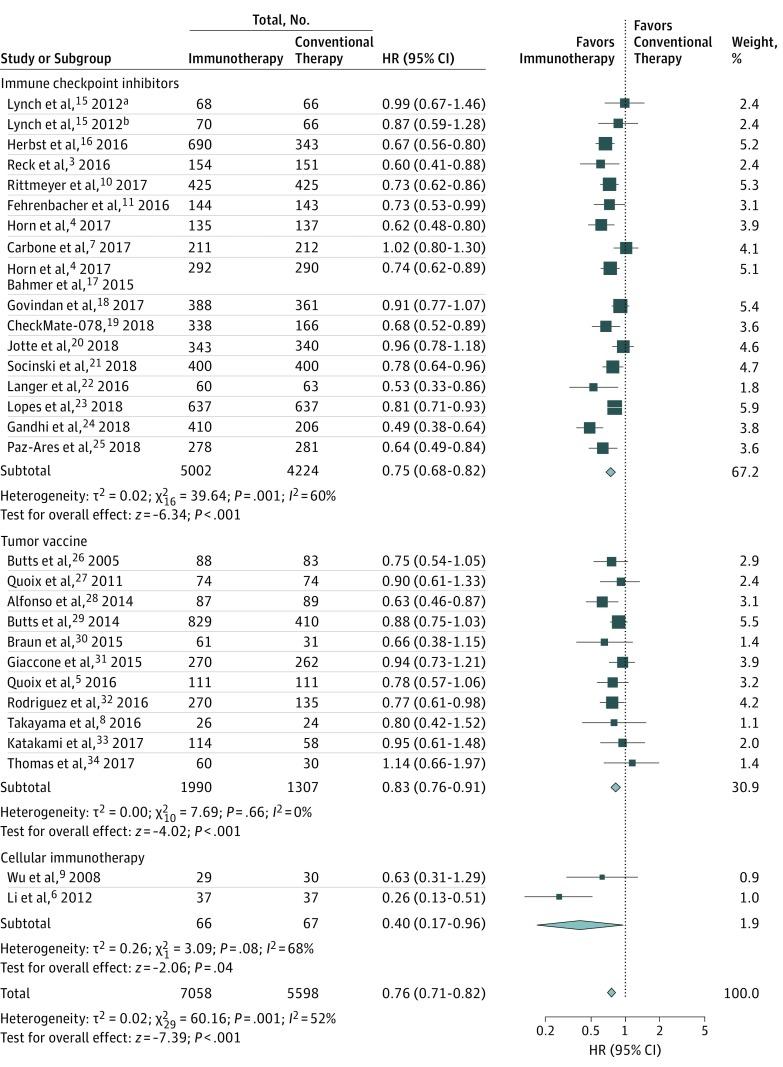
In total, 14 395 patients (9500 [66.0%] men) were included in the meta-analysis, and 1833 patients (mean [SD], 65.2 [9.9] years; 1063 [58.0%] men) were included in the individual patient-level study. Compared with conventional therapy, immunotherapy was associated with significantly longer OS (hazard ratio, 0.76; 95% CI, 0.71-0.82; P < .001) and PFS (hazard ratio, 0.76; 95% CI, 0.70-0.83; P < .001). The best checkpoint blockade strategy was first-line pembrolizumab with platinum-based chemotherapy. The combined predictive utility of programmed cell death ligand 1 (PD-L1) expression and tumor mutation burden (TMB) was associated with predictive prognosis (whole-exome sequencing: 1-year PFS area under the receiver operating characteristic curve [AUC], 0.829; 3-year PFS AUC, 0.839; targeted next-generation sequencing: 1-year PFS AUC, 0.826; 3-year PFS AUC, 0.948). Moreover, the addition of CD8+ T-cell tumor-infiltrating lymphocytes was associated with improved prognosis predictions for OS (3-year OS AUC, 0.659; 5-year OS AUC, 0.665). RYR1 or MGAM mutations were significantly associated with concomitantly increased durable clinical benefits (RYR1: durable clinical benefit [DCB], 12 of 51 patients [24%]; no durable benefit [NDB], 2 of 55 patients [4%]; P < .001; MGAM: DCB, 12 of 51 patients [24%]; NDB, 0 patients; P < .001), a higher TMB (RYRI: high TMB, 12 of 53 patients [23%]; low TMB, 2 of 53 patients [38%]; P < .001; MGAM: high TMB, 9 of 53 patients [17%]; low TMB, 0 patients; P < .001), and higher PD-L1 expression (RYRI: high PD-L1 expression, 8 of 30 patients [27%]; low PD-L1 expression, 6 of 85 [7.1%]; P < .001; MGAM: high PD-L1 expression, 6 of 30 patients [20%]; low PD-L1 expression, 5 of 85 patients [6%]; P < .001).
CONCLUSIONS AND RELEVANCE
Immunotherapies showed promising clinical outcomes for patients with NSCLC. Pembrolizumab with platinum-based chemotherapy was found to be the most appropriate first-line immune checkpoint inhibitor regimen for advanced NSCLC, and the combined use of PD-L1 expression and TMB was found to be a promising biomarker to evaluate patients' survival and response to precision immunotherapy. The further combination of CD8+ T-cell tumor-infiltrating lymphocytes, PD-L1 expression, and TMB was associated with reliable prognosis. The predictive value of that combination needs to be prospectively validated in large-scale studies.
重要性
免疫疗法在非小细胞肺癌(NSCLC)中的有益作用以及当前生物标志物的临床相关性仍不确定;因此,需要进一步定义适当的策略和可靠的预测因子。
目的
评估免疫检查点抑制剂、肿瘤疫苗和细胞免疫疗法在晚期 NSCLC 患者中的临床结局,并探索适当的策略、候选药物和预测因子。
数据来源
从 2018 年 6 月前,使用相关搜索关键词和医学主题词(MeSH)术语,在 PubMed、EMBASE 和 Cochrane 对照试验中心注册数据库中进行了检索,包括肿瘤疫苗、细胞免疫疗法、免疫检查点抑制剂、细胞毒性 T 淋巴细胞相关蛋白 4、程序性死亡配体 1、程序性死亡受体 1 和非小细胞肺癌。系统评价、荟萃分析、参考文献和会议论文集也进行了手工检索。
研究选择
纳入了包含总生存期(OS)、无进展生存期(PFS)或客观缓解率的随机临床试验数据的英语随机临床试验,这些试验将免疫检查点抑制剂、肿瘤疫苗或细胞免疫疗法与晚期或转移性 NSCLC 患者的常规治疗进行了比较。共纳入 31 项免疫治疗随机临床试验,多队列数据包括来自晚期 NSCLC 患者的下一代测序数据。
数据提取和综合
使用风险比(RR)分析了 OS 和 PFS 的生存增加的合并危险比(HR)和 95%置信区间(CI)。将对象反应率数据等二分数据使用风险比进行分析。采用 Mantel-Haenszel 随机效应模型。I2 用于评估试验间的异质性;I2 值超过 50%表示存在显著的异质性。分析于 2018 年 2 月 1 日至 8 月 31 日进行。
主要结局和测量
主要结局是 OS 和 PFS。
结果
共纳入 14395 例患者(9500[66.0%]例男性)进行荟萃分析,1833 例患者(平均[SD]年龄为 65.2[9.9]岁;1063[58.0%]例男性)纳入患者个体水平研究。与常规治疗相比,免疫治疗与显著更长的 OS(HR,0.76;95%CI,0.71-0.82;P<0.001)和 PFS(HR,0.76;95%CI,0.70-0.83;P<0.001)相关。最佳的检查点阻断策略是一线帕博利珠单抗联合铂类化疗。程序性死亡配体 1(PD-L1)表达和肿瘤突变负担(TMB)的联合预测效用与预测预后相关(全外显子组测序:1 年 PFS 受试者工作特征曲线(ROC)下面积[AUROC],0.829;3 年 PFS AUROC,0.839;靶向下一代测序:1 年 PFS AUROC,0.826;3 年 PFS AUROC,0.948)。此外,CD8+T 细胞肿瘤浸润淋巴细胞的加入与 OS 预测预后的改善相关(3 年 OS AUROC,0.659;5 年 OS AUROC,0.665)。RYR1 或 MGAM 突变与同时增加持久临床获益显著相关(RYR1:持久临床获益[DCB],51 例患者中有 12 例[24%];无持久获益[NDB],55 例患者中有 2 例[4%];P<0.001;MGAM:DCB,51 例患者中有 12 例[24%];NDB,无患者;P<0.001),更高的 TMB(RYRI:高 TMB,53 例患者中有 12 例[23%];低 TMB,53 例患者中有 2 例[38%];P<0.001;MGAM:高 TMB,53 例患者中有 9 例[17%];低 TMB,无患者;P<0.001)和更高的 PD-L1 表达(RYRI:高 PD-L1 表达,30 例患者中有 8 例[27%];低 PD-L1 表达,85 例患者中有 6 例[7.1%];P<0.001;MGAM:高 PD-L1 表达,30 例患者中有 6 例[20%];低 PD-L1 表达,85 例患者中有 5 例[6%];P<0.001)。
结论和相关性
免疫疗法为 NSCLC 患者带来了有希望的临床结局。在晚期 NSCLC 患者中,发现派姆单抗联合铂类化疗是最适合的一线免疫检查点抑制剂方案,PD-L1 表达和 TMB 的联合使用是评估患者生存和对精准免疫治疗反应的有前途的生物标志物。CD8+T 细胞肿瘤浸润淋巴细胞、PD-L1 表达和 TMB 的进一步结合与可靠的预后相关。需要在大规模研究中前瞻性验证该组合的预测价值。



 Zotero 插件