
老年人的炎症与心血管疾病:心外膜脂肪组织的作用
Inflammation and Cardiovascular Diseases in the Elderly: The Role of Epicardial Adipose Tissue.
作者信息
Conte Maddalena, Petraglia Laura, Poggio Paolo, Valerio Vincenza, Cabaro Serena, Campana Pasquale, Comentale Giuseppe, Attena Emilio, Russo Vincenzo, Pilato Emanuele, Formisano Pietro, Leosco Dario, Parisi Valentina
机构信息
Department of Translational Medical Sciences, University of Naples Federico II, Naples, Italy.
Casa di Cura San Michele, Maddaloni, Italy.
出版信息
Front Med (Lausanne). 2022 Feb 15;9:844266. doi: 10.3389/fmed.2022.844266. eCollection 2022.
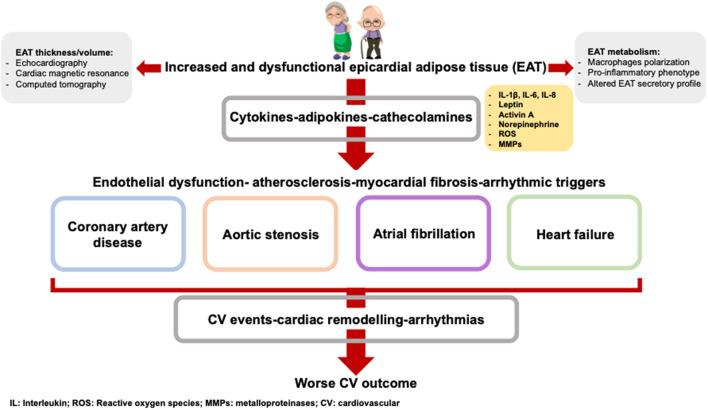
Human aging is a complex phenomenon characterized by a wide spectrum of biological changes which impact on behavioral and social aspects. Age-related changes are accompanied by a decline in biological function and increased vulnerability leading to frailty, thereby advanced age is identified among the major risk factors of the main chronic human diseases. Aging is characterized by a state of chronic low-grade inflammation, also referred as inflammaging. It recognizes a multifactorial pathogenesis with a prominent role of the innate immune system activation, resulting in tissue degeneration and contributing to adverse outcomes. It is widely recognized that inflammation plays a central role in the development and progression of numerous chronic and cardiovascular diseases. In particular, low-grade inflammation, through an increased risk of atherosclerosis and insulin resistance, promote cardiovascular diseases in the elderly. Low-grade inflammation is also promoted by visceral adiposity, whose accumulation is paralleled by an increased inflammatory status. Aging is associated to increase in epicardial adipose tissue (EAT), the visceral fat depot of the heart. Structural and functional changes in EAT have been shown to be associated with several heart diseases, including coronary artery disease, aortic stenosis, atrial fibrillation, and heart failure. EAT increase is associated with a greater production and secretion of pro-inflammatory mediators and neuro-hormones, so that thickened EAT can pathologically influence, in a paracrine and vasocrine manner, the structure and function of the heart and is associated to a worse cardiovascular outcome. In this review, we will discuss the evidence underlying the interplay between inflammaging, EAT accumulation and cardiovascular diseases. We will examine and discuss the importance of EAT quantification, its characteristics and changes with age and its clinical implication.
人类衰老乃是一种复杂现象,其特征为广泛的生物学变化,这些变化会对行为和社会层面产生影响。与年龄相关的变化伴随着生物功能的衰退以及易感性的增加,进而导致身体虚弱,因此高龄被视作人类主要慢性疾病的主要风险因素之一。衰老的特征是处于慢性低度炎症状态,也被称为炎症衰老。它认识到一种多因素发病机制,其中固有免疫系统激活起着突出作用,导致组织退化并促成不良后果。人们普遍认为炎症在众多慢性疾病和心血管疾病的发生与发展中起着核心作用。特别是,低度炎症通过增加动脉粥样硬化和胰岛素抵抗的风险,促使老年人患心血管疾病。内脏肥胖也会促进低度炎症,其积累与炎症状态的增加并行。衰老与心外膜脂肪组织(EAT)的增加有关,EAT是心脏的内脏脂肪库。EAT的结构和功能变化已被证明与多种心脏病有关,包括冠状动脉疾病、主动脉瓣狭窄、心房颤动和心力衰竭。EAT增加与促炎介质和神经激素的产生及分泌增加有关,因此增厚的EAT会以旁分泌和血管分泌的方式对心脏的结构和功能产生病理影响,并与更差的心血管结局相关。在本综述中,我们将讨论炎症衰老、EAT积累与心血管疾病之间相互作用的潜在证据。我们将研究并讨论EAT量化的重要性、其特征以及随年龄的变化及其临床意义。
 Zotero 插件