
辉瑞-BioNTech 新冠疫苗接种 6 个月后针对 SARS-CoV-2 关注变异株的抗体反应
Vaccine-Induced Antibody Responses against SARS-CoV-2 Variants-Of-Concern Six Months after the BNT162b2 COVID-19 mRNA Vaccination.
机构信息
Institute of Biomedicine, University of Turkugrid.1374.1, Turku, Finland.
Finnish Institute for Health and Welfare, Helsinki, Finland.
出版信息
Microbiol Spectr. 2022 Apr 27;10(2):e0225221. doi: 10.1128/spectrum.02252-21. Epub 2022 Mar 9.
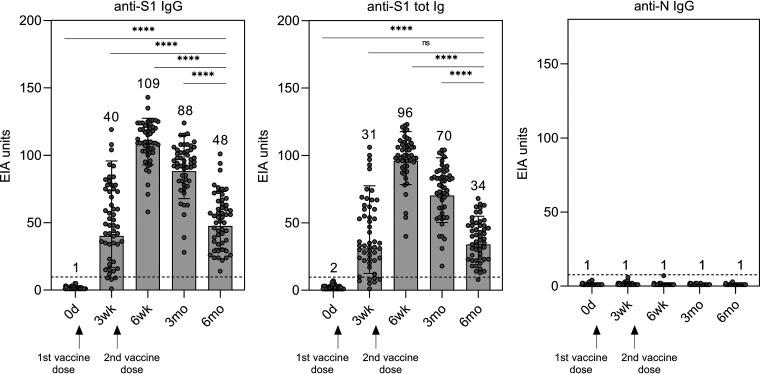
The emergence of severe acute respiratory syndrome coronavirus 2 (SARS-CoV-2) variants has raised concern about increased transmissibility, infectivity, and immune evasion from a vaccine and infection-induced immune responses. Although COVID-19 mRNA vaccines have proven to be highly effective against severe COVID-19 disease, the decrease in vaccine efficacy against emerged Beta and Delta variants emphasizes the need for constant monitoring of new virus lineages and studies on the persistence of vaccine-induced neutralizing antibodies. To analyze the dynamics of COVID-19 mRNA vaccine-induced antibody responses, we followed 52 health care workers in Finland for 6 months after receiving two doses of BNT162b2 vaccine with a 3-week interval. We demonstrate that, although anti-S1 antibody levels decrease 2.3-fold compared to peak antibody levels, anti-SARS-CoV-2 antibodies persist for months after BNT162b2 vaccination. Variants D614G, Alpha, and Eta are neutralized by sera of 100% of vaccinees, whereas neutralization of Delta is 3.8-fold reduced and neutralization of Beta is 5.8-fold reduced compared to D614G. Despite this reduction, 85% of sera collected 6 months postvaccination neutralizes Delta variant. A decrease in vaccine efficacy against emerging SARS-CoV-2 variants has increased the importance of assessing the persistence of SARS-CoV-2 spike protein-specific antibodies and neutralizing antibodies. Our data show that after 6 months post two doses of BNT162b2 vaccine, antibody levels decrease yet remain detectable and capable of neutralizing emerging variants. By monitoring the vaccine-induced antibody responses, vaccination strategies and administration of booster doses can be optimized.
严重急性呼吸综合征冠状病毒 2 (SARS-CoV-2) 变体的出现引起了人们对其传播能力、感染力和对疫苗及感染诱导的免疫反应的免疫逃逸能力增强的担忧。虽然 COVID-19 mRNA 疫苗已被证明对严重 COVID-19 疾病具有高度有效性,但针对新兴的 Beta 和 Delta 变体的疫苗效力下降强调了需要不断监测新的病毒谱系,并研究疫苗诱导的中和抗体的持久性。为了分析 COVID-19 mRNA 疫苗诱导的抗体反应的动态,我们在芬兰对 52 名医护人员进行了 6 个月的随访,这些人在接受两剂 BNT162b2 疫苗(间隔 3 周)后。我们证明,尽管与峰值抗体水平相比,抗 S1 抗体水平下降了 2.3 倍,但 BNT162b2 接种后数月内仍能持续产生抗 SARS-CoV-2 抗体。血清对变体 D614G、Alpha 和 Eta 的中和作用为 100%的接种者所具有,而对 Delta 的中和作用则降低了 3.8 倍,对 Beta 的中和作用则降低了 5.8 倍。尽管如此,接种疫苗后 6 个月采集的 85%血清仍能中和 Delta 变体。针对新兴 SARS-CoV-2 变体的疫苗效力下降增加了评估 SARS-CoV-2 刺突蛋白特异性抗体和中和抗体持久性的重要性。我们的数据表明,在接受两剂 BNT162b2 疫苗接种后 6 个月,抗体水平下降,但仍可检测到并具有中和新兴变体的能力。通过监测疫苗诱导的抗体反应,可以优化疫苗接种策略和加强针的接种。



 Zotero 插件