
迈向人工智能在医疗保健实践中的成功应用:一项研究计划的方案
Toward Successful Implementation of Artificial Intelligence in Health Care Practice: Protocol for a Research Program.
作者信息
Svedberg Petra, Reed Julie, Nilsen Per, Barlow James, Macrae Carl, Nygren Jens
机构信息
School of Health and Welfare, Halmstad University, Halmstad, Sweden.
Department of Health, Medicine and Caring Sciences, Linköping University, Linköping, Sweden.
出版信息
JMIR Res Protoc. 2022 Mar 9;11(3):e34920. doi: 10.2196/34920.
BACKGROUND
The uptake of artificial intelligence (AI) in health care is at an early stage. Recent studies have shown a lack of AI-specific implementation theories, models, or frameworks that could provide guidance for how to translate the potential of AI into daily health care practices. This protocol provides an outline for the first 5 years of a research program seeking to address this knowledge-practice gap through collaboration and co-design between researchers, health care professionals, patients, and industry stakeholders.
OBJECTIVE
The first part of the program focuses on two specific objectives. The first objective is to develop a theoretically informed framework for AI implementation in health care that can be applied to facilitate such implementation in routine health care practice. The second objective is to carry out empirical AI implementation studies, guided by the framework for AI implementation, and to generate learning for enhanced knowledge and operational insights to guide further refinement of the framework. The second part of the program addresses a third objective, which is to apply the developed framework in clinical practice in order to develop regional capacity to provide the practical resources, competencies, and organizational structure required for AI implementation; however, this objective is beyond the scope of this protocol.
METHODS
This research program will use a logic model to structure the development of a methodological framework for planning and evaluating implementation of AI systems in health care and to support capacity building for its use in practice. The logic model is divided into time-separated stages, with a focus on theory-driven and coproduced framework development. The activities are based on both knowledge development, using existing theory and literature reviews, and method development by means of co-design and empirical investigations. The activities will involve researchers, health care professionals, and other stakeholders to create a multi-perspective understanding.
RESULTS
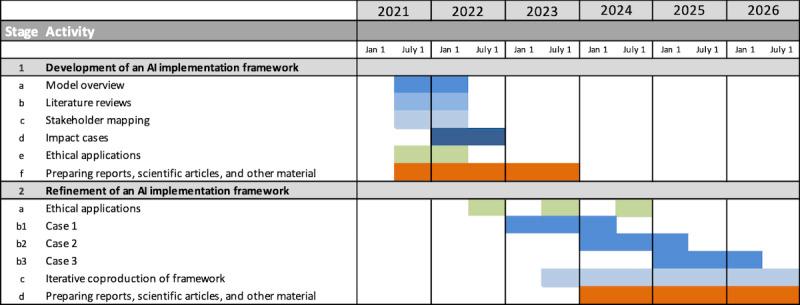
The project started on July 1, 2021, with the Stage 1 activities, including model overview, literature reviews, stakeholder mapping, and impact cases; we will then proceed with Stage 2 activities. Stage 1 and 2 activities will continue until June 30, 2026.
CONCLUSIONS
There is a need to advance theory and empirical evidence on the implementation requirements of AI systems in health care, as well as an opportunity to bring together insights from research on the development, introduction, and evaluation of AI systems and existing knowledge from implementation research literature. Therefore, with this research program, we intend to build an understanding, using both theoretical and empirical approaches, of how the implementation of AI systems should be approached in order to increase the likelihood of successful and widespread application in clinical practice.
INTERNATIONAL REGISTERED REPORT IDENTIFIER (IRRID): PRR1-10.2196/34920.
背景
人工智能(AI)在医疗保健领域的应用尚处于早期阶段。最近的研究表明,缺乏特定于人工智能的实施理论、模型或框架,无法为如何将人工智能的潜力转化为日常医疗保健实践提供指导。本方案概述了一项研究计划的前5年,该计划旨在通过研究人员、医疗保健专业人员、患者和行业利益相关者之间的合作与共同设计来弥合这一知识与实践之间的差距。
目的
该计划的第一部分侧重于两个具体目标。第一个目标是为医疗保健领域的人工智能实施制定一个理论上完善的框架,该框架可用于促进在常规医疗保健实践中的实施。第二个目标是在人工智能实施框架的指导下开展实证性人工智能实施研究,并生成相关知识,以增强知识和运营洞察力,从而指导对该框架的进一步完善。该计划的第二部分涉及第三个目标,即应用已开发的框架于临床实践,以培养区域能力,提供人工智能实施所需的实际资源、能力和组织结构;然而,这一目标超出了本方案的范围。
方法
本研究计划将使用逻辑模型来构建一个方法框架,用于规划和评估医疗保健领域人工智能系统的实施,并支持其在实践中的使用能力建设。逻辑模型分为按时间划分的阶段,重点是理论驱动和共同产生的框架开发。这些活动基于知识开发(利用现有理论和文献综述)以及通过共同设计和实证研究进行的方法开发。这些活动将涉及研究人员、医疗保健专业人员和其他利益相关者,以形成多视角的理解。
结果
该项目于2021年7月1日启动,开展了第一阶段活动,包括模型概述、文献综述、利益相关者映射和影响案例;然后我们将继续进行第二阶段活动。第一阶段和第二阶段活动将持续到2026年6月30日。
结论
有必要推进关于医疗保健领域人工智能系统实施要求的理论和实证证据,同时也有机会整合人工智能系统开发、引入和评估研究的见解以及实施研究文献中的现有知识。因此,通过本研究计划,我们打算运用理论和实证方法,来理解应如何开展人工智能系统的实施,以提高其在临床实践中成功广泛应用的可能性。
国际注册报告识别号(IRRID):PRR1-10.2196/34920

 Zotero 插件