
细胞因子和趋化因子对髓源性抑制细胞的协同调控
Coordinated Regulation of Myeloid-Derived Suppressor Cells by Cytokines and Chemokines.
作者信息
Li Ru, Mukherjee Mousumi Beto, Lin Jun
机构信息
Department of Anesthesiology, Stony Brook University School of Medicine, Stony Brook, NY 11794, USA.
出版信息
Cancers (Basel). 2022 Feb 27;14(5):1236. doi: 10.3390/cancers14051236.
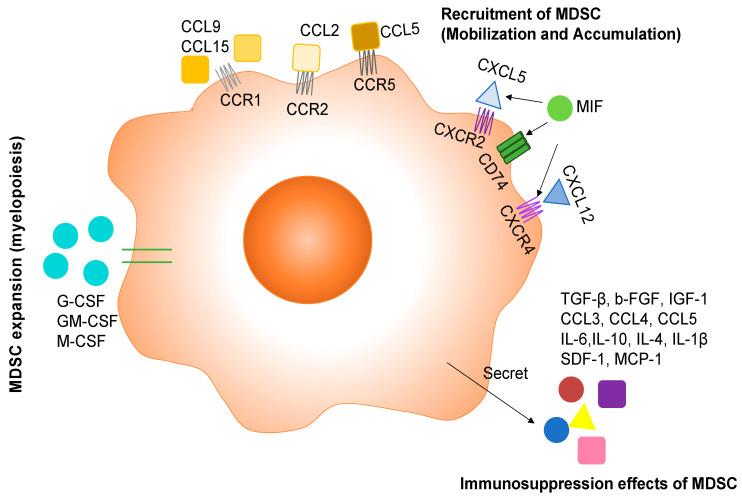
Myeloid-derived suppressor cells (MDSCs) are immature myeloid cells that impair immune cell functions and promote tumor progression. Mounting evidence indicates that cytokines and chemokines in the tumor microenvironment alter MDSCs. Various cytokines and chemokines are involved in MDSC production, their infiltration into tumors, and their exertion of suppressive functions. Here, we consider those cytokines, chemokines, and MDSCs as an intricately connected, complex system and we focus on how tumors manipulate the MDSCs through various cytokines and chemokines. We also discuss treatment capitalizing on cytokines/chemokine signaling aimed at combating the potent immunosuppressive activities of MDSCs to improve disease outcomes.
髓源性抑制细胞(MDSCs)是未成熟的髓细胞,可损害免疫细胞功能并促进肿瘤进展。越来越多的证据表明,肿瘤微环境中的细胞因子和趋化因子会改变MDSCs。多种细胞因子和趋化因子参与MDSC的产生、它们向肿瘤的浸润以及它们抑制功能的发挥。在此,我们将这些细胞因子、趋化因子和MDSCs视为一个相互紧密连接的复杂系统,并关注肿瘤如何通过各种细胞因子和趋化因子来操纵MDSCs。我们还讨论了利用细胞因子/趋化因子信号传导进行治疗,旨在对抗MDSCs强大的免疫抑制活性以改善疾病结局。
 Zotero 插件