
昼夜节律类型:一种筛查多囊卵巢综合征饮食习惯的工具?
Chronotype: A Tool to Screen Eating Habits in Polycystic Ovary Syndrome?
作者信息
Barrea Luigi, Verde Ludovica, Vetrani Claudia, Savastano Silvia, Colao Annamaria, Muscogiuri Giovanna
机构信息
Dipartimento di Scienze Umanistiche, Università Telematica Pegaso, Via Porzio, Centro Direzionale, Isola F2, 80143 Napoli, Italy.
Centro Italiano per la Cura e il Benessere del Paziente con Obesità (C.I.B.O), Endocrinology Unit, Dipartimento di Medicina Clinica e Chirurgia, Federico II University, Sergio Pansini, 5, 80131 Naples, Italy.
出版信息
Nutrients. 2022 Feb 23;14(5):955. doi: 10.3390/nu14050955.
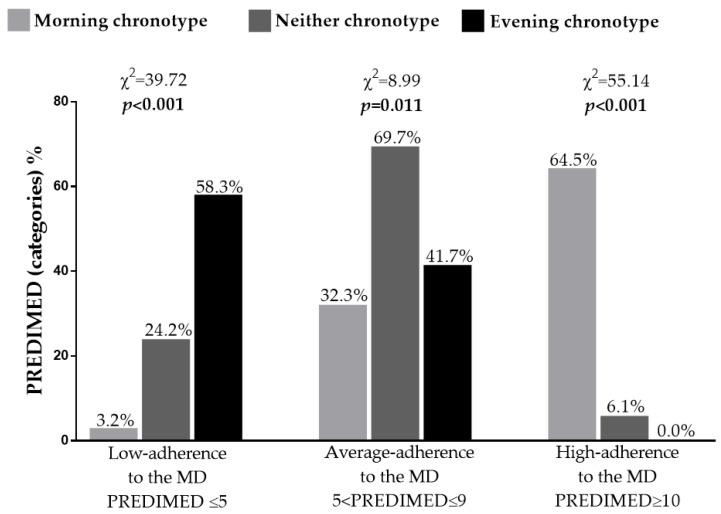
Polycystic ovary syndrome (PCOS) is the most common endocrine disorders in women of reproductive age, whose lifestyle approach is an essential part of the treatment. Recently, chronotype, i.e., a trait that determines individual’s circadian preference in behavioral and biological rhythms, has been reported to play a role in determining nutrition preferences and the risk of developing chronic diseases. Thus, the aim of this study was to investigate if chronotype categories (morning, evening, and neither) could be used as tool to screen eating habits in women with PCOS. In this observational cross-sectional study, we assessed anthropometric measurements, lifestyle habits, chronotype categories, adherence to the Mediterranean Diet, dietary pattern, and metabolic parameters in 112 women with PCOS. Chronotype was classified as morning in 27.7%, evening in 42.9%, and neither in 29.5% of subjects. Women with PCOS with evening chronotype showed significantly higher percentages of grade I (p = 0.003) and grade II obesity (p = 0.001), did less regular exercise (p < 0.001), and most of them were smokers (p < 0.001) compared to those with neither and morning chronotypes. Women with PCOS with evening chronotype were significantly more insulin resistant (Homeostatic Model Assessment of Insulin Resistance (HoMA-IR) cut off > 2.5) than other two chronotypes (p < 0.001). Women with PCOS with evening chronotype had the lowest PREvención con DIetaMEDiterránea (PREDIMED) score, consumed more calories (p < 0.001), total (p < 0.001) and simple carbohydrates (p < 0.001), total fat (p < 0.001) and saturated fatty acids (p < 0.001), polyunsaturated fatty acids (p < 0.001) and n-6 polyunsaturated fatty acids (p < 0.001), and less fiber (p < 0.001) than women with PCOS with other chronotypes. In addition, women with PCOS with evening chronotype consumed less extra virgin olive oil (p = 0.001), legumes (p = 0.038), fish/seafood (p < 0.001), and tree nuts (p = 0.041) than women with PCOS of the other two chronotype categories and less red wine (p < 0.001) and more red/processed meat (p < 0.001) than women with PCOS with morning chronotype. In conclusion, in women with PCOS, evening chronotype has been associated with a most severe insulin resistance and unhealthiest eating habits. Thus, chronotype assessment could be an effective tool to screen the eating habits, and more generally the lifestyle, of women with PCOS.
多囊卵巢综合征(PCOS)是育龄女性中最常见的内分泌疾病,其生活方式干预是治疗的重要组成部分。最近,有报道称生物钟类型,即决定个体行为和生物节律中昼夜偏好的一种特质,在决定营养偏好和患慢性病风险方面发挥作用。因此,本研究的目的是调查生物钟类型类别(早晨型、夜晚型和非此二者)是否可作为筛查PCOS女性饮食习惯的工具。在这项观察性横断面研究中,我们评估了112名PCOS女性的人体测量指标、生活习惯、生物钟类型类别、对地中海饮食的依从性、饮食模式和代谢参数。受试者中,27.7%被归类为早晨型生物钟,42.9%为夜晚型生物钟,29.5%为非此二者。与非此二者和早晨型生物钟的PCOS女性相比,夜晚型生物钟的PCOS女性I级肥胖(p = 0.003)和II级肥胖(p = 0.001)的比例显著更高,运动频率更低(p < 0.001),且大多数为吸烟者(p < 0.001)。与其他两种生物钟类型相比,夜晚型生物钟的PCOS女性胰岛素抵抗明显更严重(胰岛素抵抗稳态模型评估(HoMA-IR)临界值> 2.5)(p < 0.001)。夜晚型生物钟的PCOS女性的地中海饮食预防(PREDIMED)得分最低,摄入的卡路里更多(p < 0.001)、总碳水化合物(p < 0.001)和简单碳水化合物(p < 0.001)、总脂肪(p < 0.001)和饱和脂肪酸(p < 0.001)、多不饱和脂肪酸(p < 0.001)和n-6多不饱和脂肪酸(p < 0.001)更多,而膳食纤维更少(p < 0.001)。此外,与其他两种生物钟类型的PCOS女性相比,夜晚型生物钟的PCOS女性食用的特级初榨橄榄油更少(p = 0.001)、豆类更少(p = 0.038)、鱼类/海鲜更少(p < 0.001)和坚果更少(p = 0.041),与早晨型生物钟的PCOS女性相比,饮用的红酒更少(p < 0.001),食用的红肉/加工肉类更多(p < 0.001)。总之,在PCOS女性中,夜晚型生物钟与更严重的胰岛素抵抗和最不健康的饮食习惯相关。因此,生物钟类型评估可能是筛查PCOS女性饮食习惯乃至更广泛生活方式的有效工具。
 Zotero 插件