
铁羧基麦芽糖改善射血分数降低的心力衰竭伴缺铁患者的健康状况。
Health status improvement with ferric carboxymaltose in heart failure with reduced ejection fraction and iron deficiency.
机构信息
Department of Medicine, University of Mississippi, Jackson, MS, USA.
Division of Cardiology, Duke University Medical Center, Durham, NC, USA.
出版信息
Eur J Heart Fail. 2022 May;24(5):821-832. doi: 10.1002/ejhf.2478. Epub 2022 Mar 29.
AIM
Intravenous ferric carboxymaltose (FCM) has been shown to improve overall quality of life in iron-deficient heart failure with reduced ejection fraction (HFrEF) patients at a trial population level. This FAIR-HF and CONFIRM-HF pooled analysis explored the likelihood of individual improvement or deterioration in Kansas City Cardiomyopathy Questionnaire (KCCQ) domains with FCM versus placebo and evaluated the stability of this response over time.
METHODS AND RESULTS
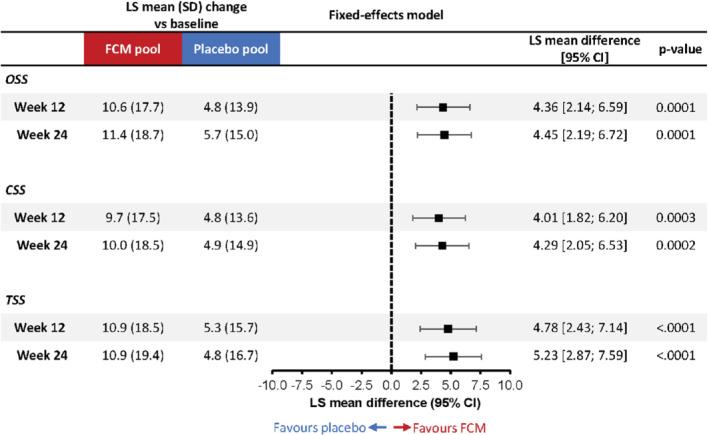
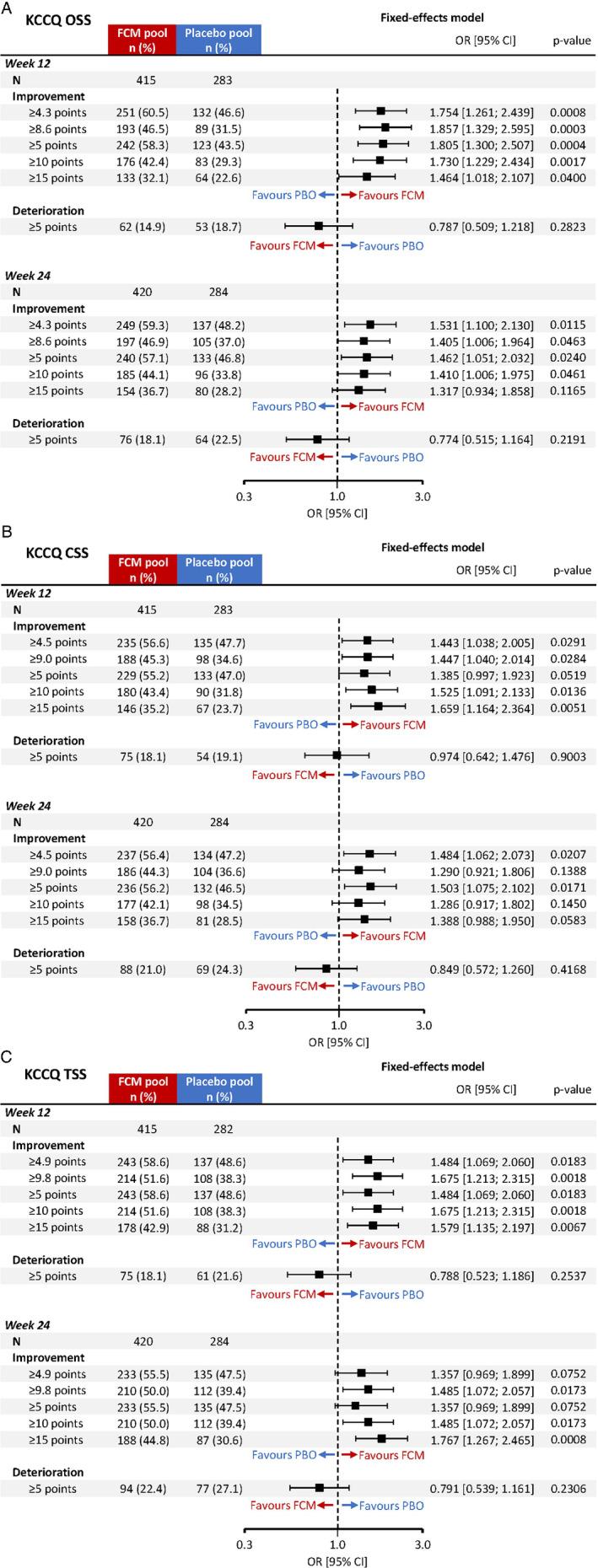
Changes versus baseline in KCCQ overall summary score (OSS), clinical summary score (CSS) and total symptom score (TSS) were assessed at weeks 12 and 24 in FCM and placebo groups. Mean between-group differences were estimated and individual responder analyses and analyses of response stability were performed. Overall, 760 (FCM, n = 454) patients were studied. At week 12, the mean improvement in KCCQ OSS was 10.6 points with FCM versus 4.8 points with placebo (least-square mean difference [95% confidence interval, CI] 4.36 [2.14; 6.59] points). A higher proportion of patients on FCM versus placebo experienced a KCCQ OSS improvement of ≥5 (58.3% vs. 43.5%; odds ratio [95% CI] 1.81 [1.30; 2.51]), ≥10 (42.4% vs. 29.3%; 1.73 [1.23; 2.43]) or ≥15 (32.1% vs. 22.6%; 1.46 [1.02; 2.11]) points. Differences were similar at week 24 and for CSS and TSS domains. Of FCM patients with a ≥5-, ≥10- or ≥15-point improvement in KCCQ OSS at week 12, >75% sustained this improvement at week 24.
CONCLUSION
Treatment of iron-deficient HFrEF patients with intravenous FCM conveyed clinically relevant improvements in health status at an individual-patient level; benefits were sustained over time in most patients.
目的
在缺铁性射血分数降低心力衰竭(HFrEF)患者中,静脉注射羧麦芽糖铁(FCM)已被证明可以改善整体生活质量。这项 FAIR-HF 和 CONFIRM-HF 联合分析探讨了与安慰剂相比,FCM 对堪萨斯城心肌病问卷(KCCQ)各领域的个体改善或恶化的可能性,并评估了这种反应随时间的稳定性。
方法和结果
在 FCM 和安慰剂组中,分别在第 12 周和第 24 周评估 KCCQ 总综合评分(OSS)、临床综合评分(CSS)和总症状评分(TSS)与基线相比的变化。估计组间平均差异,并进行个体反应者分析和反应稳定性分析。总体而言,研究了 760 名(FCM,n=454)患者。在第 12 周时,与安慰剂相比,FCM 使 KCCQ OSS 平均改善 10.6 分,而安慰剂则改善 4.8 分(最小二乘均数差值[95%置信区间,CI]为 4.36[2.14;6.59]分)。与安慰剂相比,接受 FCM 治疗的患者中,有更高比例的患者 KCCQ OSS 改善≥5(58.3% vs. 43.5%;比值比[95%CI]为 1.81[1.30;2.51])、≥10(42.4% vs. 29.3%;1.73[1.23;2.43])或≥15(32.1% vs. 22.6%;1.46[1.02;2.11])分。在第 24 周和 CSS 和 TSS 领域,差异相似。在第 12 周 KCCQ OSS 改善≥5、≥10 或≥15 分的 FCM 患者中,超过 75%的患者在第 24 周时保持了这种改善。
结论
在缺铁性射血分数降低心力衰竭患者中,静脉注射 FCM 可在个体患者层面上带来具有临床意义的健康状况改善;在大多数患者中,这种益处随时间持续存在。

 Zotero 插件