
铁状态与心脏病、中风和糖尿病风险:欧洲成年人的孟德尔随机研究。
Iron Status and Risk of Heart Disease, Stroke, and Diabetes: A Mendelian Randomization Study in European Adults.
机构信息
CAS Key Laboratory of Nutrition, Metabolism and Food Safety Shanghai Institute of Nutrition and Health, University of Chinese Academy of Sciences, Chinese Academy of Sciences Shanghai China.
Nuffield Department of Population Health University of Oxford Oxford United Kingdom.
出版信息
J Am Heart Assoc. 2024 Mar 19;13(6):e031732. doi: 10.1161/JAHA.123.031732. Epub 2024 Mar 18.
BACKGROUND
The relevance of iron status biomarkers for coronary artery disease (CAD), heart failure (HF), ischemic stroke (IS), and type 2 diabetes (T2D) is uncertain. We compared the observational and Mendelian randomization (MR) analyses of iron status biomarkers and hemoglobin with these diseases.
METHODS AND RESULTS
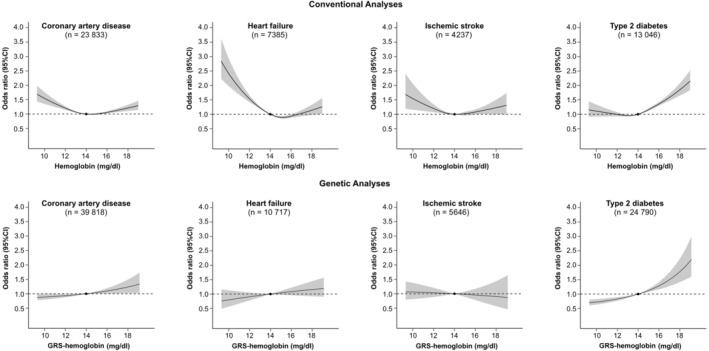
Observational analyses of hemoglobin were compared with genetically predicted hemoglobin with cardiovascular diseases and diabetes in the UK Biobank. Iron biomarkers included transferrin saturation, serum iron, ferritin, and total iron binding capacity. MR analyses assessed associations with CAD (CARDIOGRAMplusC4D [Coronary Artery Disease Genome Wide Replication and Meta-Analysis Plus The Coronary Artery Disease Genetics], n=181 522 cases), HF (HERMES [Heart Failure Molecular Epidemiology for Therapeutic Targets), n=115 150 cases), IS (GIGASTROKE, n=62 100 cases), and T2D (DIAMANTE [Diabetes Meta-Analysis of Trans-Ethnic Association Studies], n=80 154 cases) genome-wide consortia. Observational analyses demonstrated J-shaped associations of hemoglobin with CAD, HF, IS, and T2D. In contrast, MR analyses demonstrated linear positive associations of higher genetically predicted hemoglobin levels with 8% higher risk per 1 SD higher hemoglobin for CAD, 10% to 13% for diabetes, but not with IS or HF in UK Biobank. Bidirectional MR analyses confirmed the causal relevance of iron biomarkers for hemoglobin. Further MR analyses in global consortia demonstrated modest protective effects of iron biomarkers for CAD (7%-14% lower risk for 1 SD higher levels of iron biomarkers), adverse effects for T2D, but no associations with IS or HF.
CONCLUSIONS
Higher levels of iron biomarkers were protective for CAD, had adverse effects on T2D, but had no effects on IS or HF. Randomized trials are now required to assess effects of iron supplements on risk of CAD in high-risk older people.
背景
铁状态生物标志物与冠状动脉疾病(CAD)、心力衰竭(HF)、缺血性中风(IS)和 2 型糖尿病(T2D)的相关性尚不确定。我们比较了铁状态生物标志物和血红蛋白的观察性和孟德尔随机化(MR)分析与这些疾病的关系。
方法和结果
在英国生物库中,对血红蛋白的观察性分析与心血管疾病和糖尿病的遗传预测血红蛋白进行了比较。铁生物标志物包括转铁蛋白饱和度、血清铁、铁蛋白和总铁结合能力。MR 分析评估了与 CAD(CARDIOGRAMplusC4D [冠状动脉疾病全基因组复制和荟萃分析加冠状动脉疾病遗传学],n=181522 例)、HF(HERMES [心力衰竭分子流行病学治疗靶点],n=115150 例)、IS(GIGASTROKE,n=62100 例)和 T2D(DIAMANTE [跨种族关联研究的糖尿病荟萃分析],n=80154 例)基因组范围联盟的关联。观察性分析表明,血红蛋白与 CAD、HF、IS 和 T2D 呈 J 形关联。相比之下,MR 分析表明,较高的遗传预测血红蛋白水平与 CAD 风险增加 8%,糖尿病风险增加 10%至 13%,但与 IS 或 HF 无关。英国生物库的双向 MR 分析证实了铁生物标志物与血红蛋白之间的因果关系。在全球联盟中的进一步 MR 分析表明,铁生物标志物对 CAD 有适度的保护作用(铁生物标志物水平每增加 1 SD,风险降低 7%-14%),对 T2D 有不利影响,但与 IS 或 HF 无关。
结论
较高水平的铁生物标志物对 CAD 有保护作用,对 T2D 有不利影响,但对 IS 或 HF 没有影响。现在需要进行随机试验来评估铁补充剂对高危老年人 CAD 风险的影响。


 Zotero 插件