
早期三阴性乳腺癌中的铁-炎症轴
The Iron-Inflammation Axis in Early-Stage Triple-Negative Breast Cancer.
作者信息
Duan Fangfang, Zhong Muyi, Ye Jinhui, Wang Li, Jiang Chang, Yuan Zhongyu, Bi Xiwen, Huang Jiajia
机构信息
Department of Medical Oncology, The State Key Laboratory of Oncology in South China, Collaborative Innovation Center for Cancer Medicine, Sun Yat-sen University Cancer Center, Guangzhou, China.
Department of Breast Oncology, Dongguan People's Hospital, Dongguan, China.
出版信息
Front Cell Dev Biol. 2022 Feb 23;10:784179. doi: 10.3389/fcell.2022.784179. eCollection 2022.
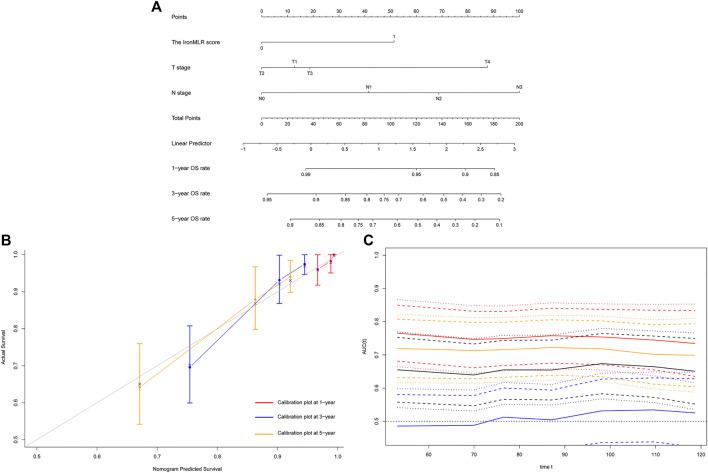
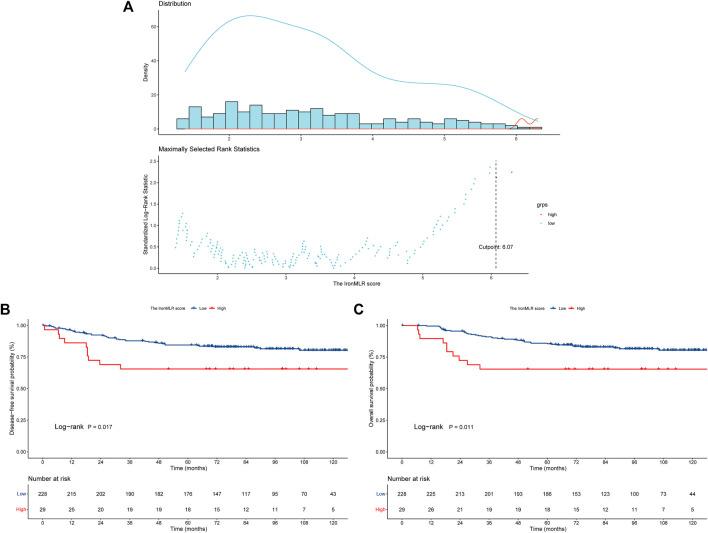
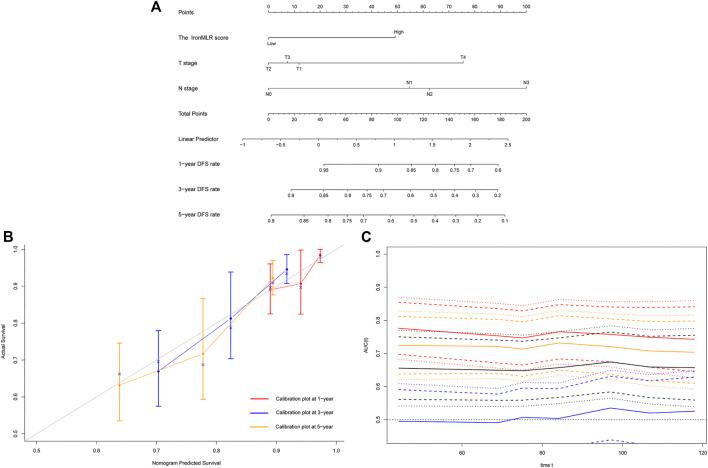
The iron-related homeostasis and inflammatory biomarker have been identified as prognostic factors for cancers. We aimed to explore the prognostic value of a novel comprehensive biomarker, the iron-monocyte-to-lymphocyte ratio (IronMLR) score, in patients with early-stage triple-negative breast cancer (TNBC) in this study. We retrospectively analysed a total of 257 early-stage TNBC patients treated at Sun Yat-sen University Cancer Center (SYSUCC) between March 2006 and October 2016. Their clinicopathological information and haematological data tested within 1 week of the diagnosis were collected. According to the IronMLR score cutoff value of 6.07 μmol/L determined by maximally selected rank statistics, patients were stratified into the low- and high-IronMLR groups, after a median follow-up of 92.3 months (95% confidence interval [CI] 76.0-119.3 months), significant differences in 5-years disease-free survival (DFS) rate (81.2%, 95% CI 76.2%-86.5% 65.5%, 95% CI 50.3%-85.3%, = 0.012) and 5-years overall survival (OS) rate (86.0%, 95% CI 81.6%-90.7% 65.5%, 95% CI 50.3%-85.3%, = 0.011) were seen between two groups. Further multivariate Cox regression analysis revealed the IronMLR score as an independent predictor for DFS and OS, respectively, we then established a prognostic nomogram integrating the IronMLR score, T stage and N stage for individualized survival predictions. The prognostic model showed good predictive performance with a C-index of DFS 0.725 (95% CI 0.662-0.788) and OS 0.758 (95% CI 0.689-0.826), respectively. Besides, calibration curves for 1-, 3-, 5-DFS, and OS represented satisfactory consistency between actual and nomogram predicted survival. In conclusion, the Iron-inflammation axis might be a potential prognostic biomarker of survival outcomes for patients with early-stage TNBC, prognostic nomograms based on it with good predictive performance might improve individualized survival predictions.
铁相关的内稳态和炎症生物标志物已被确定为癌症的预后因素。在本研究中,我们旨在探讨一种新型综合生物标志物——铁单核细胞与淋巴细胞比值(IronMLR)评分在早期三阴性乳腺癌(TNBC)患者中的预后价值。我们回顾性分析了2006年3月至2016年10月在中山大学肿瘤防治中心(SYSUCC)接受治疗的257例早期TNBC患者。收集了他们的临床病理信息以及诊断后1周内检测的血液学数据。根据最大选择秩统计确定的IronMLR评分临界值6.07μmol/L,将患者分为低IronMLR组和高IronMLR组。在中位随访92.3个月(95%置信区间[CI]76.0 - 119.3个月)后,两组的5年无病生存率(DFS)(81.2%,95%CI 76.2% - 86.5%对65.5%,95%CI 50.3% - 85.3%,P = 0.012)和5年总生存率(OS)(86.0%,95%CI 81.6% - 90.7%对65.5%,95%CI 50.3% - 85.3%,P = 0.011)存在显著差异。进一步的多因素Cox回归分析显示,IronMLR评分分别是DFS和OS的独立预测因子。然后,我们建立了一个整合IronMLR评分、T分期和N分期的预后列线图,用于个体化生存预测。该预后模型显示出良好的预测性能,DFS的C指数为0.725(95%CI 0.662 - 0.788),OS的C指数为0.758(95%CI 0.689 - 0.826)。此外,1年、3年、5年DFS和OS的校准曲线显示实际生存与列线图预测生存之间具有令人满意的一致性。总之,铁炎症轴可能是早期TNBC患者生存结局的潜在预后生物标志物,基于此的具有良好预测性能的预后列线图可能会改善个体化生存预测。

 Zotero 插件