
野火烟雾的本地和远距离传输对心肺健康的不同影响。
Differential Cardiopulmonary Health Impacts of Local and Long-Range Transport of Wildfire Smoke.
作者信息
Magzamen Sheryl, Gan Ryan W, Liu Jingyang, O'Dell Katelyn, Ford Bonne, Berg Kevin, Bol Kirk, Wilson Ander, Fischer Emily V, Pierce Jeffrey R
机构信息
Department of Environmental and Radiological Health Sciences Colorado State University Fort Collins CO USA.
Department of Atmospheric Science Colorado State University Fort Collins CO USA.
出版信息
Geohealth. 2021 Feb 25;5(3):e2020GH000330. doi: 10.1029/2020GH000330. eCollection 2021 Mar.
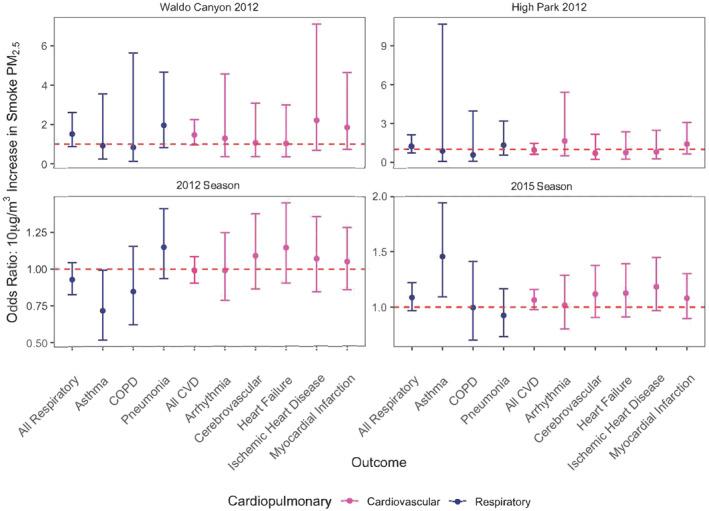
We estimated cardiopulmonary morbidity and mortality associated with wildfire smoke (WFS) fine particulate matter (PM) in the Front Range of Colorado from 2010 to 2015. To estimate WFS PM, we developed a daily kriged PM surface at a 15 × 15 km resolution based on the Environmental Protection Agency Air Quality System monitors for the western United States; we subtracted out local seasonal-average PM of nonsmoky days, identified using satellite-based smoke plume estimates, from the local daily estimated PM if smoke was identified by National Oceanic and Atmospheric Administration's Hazard Mapping System. We implemented time-stratified case-crossover analyses to estimate the effect of a 10 µg/m increase in WFS PM with cardiopulmonary hospitalizations and deaths using single and distributed lag models for lags 0-5 and distinct annual impacts based on local and long-range smoke during 2012, and long-range transport of smoke in 2015. A 10 µg/m increase in WFS was associated with all respiratory, asthma, and chronic obstructive pulmonary disease hospitalizations for lag day 3 and hospitalizations for ischemic heart disease at lag days 2 and 3. Cardiac arrest deaths were associated with WFS PM at lag day 0. For 2012 local wildfires, asthma hospitalizations had an inverse association with WFS PM (OR: 0.716, 95% CI: 0.517-0.993), but a positive association with WFS PM during the 2015 long-range transport event (OR: 1.455, 95% CI: 1.093-1.939). Cardiovascular mortality was associated with the 2012 long-range transport event (OR: 1.478, 95% CI: 1.124-1.944).
我们估算了2010年至2015年科罗拉多州前缘地区野火烟雾(WFS)细颗粒物(PM)相关的心肺发病率和死亡率。为了估算WFS PM,我们基于美国环境保护局空气质量系统对美国西部的监测数据,开发了一个分辨率为15×15千米的每日克里金插值PM表面;如果美国国家海洋和大气管理局的灾害制图系统识别出有烟雾,我们就从当地每日估算的PM中减去基于卫星烟雾羽流估算确定的非烟雾日的当地季节性平均PM。我们采用时间分层病例交叉分析,使用单滞后和分布滞后模型(滞后0至5天)以及基于2012年当地和远距离烟雾以及2015年烟雾远距离传输的不同年度影响,来估算WFS PM每增加10微克/立方米对心肺住院和死亡的影响。WFS每增加10微克/立方米与第3滞后日的所有呼吸道、哮喘和慢性阻塞性肺疾病住院以及第2和3滞后日的缺血性心脏病住院相关。心脏骤停死亡与第0滞后日的WFS PM相关。对于2012年当地野火,哮喘住院与WFS PM呈负相关(比值比:0.716,95%置信区间:0.517 - 0.993),但在2015年远距离传输事件期间与WFS PM呈正相关(比值比:1.455,95%置信区间:1.093 - 1.939)。心血管死亡率与2012年远距离传输事件相关(比值比:1.478,95%置信区间:1.124 - 1.944)。




 Zotero 插件