
去神经支配相关的神经肌肉接头变化:从退变到再生
Denervation-Related Neuromuscular Junction Changes: From Degeneration to Regeneration.
作者信息
Huang Xinying, Jiang Junjian, Xu Jianguang
机构信息
Department of Hand Surgery, Huashan Hospital, Fudan University, Shanghai, China.
Shanghai Medical College, Fudan University, Shanghai, China.
出版信息
Front Mol Neurosci. 2022 Feb 24;14:810919. doi: 10.3389/fnmol.2021.810919. eCollection 2021.
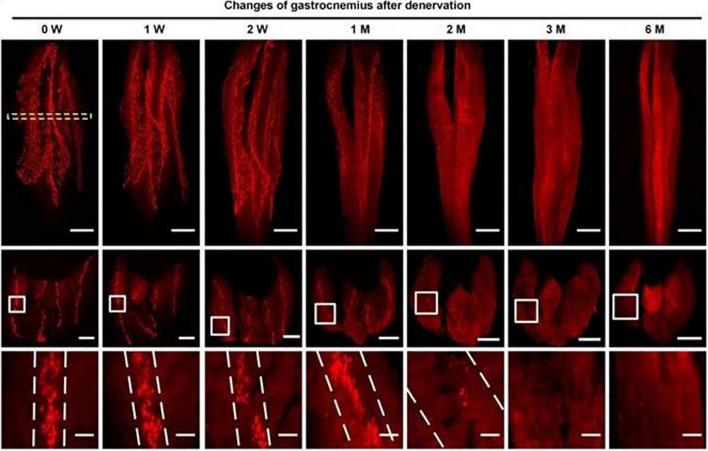
Neuromuscular junctions (NMJs) are the key interface between terminal nerves and targeted muscle, which undergo degeneration during denervation periods. Denervation-related NMJs changes limits the recovery level of nerve repair strategies. Insights into mechanisms behind neuromuscular junction degeneration and regeneration, following denervation and reinnervation, are of clinical value. Developing some therapies to maintain or protect structures and functions of NMJs may contribute to a better prognosis. Here, we reviewed previous studies of NMJs focusing on the morphological, functional, and molecular changes after denervation, and if those changes can be reversed after reinnervation. Also, we reviewed about the present probable strategies that have been applied clinically or could still be studied in targeting the neuromuscular junction protection or regeneration improvement.
神经肌肉接头(NMJs)是终末神经与目标肌肉之间的关键界面,在去神经支配期间会发生退化。与去神经支配相关的神经肌肉接头变化限制了神经修复策略的恢复水平。深入了解去神经支配和再支配后神经肌肉接头退化和再生背后的机制具有临床价值。开发一些疗法来维持或保护神经肌肉接头的结构和功能可能有助于获得更好的预后。在此,我们回顾了以往关于神经肌肉接头的研究,重点关注去神经支配后形态、功能和分子水平的变化,以及这些变化在再支配后是否可以逆转。此外,我们还回顾了目前临床上已应用或仍可研究的针对神经肌肉接头保护或改善再生的可能策略。


 Zotero 插件